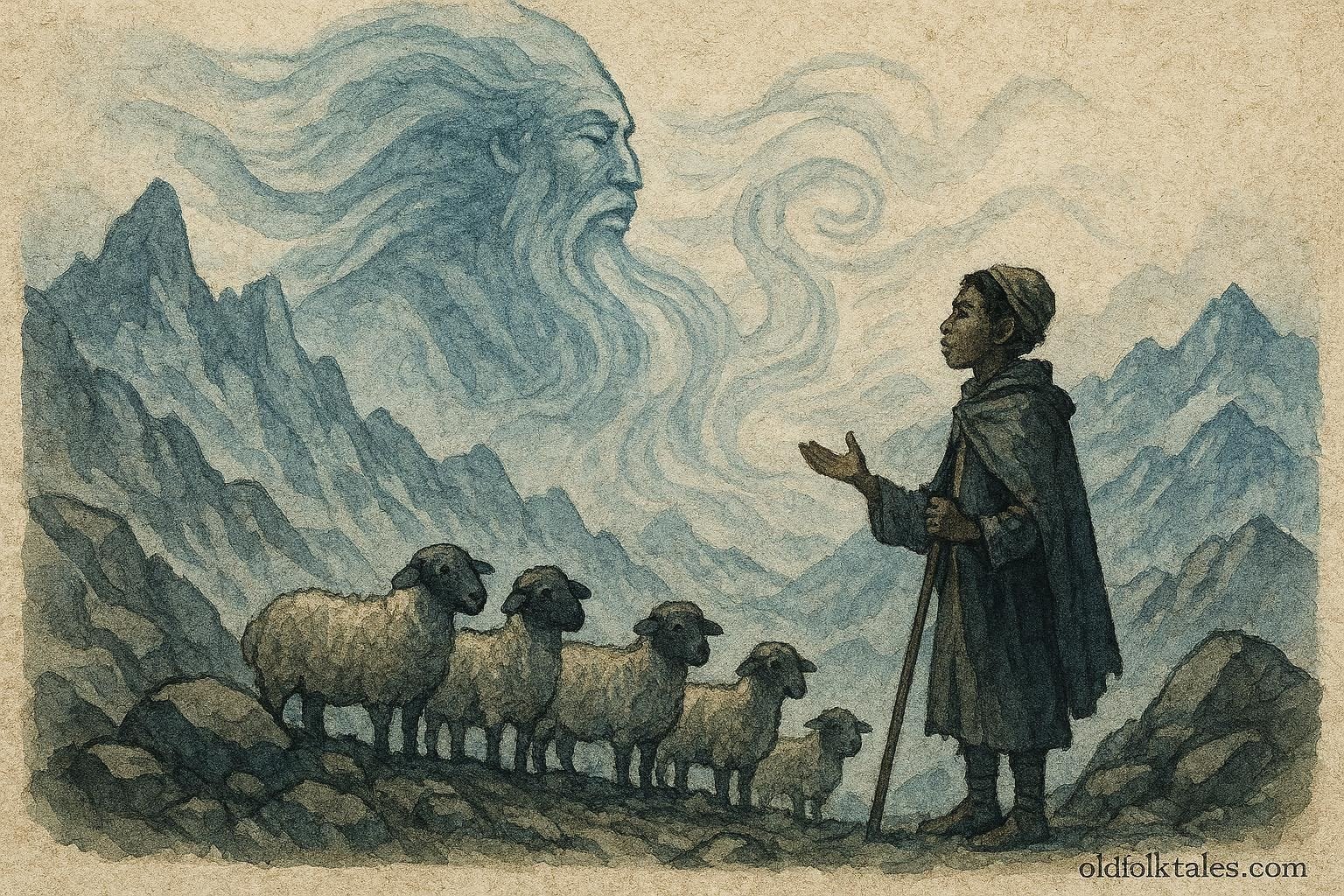
In the towering Atlas Mountains of Morocco, where snow clings to peaks even as the valleys burn under the sun, villages have always lived in close conversation with the land.
The mountains are not silent there.
Looking for more? Explore the magic of East African folktales here
They are watched.
They are felt.
And, in the old stories of the Amazigh people, they are also inhabited by spirits, ancient forces tied to stone, wind, and memory.
Among these mountains lived a young shepherd.
He tended his flock across steep slopes and narrow paths carved by generations of hooves and footsteps. He knew the rhythms of the land well, the way goats moved before storms, the way wind shifted before snow, the way silence could sometimes feel heavier than sound.
He had grown up on stories.
But not all stories remain stories forever.
The Demand of the Mountain Spirit
It began during a season when the mountains grew unusually still.
The wind, which usually moved freely through the valleys, seemed restrained. Even the birds flew lower, as though avoiding unseen boundaries.
One evening, as the shepherd gathered his flock near a rocky pass, the air changed.
The ground beneath him felt colder.
The shadows lengthened too quickly.
And then he heard it.
A voice, not carried by wind, not formed by any human throat—echoing from the mountain itself.
“You walk upon my body,” it said.
The shepherd froze.
The flock shifted nervously behind him.
“You graze your animals upon my slopes,” the voice continued. “And yet you offer nothing in return.”
The shepherd swallowed, but did not run.
“What do you want?” he asked carefully.
The mountains answered.
“Tribute.”
The Burden on the Villagers
In the days that followed, strange things began to happen in the nearby village.
Goats went missing.
Paths became dangerous without warning.
Water sources dried more quickly than usual.
And always, there was the same pattern.
Whenever the villagers attempted to use certain grazing lands, misfortune followed.
Soon, fear settled in.
The elders spoke in low voices.
“It is the mountain spirit,” they said.
“It demands payment.”
And so, offerings began.
Food was left at the edge of the slopes.
Milk was poured onto stones.
Small sacrifices were made in silence.
Yet still, the disturbances continued.
The burden grew heavier.
The villagers suffered.
And the spirit remained unseen.
The Shepherd’s Decision
The young shepherd watched all of this closely.
He did not believe in surrendering so easily.
The mountains had always been harsh, but they had also always been fair in their own way. What troubled him was not the existence of the spirit, but its demands without reason.
One night, as he sat beside his flock, he made a decision.
“If it speaks,” he said quietly, “then it can be answered.”
The wind did not respond.
But the mountains listened.
The First Encounter
He returned to the rocky pass where he had first heard the voice.
The air was colder there.
He stood alone.
And he spoke.
“You demand tribute,” he said. “But what is your name?”
The mountain did not answer immediately.
Then, slowly, the voice returned.
“I am what endures,” it said.
The shepherd nodded.
“And what do you give in return for what you take?” he asked.
Silence followed.
Then the wind shifted slightly.
The spirit did not answer.
Instead, the ground beneath him trembled faintly.
A warning.
The Riddle Begins
The shepherd did not retreat.
Instead, he spoke again.
“If I answer your demand,” he said, “will you answer mine?”
The spirit responded.
“Ask.”
So, the shepherd did something unexpected.
He asked a riddle.
“If I take from you without asking,” he said, “I am called a thief. If I take with asking, I am called a trader. But what am I if I take what was never yours to give?”
The mountain grew silent.
The wind stopped again.
Even the goats in the distance fell still.
The question lingered between stone and sky.
The Spirit’s Unease
Time passed.
Then the voice returned, slower now.
“You speak in circles,” it said.
“No,” the shepherd replied. “I speak in mirrors.”
The spirit did not respond immediately.
The shepherd continued.
“You take tribute,” he said. “But the land does not belong to one voice alone. If you demand balance, then you must answer balance.”
The mountains shifted slightly.
Not violently.
But thoughtfully.
The Second Riddle
The spirit answered at last.
“Then answer me this,” it said.
“If I am unseen yet always present, if I move without feet and speak without breath, what am I?”
The shepherd looked at the mountains around him.
He thought of wind.
Of memory.
Of fear.
Then he replied.
“You are what people believe you are,” he said.
The wind stilled.
The Shift in Power
For the first time, the spirit did not respond immediately.
The shepherd stood firm.
He was not stronger than the mountain.
He knew that.
But he had changed the shape of the conversation.
No longer demand.
No longer submission.
But question against question.
The silence stretched.
Then, at last, the spirit spoke.
“You are bold for something so small,” it said.
The shepherd answered calmly.
“And you are loud for something so unseen.”
The Balance Restored… or Disrupted
Days later, the villagers noticed something unusual.
The disturbances stopped.
The goats returned.
The water flows steadied.
The fear lessened.
But something else changed.
The mountains no longer felt as they once did.
There was no more demand.
But there was also no more certainty.
The balance had shifted, not broken, but unsettled.
The Shepherd’s Realization
The shepherd returned to the pass one final time.
He did not hear the spirit immediately.
Instead, he felt its presence.
“You changed the agreement,” the spirit said quietly.
“I changed the question,” he replied.
A long silence followed.
Then the spirit spoke.
“Power without understanding is danger,” it said.
“And obedience without questioning is blindness,” the shepherd replied.
The mountains did not answer.
But they did not oppose him either.
What Remained
From that time onward, the villagers no longer made offerings out of fear.
Instead, they respected the land with awareness.
They listened more carefully to changes in weather.
They watched the mountains not as rulers, but as forces to be understood.
And the shepherd?
He continued his work.
But he was no longer just a keeper of flocks.
He had become a keeper of questions.
Want to dive deeper? Read more North African folktales today
Moral Lesson
True courage is not the absence of fear, but the willingness to question power, even when it seems larger than life. Wisdom does not always defeat force; sometimes it transforms the terms under which force operates.
Knowledge Check
- What is the main lesson of “The Shepherd Who Challenged the Atlas Mountain Spirit”?
The story teaches that intelligence and questioning can challenge oppressive forces more effectively than strength alone. - What did the mountain spirit demand from the villagers?
It demanded tribute from villagers in the form of offerings and respect, creating fear and imbalance in the community. - How did the shepherd confront the spirit?
He used riddles and questions instead of force, challenging the spirit’s logic and authority. - What does the mountain spirit symbolize?
It symbolizes natural forces, authority, and systems of power that demand obedience without explanation. - How did the villagers change after the encounter?
They stopped acting out of fear and began to respect and observe the land more thoughtfully. - What cultural values are reflected in this Moroccan Amazigh folktale?
The story emphasizes wisdom, courage, balance with nature, critical thinking, and respect for both human and environmental systems.
Source: African folktale, Morocco. Based on Amazigh (Berber) oral traditions compiled in Legends of the High Atlas by Mohammed Chafik (2002).
Cultural Origin: Atlas Mountains, Morocco