Across the fertile lands of Buganda, long before modern factories and machines transformed daily life, blacksmiths occupied a special place in society. Their work supplied communities with tools for farming, equipment for hunting, household items, and objects used in ceremonies. Among these craftsmen, none was remembered more fondly in local tradition than Walukaga, a gifted blacksmith whose reputation spread far beyond his home village.
Walukaga was born into a family known for metalworking. From childhood, he spent hours observing older craftsmen at work. While other children played nearby, he watched sparks fly from glowing iron and listened to the rhythmic sounds of hammers striking metal. He became fascinated by the way skilled hands could transform raw materials into useful objects.
His father noticed this interest and began teaching him at an early age.
The lessons were not easy.
Walukaga learned how to control fire, shape heated metal, and select the best materials for different tasks. Mistakes were common. Sometimes a tool cracked during production. Sometimes a blade emerged crooked or weak. Yet each failure taught an important lesson.
Instead of becoming discouraged, Walukaga became more determined.
Keep reading: Discover more Central African folktales
As he grew older, his abilities improved rapidly.
He developed a reputation for patience and attention to detail. Farmers appreciated the durability of his hoes and harvesting tools. Hunters trusted the quality of his spearheads. Traders traveling through the region often stopped to purchase items from his workshop.
Before long, people began referring to him as the master blacksmith.
His fame reached neighboring villages and eventually attracted the attention of local leaders.
One year, however, a serious problem threatened several communities.
The region experienced unusually heavy rainfall.
Rivers overflowed their banks.
Footpaths became difficult to use.
Several wooden bridges that connected important settlements were damaged or washed away entirely.
The destruction disrupted trade and communication.
Farmers struggled to transport crops to markets.
Families found it difficult to visit relatives living across rivers.
Community leaders searched for solutions but faced significant obstacles.
Constructing stronger bridges required tools and techniques that many people lacked.
Meetings were held to discuss possible responses.
During one gathering, an elder suggested consulting Walukaga.
The idea was welcomed.
Although he was known primarily as a blacksmith, people also respected his practical intelligence and ability to solve difficult problems.
When representatives visited his workshop, they explained the situation.
Walukaga listened carefully.
Rather than offering an immediate answer, he spent several days studying the damaged crossings. He examined riverbanks, measured distances, and spoke with residents who used the routes regularly.
After gathering information, he proposed an innovative solution.
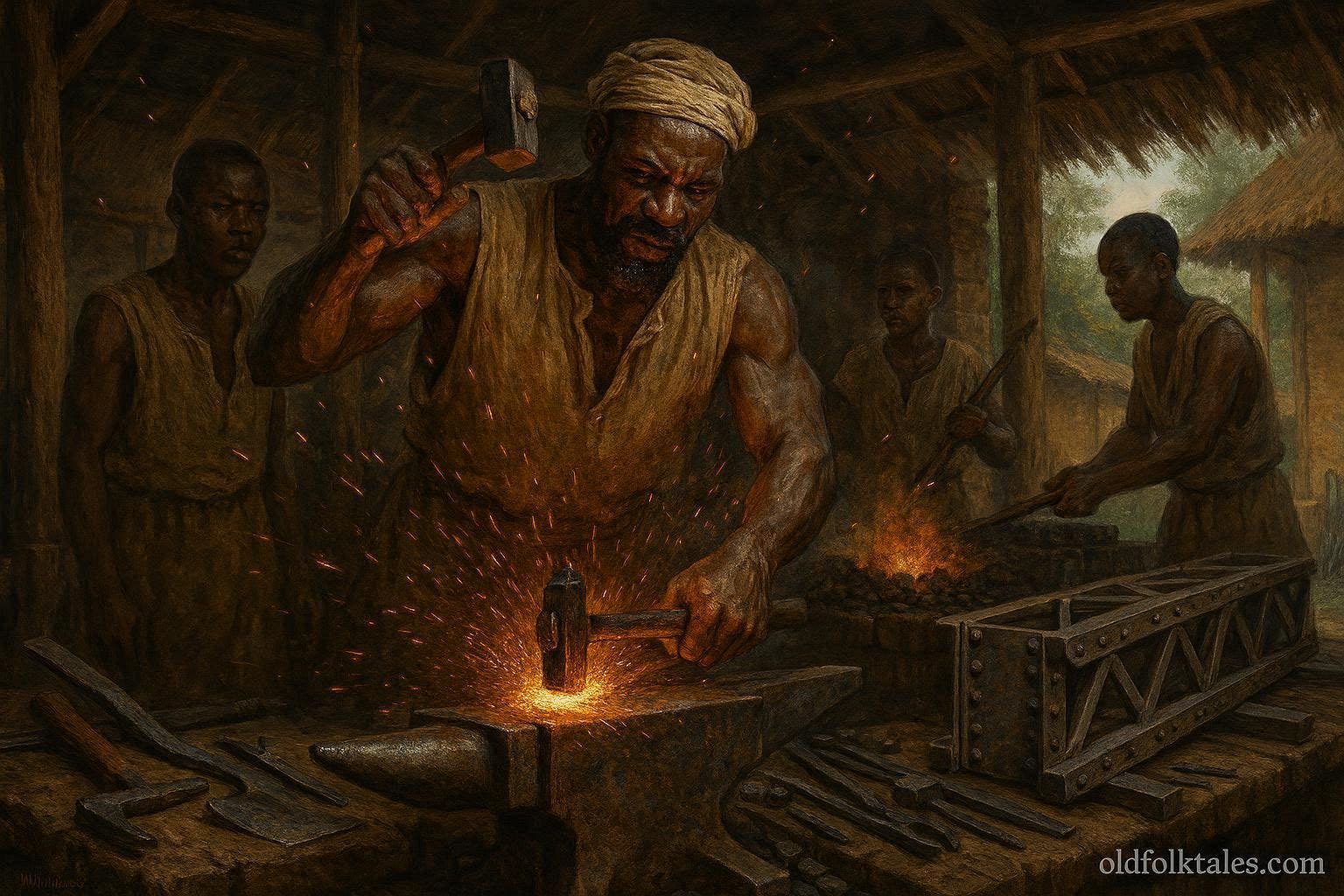
Instead of relying entirely on traditional wooden structures, he suggested reinforcing critical sections with metal components produced in his forge. Strong metal fastenings could improve stability and help bridges withstand future floods.
Some people doubted the idea.
Metal was valuable and producing large quantities would require considerable effort.
Others worried that the plan might fail.
Walukaga remained confident.
He explained his reasoning patiently and demonstrated how the components would function.
Eventually, community leaders agreed to support the project.
Work began immediately.
Walukaga organized teams of assistants and apprentices. The forge operated from dawn until late evening. Fires burned continuously as workers shaped iron into brackets, clamps, and connectors.
The task demanded enormous effort.
Heat from the forge was exhausting.
Supplies had to be gathered from distant locations.
Unexpected challenges emerged regularly.
Yet Walukaga refused to abandon the project.
His determination inspired others.
Villagers volunteered labor.
Farmers provided food for workers.
Young apprentices eagerly learned new skills while assisting experienced craftsmen.
After weeks of hard work, the first reinforced bridge was completed.
People gathered to observe the result.
The structure appeared stronger than previous designs, and early tests suggested it would endure heavy use.
Months later, additional rains arrived.
Communities watched anxiously.
To their relief, the reinforced bridge remained intact.
The success encouraged further construction.
Over time, other crossings were improved using similar methods.
Transportation became more reliable.
Trade recovered.
Communication between settlements improved.
Walukaga’s reputation grew even stronger.
Yet his greatest contribution was not the bridges themselves.
It was the example he provided.
He demonstrated that knowledge and creativity could solve problems that initially seemed overwhelming.
Years later, another challenge emerged.
Wild animals began damaging crops near several villages. Farmers worked hard to protect their fields, but existing barriers proved ineffective.
Once again, community leaders turned to Walukaga.
Rather than relying solely on traditional methods, he carefully studied the situation. He observed animal movements and consulted experienced hunters.
After evaluating the problem, he designed improved tools and protective devices that helped farmers defend their crops more effectively.
The results were impressive.
Harvest losses decreased.
Food supplies stabilized.
Communities benefited from his practical ingenuity.
As time passed, Walukaga became known not only as a craftsman but also as a teacher.
Young apprentices traveled from distant regions to study under him.
He welcomed them enthusiastically.
Rather than keeping his knowledge secret, he believed skills should be shared for the benefit of future generations.
His workshop became a place of learning.
Students practiced metalworking techniques, but they also learned broader lessons.
Walukaga encouraged curiosity.
He taught the importance of observation and careful planning.
He reminded apprentices that every challenge presents an opportunity for innovation.
One of his favorite sayings became widely known throughout the region.
He often told students that a strong tool begins with a strong idea.
The statement reflected his belief that intelligence and creativity are as important as physical skill.
As the years passed, Walukaga’s influence extended far beyond his own village.
Tools produced by his apprentices appeared across Buganda.
Communities benefited from techniques he helped develop.
Stories about his achievements became part of local oral tradition.
Parents shared them with children.
Elders recounted them during gatherings.
The tales celebrated not only craftsmanship but also perseverance and problem solving.
Eventually, Walukaga grew old.
Although he spent less time working at the forge, he continued mentoring younger generations.
Many of his students became respected craftsmen in their own right.
They carried his teachings to new communities and ensured that his methods survived long after his lifetime.
Today, the story of Walukaga the Master Blacksmith remains an important part of Baganda oral heritage.
It honors the contributions of artisans whose skills supported society and improved everyday life.
It also reminds listeners that innovation does not always come from rulers or warriors.
Sometimes it comes from dedicated individuals who combine knowledge, creativity, and determination to serve their communities.
For this reason, Walukaga continues to be remembered as a hero not because of military victories or political power but because he used his talents to help others.
His story demonstrates that true greatness can be found in craftsmanship, ingenuity, and a commitment to solving problems for the common good.
Continue your journey: Read more East African folktales
Moral Lesson
Knowledge, creativity, and perseverance can help communities overcome even the most difficult challenges.
Knowledge Check
1. Who was Walukaga?
A master blacksmith celebrated in Baganda oral traditions for his skill and intelligence.
2. Why did community leaders seek his help?
Heavy rains had damaged important bridges connecting villages.
3. What solution did Walukaga propose?
Using metal reinforcements to strengthen bridge structures.
4. How did Walukaga help farmers later in the story?
He designed improved tools and protective devices to safeguard crops.
5. Why did many apprentices study under him?
Because he willingly shared his knowledge and skills.
6. What is the main lesson of the story?
Creativity, learning, and persistence can solve major problems.
Source
Adapted from Baganda oral traditions, artisan hero narratives, and materials preserved in Baganda oral literature archives.