In the earliest days of the land, before the people were divided into clans and before each family knew its place among others, there was only one community. They lived together without clear boundaries, sharing the same hills, the same grazing lands, and the same rivers that sustained them.
At that time, people were known simply as one people. They worked together, married among themselves without distinction, and settled disputes without reference to lineage or inherited identity. Life was simple, and though they lived in peace, there was also confusion.
As the population grew, this confusion began to show itself more clearly. Disagreements arose over land, over cattle, and over responsibilities. Without structure, it became difficult to decide who should lead, who should mediate disputes, and who should carry out certain duties within the community.
The elders saw that something needed to change.
Love this story? Discover our full Southern African folktales collection
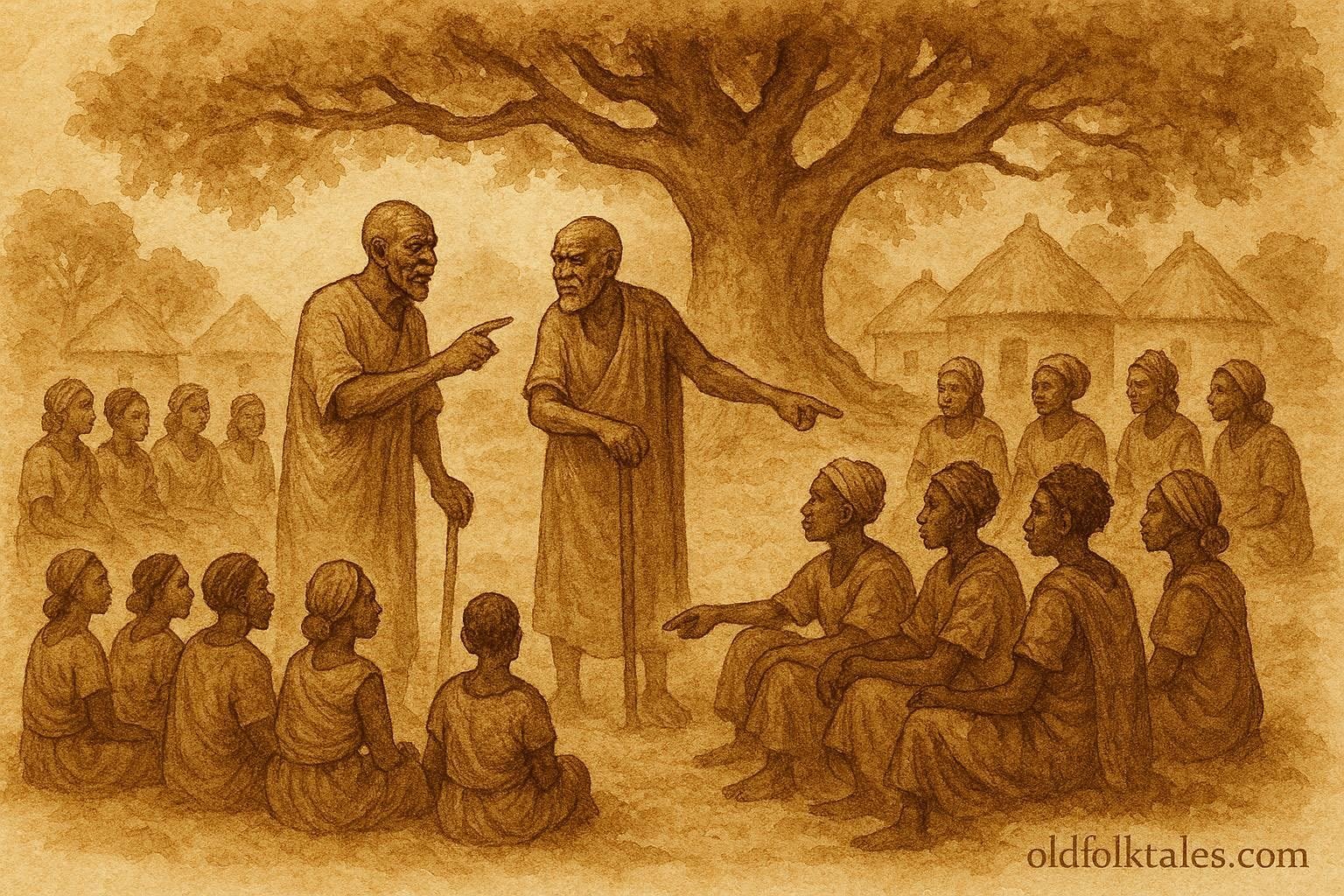
They gathered beneath a large tree, a place where important matters had always been discussed. There, they spoke at length about the future of their people.
“Our numbers have grown,” one elder said. “What once worked for a few cannot guide many.”
Another added, “We must find a way to organize ourselves so that each person knows their place, not to divide us, but to strengthen us.”
After much discussion, the elders decided to seek guidance beyond themselves. They turned to the wisdom of the ancestors, believing that the answer lay in the traditions that had been passed down through generations.
That night, they performed the necessary rituals, calling upon the ancestors to guide them. They offered their prayers with humility, asking for a way to bring order without destroying unity.
In time, an answer came.
It was understood that the people should be divided into clans, each with its own identity, responsibilities, and lineage. These clans would not separate the people, but rather give them structure and purpose.
The elders accepted this guidance and began the work of organizing the community.
They started by identifying groups within the population, tracing connections through family lines and shared ancestry. From these connections, distinct clans began to emerge. Each clan was given a name, a history, and a role within the larger community.
Some clans became known for leadership and governance. Others were recognized for their skill in farming, tending the land and ensuring that the people were fed. Some were associated with cattle, caring for the herds that symbolized wealth and stability. Others took on roles as mediators, healers, or keepers of tradition.
Each clan carried a responsibility, and no role was considered greater than another. Together, they formed a complete and balanced society.
At first, the people were uncertain about these changes.
They had always seen themselves as one group, and now they were being asked to identify with smaller units within the whole. Some feared that this division might lead to separation or conflict.
The elders addressed these concerns carefully.
“These clans are not meant to divide us,” they said. “They are meant to guide us. Each clan is a part of the whole, just as each part of the body serves a purpose. Without one, the others cannot function as they should.”
Gradually, the people began to understand.
They saw that the clans brought clarity where there had once been confusion. Disputes could now be addressed through lineage and responsibility. Leadership became more structured. Tasks were carried out with greater efficiency because each group knew its role.
The sense of identity that came with belonging to a clan also strengthened the people. Individuals felt connected not only to their immediate families, but to a larger history that gave their lives meaning.
With time, the clans became an essential part of daily life.
Children were taught the history of their clans, learning about their ancestors and the roles they were expected to uphold. Marriage customs began to reflect clan identity, ensuring that relationships strengthened connections across the community.
Ceremonies and gatherings brought the clans together, reminding everyone that while they had distinct identities, they were still one people.
Despite these benefits, the elders remained watchful. They knew that the very structure that brought order could also create division if it was misunderstood.
They reminded the people again and again that no clan was above another.
“All clans are equal,” they said. “Each one carries a piece of what makes us whole.”
There came a time when this teaching was tested.
A disagreement arose between two clans, each believing their role to be more important than the other. Voices were raised, and for a moment, it seemed that the unity the clans were meant to protect might be broken.
The elders intervened.
They gathered the people once more beneath the great tree and spoke with firmness.
“Remember why the clans were created,” they said. “Not to compete, but to support one another. When one clan rises above the others, balance is lost. And when balance is lost, the whole community suffers.”
Their words reminded the people of the purpose behind the clans. The disagreement was resolved, and unity was restored.
From that time onward, the story of the founding of the clans was told and retold. It served as a reminder of how the people had once lived without structure, and how the guidance of the ancestors had brought order and harmony to their lives.
The clans became more than a system of organization. They became a symbol of identity, unity, and shared responsibility.
Each person carried the pride of their clan, but also the understanding that their strength came from being part of a greater whole.
And so, the people continued to live, guided by the structure that had been given to them. They worked together, resolved their differences, and honored the roles that connected them to their past and to one another.
The founding of the clans was never forgotten, for it marked the moment when the people truly became a community, not just in name, but in purpose and unity.
Looking for more? Explore the magic of East African folktales here
Moral Lesson
Structure and identity strengthen a community, but unity must always remain greater than division. Every role is important in maintaining balance.
Knowledge Check
- Why were clans created in the community?
To bring structure, order, and clear roles among the people. - What roles did the clans have?
Leadership, farming, cattle keeping, mediation, and preserving tradition. - Did clans divide the people?
No, they were meant to strengthen unity and organization. - How did people learn about their clans?
Through teachings from elders and ancestral history. - What problem arose after the clans were formed?
Some clans believed they were more important than others. - What is the main lesson of the story?
Unity and balance are more important than individual status or identity.
Source
Central African oral tradition, Burundi. Recorded by Jan Vansina in Oral Tradition as History (1985).