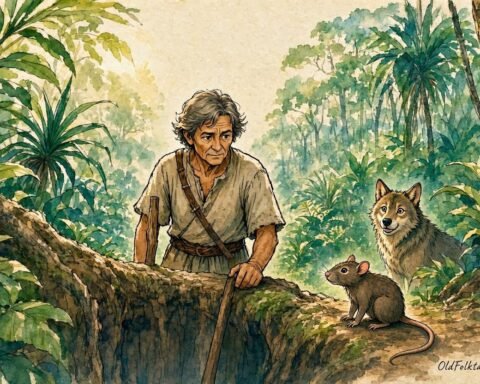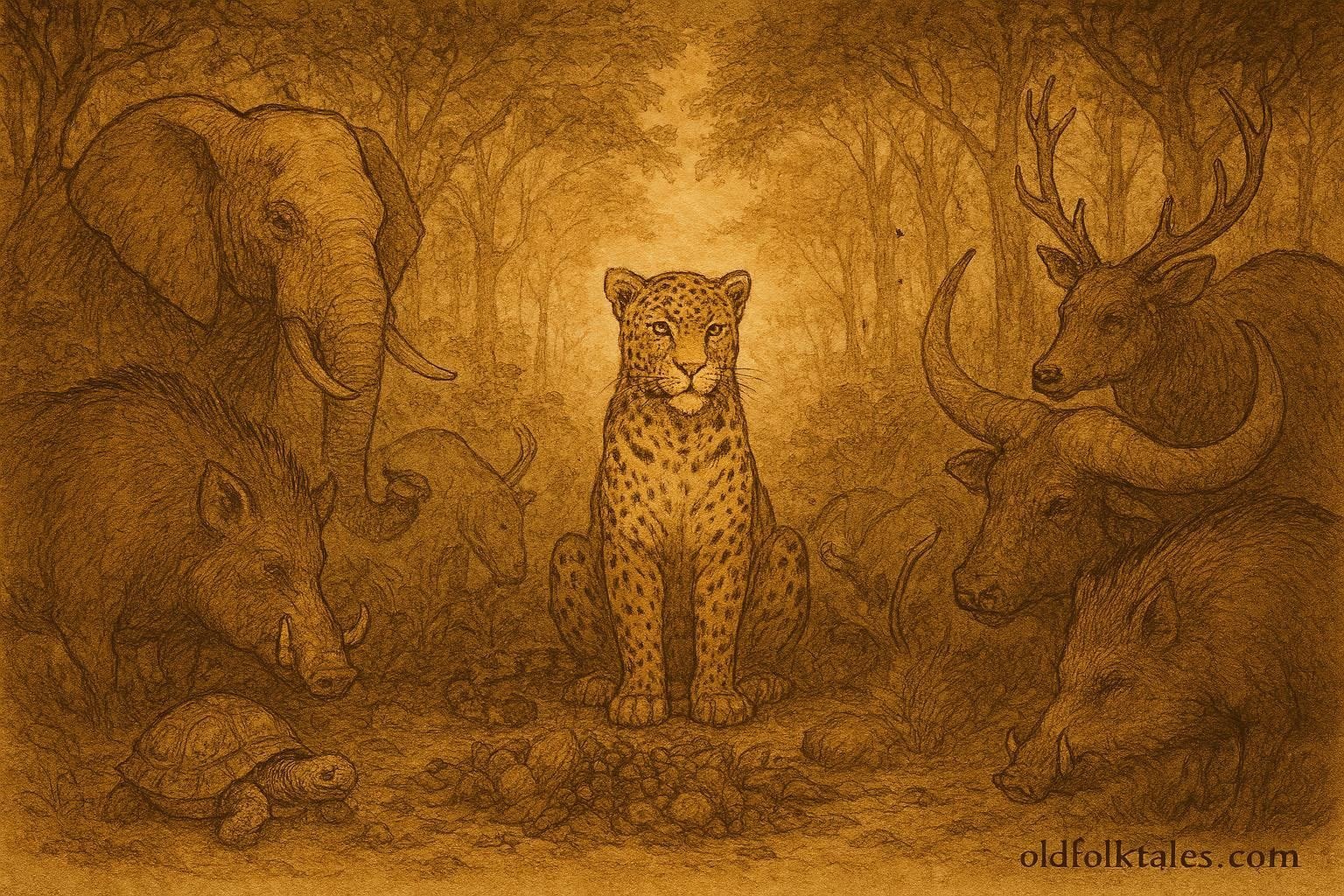
In the deep, shadowed forests of the Congo Basin, where towering trees formed a living roof above the earth and the air hummed with life, the animals lived according to a quiet order.
Strength commanded respect.
Speed earned survival.
And power, above all, shaped who led and who followed.
Fascinated by this tale? Discover more North African folktales
Among these animals was Leopard.
He was feared and admired in equal measure, swift, silent, and strong. His presence alone could quiet the chatter of monkeys and send smaller creatures scurrying into hiding. When Leopard moved, the forest noticed.
And when Leopard spoke, others listened.
It was therefore no surprise that when word spread of a grand feast to be held in the forest, it was Leopard who would host it.
The feast was to be unlike any other.
Animals from across the forest were invited, those who could hunt, those who could gather, those who could contribute in their own way. It would be a celebration of abundance, a rare moment of shared prosperity in a world often shaped by survival.
Preparations began days in advance.
Some animals gathered fruits and roots, others hunted game, and still others prepared the clearing where the feast would take place. The air filled with anticipation, and even the quietest corners of the forest seemed to stir with excitement.
But not all were invited equally.
Some animals, especially the smaller and weaker ones, knew their place. They would come, yes, but they would wait, watch, and take only what remained after the powerful had eaten.
Such was the way of things.
Among these smaller creatures was Tortoise.
He moved slowly along the forest floor, his shell glinting softly in the filtered sunlight. Though not strong, not fast, and certainly not feared, Tortoise possessed something many others did not.
A mind that never rested.
He heard of the feast, as all did.
And like many, he felt the pull of hunger and opportunity.
But unlike the others, Tortoise did not intend to sit quietly at the edges, waiting for scraps.
“No,” he murmured to himself. “There is always a better way.”
Tortoise knew Leopard’s nature.
Proud. Confident. Certain of his place above the rest.
“If I am to eat well,” Tortoise thought, “I must not approach as one beneath him, but as one he chooses to favor.”
And so, he began to plan.
On the morning before the feast, Tortoise made his way toward Leopard’s territory.
He moved with unusual purpose, his steps deliberate despite his slow pace. When at last he reached the shaded clearing where Leopard rested, he paused—then called out respectfully.
“Great Leopard,” he said, his voice measured. “I come with words that may be of interest to you.”
Leopard lifted his head, his golden eyes narrowing slightly.
“Tortoise,” he said. “You are far from your usual path. Speak.”
Tortoise bowed his head.
“I have heard of your feast,” he began. “And I must say, it will surely be remembered across the forest.”
Leopard’s tail flicked with quiet satisfaction.
“It will,” he said.
“But,” Tortoise continued carefully, “a feast of such importance deserves to be… exceptional in every way.”
Leopard watched him now, curious.
“What do you mean?”
Tortoise allowed a small pause, as though choosing his words with care.
“There are things,” he said, “small details, subtle touches, that can elevate a gathering from great to unforgettable. I have seen such things in my travels.”
Leopard leaned forward slightly.
“You suggest you can help?”
Tortoise nodded.
“If you permit it.”
Leopard considered this.
Though powerful, he was not without pride, and the idea of a feast remembered as the greatest in the forest appealed to him.
“Very well,” he said. “You may assist. But do not waste my time.”
Tortoise bowed deeply.
“I would not dare.”
From that moment, Tortoise moved freely among the preparations.
He offered suggestions, where to place certain foods, how to arrange the gathering, how to ensure that everything flowed smoothly.
Some animals watched him with suspicion.
Others simply shrugged.
After all, Leopard had allowed it.
But Tortoise’s true plan was quieter.
More patient.
He observed not only the feast, but the rhythm of it.
Who would serve.
Who would eat first.
Where the best portions would be placed.
And slowly, he positioned himself.
Not at the edges, but near the center.
Not among the weakest, but close to where Leopard and the strongest animals would gather.
When the day of the feast arrived, the forest came alive.
Animals gathered from every direction, filling the clearing with movement and sound. The scent of food rose into the air, rich, warm, and irresistible.
Leopard stood at the center, commanding attention.
“Today,” he declared, “we share in the bounty of the forest.”
A cheer rose.
The feast began.
At first, things followed the usual order.
Leopard and the strongest animals approached the food first, selecting the best portions. Others waited, watching, hoping.
But Tortoise did not wait.
Through careful timing and quiet movement, he slipped closer, always just at the edge of notice.
When Leopard turned, Tortoise stepped forward.
When others hesitated, Tortoise advanced.
And somehow, without drawing too much attention, he began to eat.
Not just scraps.
Not leftovers.
But the good food.
The rich portions.
The ones meant for those who stood at the top.
He ate slowly at first, as though he belonged there.
Then more boldly.
Then with growing confidence.
Each bite fed not only his hunger, but his satisfaction.
“You see?” he thought. “Strength is not everything.”
But as the feast continued, something shifted.
A few animals began to notice.
“Was Tortoise always there?” one whispered.
Another frowned. “How does he eat so freely?”
Leopard, too, began to observe.
At first, he said nothing.
But his eyes followed Tortoise more closely.
Tortoise, sensing the change, slowed.
He adjusted.
Moved slightly away.
Then returned again from another angle.
Each movement careful.
Each step measured.
But greed, once fed, is not easily quieted.
There came a moment, small, but significant, when Tortoise reached for more than he should.
A portion set clearly before Leopard.
A piece too visible.
Too bold.
Leopard’s paw came down before him.
The clearing fell silent.
“Tortoise,” Leopard said slowly, “you seem to eat as though this feast was prepared for you alone.”
All eyes turned.
Tortoise looked up.
For a brief moment, his mind raced.
Then he smiled.
“Great Leopard,” he said, his voice calm, “I eat only because your feast is so generous. It would be a shame for such abundance to go to waste.”
A few animals murmured.
Leopard’s gaze did not soften.
“And you believe it is your place to decide that?”
Tortoise lowered his head slightly.
“I believe,” he said carefully, “that a well-prepared feast should be enjoyed fully.”
The tension lingered.
For a long moment, it seemed as though Leopard might act.
But then,
He withdrew his paw.
“Be mindful,” he said. “Even cleverness has its limits.”
Tortoise bowed.
“I understand.”
But inside, he felt the edge of something he rarely acknowledged.
Risk.
For the rest of the feast, he ate less boldly.
More carefully.
And when at last the gathering ended, he slipped away quietly, his stomach full, his mind alert.
He had succeeded.
But not without cost.
For though he had eaten well, he had come close, too close, to being exposed.
And in a forest ruled by strength, such exposure could have meant more than embarrassment.
As he made his way home, the forest quiet once more, Tortoise reflected.
“Cleverness,” he said softly, “can open doors that strength cannot.”
He paused.
“But it must be guided.”
For even he knew, deep down, that one step further, one moment less careful, and the story might have ended very differently.
Click here to explore more Central African folktales
Moral Lesson
This folktale teaches that intelligence can overcome strength, but when cleverness is driven by greed, it becomes dangerous. True wisdom lies in knowing when to stop, when to be content, and how to balance wit with restraint.
Knowledge Check
- Why did the tortoise want to attend Leopard’s feast?
He wanted to avoid being left with scraps and instead enjoy the best food by using his cleverness. - How did the tortoise gain access to the feast’s central area?
He flattered Leopard and offered to help organize the feast, earning permission to move freely. - What strategy did the tortoise use during the feast?
He carefully positioned himself near the strongest animals and used timing and subtle movement to eat premium food. - When did the tortoise almost get caught?
He reached for food meant for Leopard, drawing attention and suspicion. - How did the tortoise avoid punishment?
He responded calmly and respectfully, using words to defuse the situation. - What is the main lesson of this Congo Basin folktale?
It shows that while intelligence can outmatch strength, greed can lead to danger if not controlled.
Source: Central African oral traditions documented by ethnographers such as Hermann Baumann (1930s)
Cultural Origin: Bantu peoples of the Congo Basin