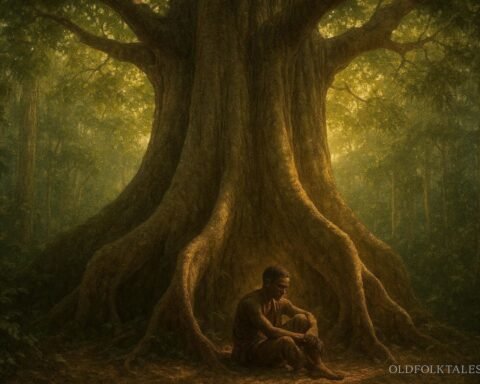
In the deep forest regions where the Mongo people lived, life moved in rhythm with the land and the unseen. Villages were built with care, families lived close, and traditions were passed down not only through words but through quiet understanding.
It was known, though not always spoken, that the world of humans was not the only world.
Explore more Southern African folktales here
There were others.
Worlds that existed alongside theirs, separated not by distance, but by awareness. And sometimes, though rarely, those worlds touched.
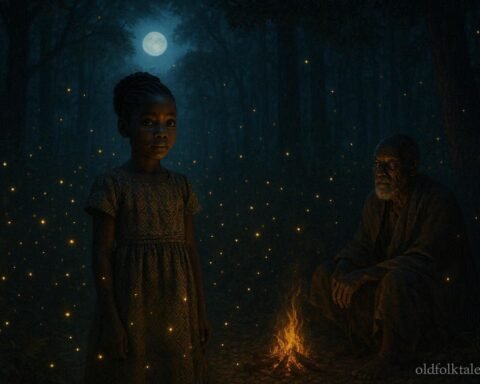
In one such village lived a young girl.
She was known for her gentleness, her quiet strength, and the way she listened more than she spoke. She helped her family with daily tasks, learned from the elders, and carried herself with a calm that others admired.
As she grew, talk of marriage began.
Suitors came, young men from nearby villages, some bold, some shy, each hoping to win her attention. But though she treated them all with respect, she felt no certainty in her heart.
And so, she waited.
One evening, as the sun dipped low and the village prepared for rest, a stranger arrived.
He was unlike the others.
His presence was calm, his voice measured, and his appearance, neat, composed, almost too perfect, caught the attention of many. He greeted the elders respectfully, spoke with clarity, and carried himself with a quiet confidence.
When he spoke to the girl, he did not rush.
He did not boast.
He simply said, “I have come because I see in you what I have been searching for.”
His words were simple, but they settled deeply.
In the days that followed, he remained in the village.
He worked where needed, spoke little, and observed much. The elders watched him closely, as they always did with strangers. He showed no signs of disrespect. No obvious fault.
And so, when he asked for the girl’s hand in marriage, the request was considered.
Her family spoke with her.
“He is not known to us,” one elder said. “But he has shown no wrongdoing.”
The girl listened.
There was something about him she could not fully understand, but neither could she find reason to refuse.
At last, she agreed.
The marriage was prepared.
Songs were sung, blessings given, and the girl left her family’s home to follow her husband.
But instead of settling near the village, as most did, the man led her into the forest.
“We will build our life there,” he said.
The girl hesitated.
“The forest is deep,” she replied.
“It is where I belong,” he said calmly. “And now, it is where you will belong too.”
They walked far.
Further than she had ever gone before.
The paths grew narrower, the trees taller, and the air heavier. The familiar sounds of village life faded, replaced by a quiet that felt watchful.
At last, they reached a place where a dwelling stood.
It was well built, but strange.
Too still.
Too perfect.
Life there began.
At first, everything seemed normal.
Her husband provided food, though she rarely saw how he obtained it. He left at odd times and returned without explanation. He spoke kindly, but there was always something distant in his eyes.
And slowly, the girl began to notice.
There were rules.
Unspoken at first, then clearer.
“There are places you must not go,” he told her one day.
“Why?” she asked.
“Because they are not for you,” he replied.
At night, she sometimes woke to sounds.
Movement.
Whispers.
But when she turned, her husband lay still beside her.
One day, while sweeping near the back of the dwelling, she found something.
A small space, partially hidden.
She paused.
Her husband’s words echoed in her mind.
There are places you must not go.
But something stronger pulled at her.
Not curiosity alone, but unease.
Slowly, she moved closer.
Carefully, she looked inside.
What she saw was not what she expected.
It was not a store of food.
Not tools.
Not anything ordinary.
It was something that did not belong to the human world.
Objects that seemed to shift when she looked at them. Shapes that did not hold their form. A presence that made her step back without thinking.
Her breath caught.
In that moment, understanding came.
Not in full, but enough.
Her husband was not what he seemed.
That night, she lay awake.
Her mind turned over what she had seen, what she had felt, what she now understood.
Fear rose, but so did something else.
Resolve.
She remembered the stories.
Stories told by elders, of spirits who walked among humans, of disguises, of hidden truths. Stories that were not meant to frighten, but to prepare.
She had listened.
Now, she understood why.
The next morning, she watched her husband carefully.
His movements.
His silence.
The way he looked at her, not unkindly, but not fully as a man looks at his wife.
“I must leave,” she thought.
“But I must do so wisely.”
That evening, she spoke.
“I would like to visit my family,” she said.
Her husband’s eyes rested on her.
“Why?” he asked.
“It has been long,” she replied. “They will wonder.”
There was a pause.
Then he nodded.
“You may go,” he said. “But you must return.”
The girl bowed her head.
“I will.”
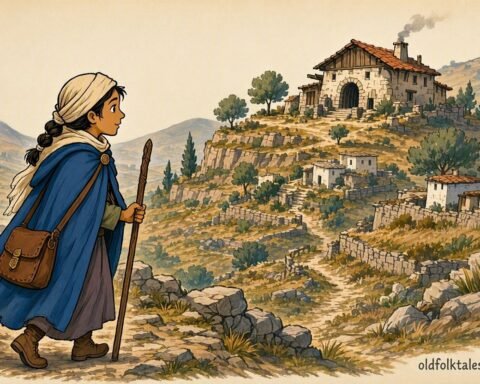
At dawn, she left.
Her steps were steady, but her heart was not.
She did not look back.
The journey felt longer than before.
The forest seemed deeper.
But she moved with purpose.
When at last she reached her village, she did not speak immediately.
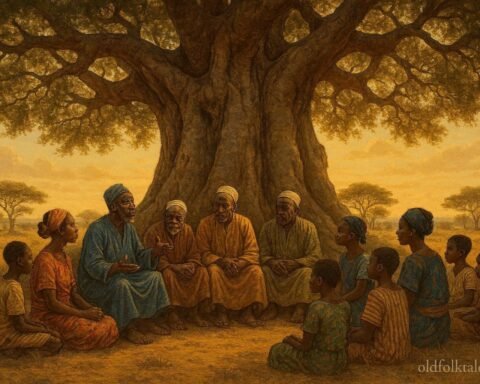
She went first to the elders.
Then to those who carried the knowledge of the ancestors.
She told them everything.
What she had seen.
What she had felt.
What she now knew.
The elders listened.
They did not interrupt.
They did not dismiss her.
For they, too, knew the stories.
“You have done well to return,” one said.
“But this is not yet finished.”
They prepared.
Not with weapons alone, but with knowledge.
With words.
With protection drawn from what had been passed down.
For when the spirit discovered her absence, it would come.
And it did.
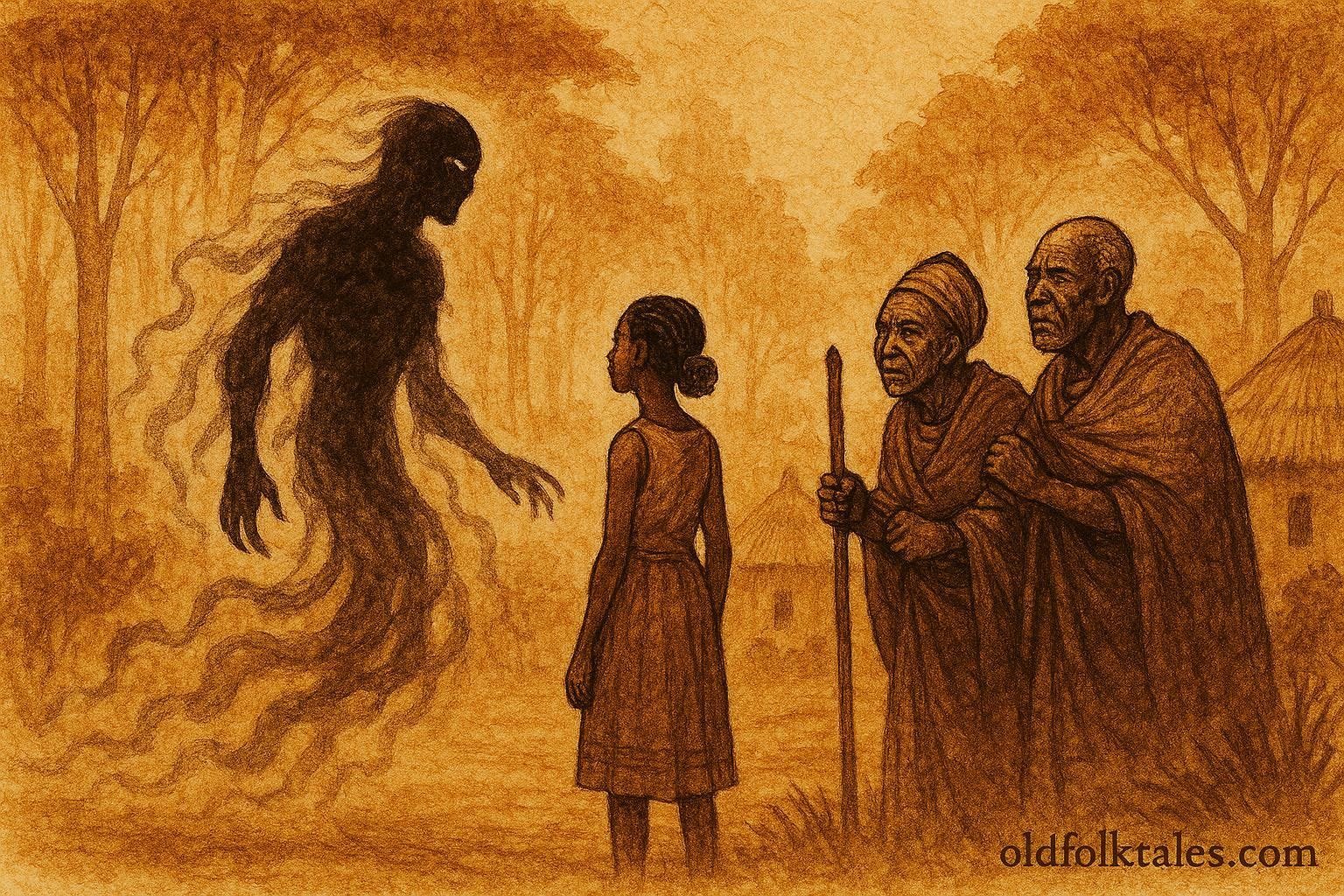
Days later, as the village moved through its usual rhythms, a figure appeared at its edge.
The husband.
But no longer entirely as before.
His form seemed less steady.
His presence heavier.
“I have come for my wife,” he said.
The villagers gathered.
The elders stepped forward.
“She is no longer yours,” one said.
The spirit’s voice shifted.
“She belongs to me,” it replied.
The air grew tense.
The elders spoke, not loudly, but with authority.
Words shaped by memory.
By tradition.
By understanding of the unseen.
The spirit faltered.
For the first time, it was no longer in control.
The girl stood behind the elders.
Afraid, but steady.
“You are not of us,” one elder said.
“And she is not of you.”
The spirit’s form wavered.
And then,
It withdrew.
Not defeated by force.
But by truth.
By knowledge.
By the boundary between worlds being restored.
The village exhaled.
The girl returned to her family.
But she was not the same.
She carried with her what she had faced, and what she had overcome.
She spoke more carefully.
Listened more deeply.
And when others spoke of strangers, of choices, of what lies beneath appearances, she did not speak in fear.
But in understanding.
For she had seen.
And she had returned.
Click here to explore more Central African folktales
Moral Lesson
This folktale teaches that appearances can be deceiving, and that true safety lies in awareness, wisdom, and connection to ancestral knowledge. Courage and discernment are essential when facing the unknown.
Knowledge Check
- Why did the girl marry the stranger?
He appeared respectful and trustworthy, and neither she nor her family recognized his true nature. - What signs revealed that her husband was a spirit?
His strange behavior, hidden spaces, and unnatural objects led her to realize he was not human. - Why did the girl decide to leave?
She understood the danger and knew she needed to return to her people for protection. - How did the village help her?
The elders used ancestral knowledge and spiritual authority to confront and drive away the spirit. - What role do ancestors play in the story?
They represent wisdom and protection, guiding the living in dealing with spiritual forces. - What is the main lesson of this Mongo folktale?
It teaches that not everything is as it seems and that wisdom, courage, and tradition help overcome hidden dangers.
Source: Central African oral narratives compiled by Jan Vansina (1960s)
Cultural Origin: Mongo people, Congo Basin