Long before paths were marked and forests thinned by many footsteps, the great lands of the Congo Basin stretched in deep, living green. The forest was not merely a place of trees and animals, it was a world within itself, watched over by forces unseen but deeply felt.
Among the Luba people, it was understood that the forest had its own order.
Want to dive deeper? Read more North African folktales today
It gave, but it also required respect.
It fed, but it could also withhold.
And within its quiet depths lived spirits, guardians of balance, watchers of those who entered.
In a village at the edge of this vast forest lived a hunter known for his skill.
He was strong, precise, and patient. His arrows rarely missed, and his traps were set with care. Because of him, his household never lacked food, and his name was spoken with admiration.
But over time, admiration grew into something else.
Confidence became pride.
And pride, slowly, became arrogance.
Where once he had paused at the forest’s edge, offering quiet respect before entering, he now walked in without thought. Where once he had taken only what he needed, he began to take more, choosing the best game, leaving little for others.
The forest still provided.
At first.
And so, the hunter believed his success was his alone.
One season, when the air was thick with heat and the forest seemed unusually still, the hunter decided to go deeper than he ever had before.
“There is more to be found,” he said to himself. “And I will find it.”
Without greeting the forest, without a word of acknowledgment, he stepped into its depths.
As he walked, something felt different.
The usual sounds, birds calling, insects humming, leaves shifting, grew faint. The deeper he went, the quieter it became.
But instead of caution, he felt excitement.
“Even better,” he thought. “Where it is quiet, there is game.”
After many hours, he came upon a clearing.
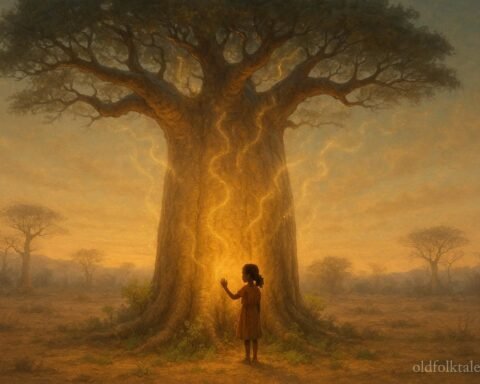
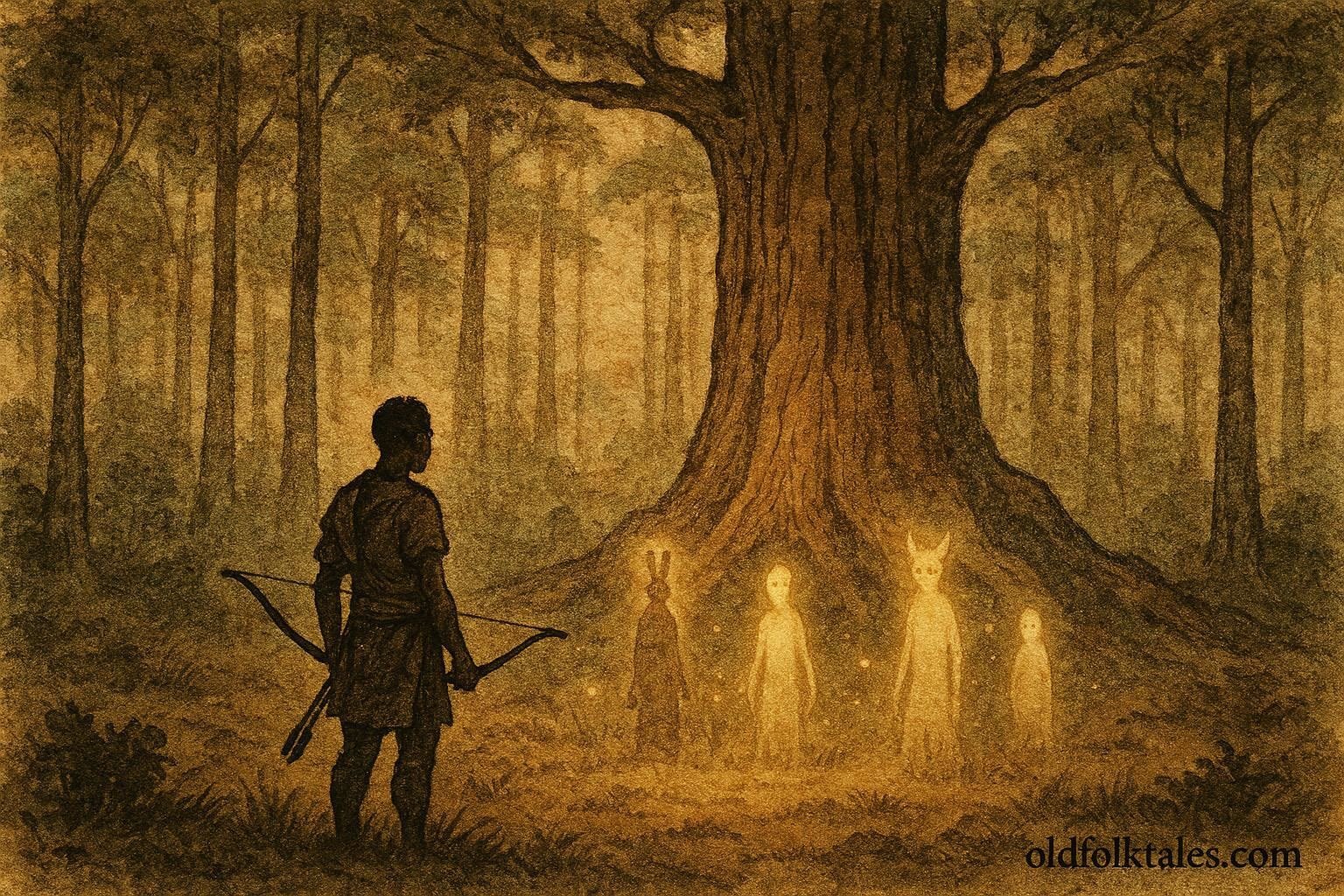
It was wide and open, with a stillness that seemed to hold its breath. At its center stood a great tree, older than any he had seen. Its roots spread across the ground like thick cords, and its branches stretched high into the filtered light.
Around it, the air felt heavy.
Watching.
Then he saw them.
The forest spirits.
They did not appear all at once.
At first, there was movement, shadows where there should be none, shapes forming between tree trunks. Then, slowly, they revealed themselves.
Some were tall, their forms blending with bark and vine. Others moved like flickers of wind through leaves. Their presence was quiet, but unmistakable.
They surrounded the clearing.
Watching him.
The hunter stood still.
But instead of lowering his gaze, instead of stepping back, he lifted his chin.
“So,” he said, “you are the ones they speak of.”
A murmur passed through the air, not sound, but something like it.
One spirit moved forward.
“You have come far,” it said, its voice low and steady.
“I go where I choose,” the hunter replied.
The spirit regarded him.
“And do you know where you stand?”
The hunter glanced around.
“In a clearing,” he said. “Nothing more.”
The air shifted.
“You stand in a place that is not yours,” another voice said. “A place that is guarded.”
The hunter shrugged.
“All forests are the same,” he said. “And all game belongs to those who can take it.”
A stillness fell deeper than before.
“Is that what you believe?” the first spirit asked.
“Yes,” the hunter said without hesitation.
“And you do not ask permission?” another voice came.
“I take what I need,” he replied.
The spirits were silent for a long moment.
Then one spoke.
“If you wish to hunt here,” it said, “you must follow what is required.”
The hunter crossed his arms.
“And what is required?”
“Take only what is given,” the spirit said. “Do not hunt without acknowledgment. Do not take more than you need. And do not return again and again without pause.”
The hunter gave a short laugh.
“These are rules for the weak,” he said. “I follow my own path.”
The clearing grew cold.
“You have been warned,” the spirit said.
But the hunter had already turned away.
“I did not come for warnings,” he said. “I came to hunt.”
That day, he found game.
Easily.
Animals appeared as though placed before him, strong, healthy, abundant. He hunted more than he ever had in a single day, his success feeding his pride.
“You see?” he said aloud. “Nothing has changed.”
He returned the next day.
And the next.
Each time, he hunted more.
Each time, he ignored the rules.
He did not greet the forest.
He did not pause.
He did not limit himself.
Then, slowly, things began to shift.
One morning, he entered the forest and found nothing.
No tracks.
No sounds.
No movement.
He walked further.
Still nothing.
“Strange,” he muttered.
The next day, the same.
The forest had gone silent.
On the third day, he saw something.
A single animal.
Weak. Thin. Moving slowly.
He raised his bow, but his hand hesitated.
Something felt wrong.
But hunger pushed him forward.
He released the arrow.
It missed.
The hunter frowned.
He had not missed in years.
He tried again.
And again.
Each time, his aim faltered.
His confidence wavered.
Days passed.
His traps failed.
His arrows missed.
His strength seemed to fade.
At home, his household began to feel the change.
Where once there had been abundance, there was now scarcity.
Whispers rose.
“What has happened?” they asked.
But the hunter had no answer.
At last, he returned to the clearing.
This time, his steps were slower.
The silence heavier.
The spirits appeared once more.
“You have come back,” one said.
The hunter did not speak at first.
He looked at them, truly looked, perhaps for the first time.
“My fortune has left me,” he said finally.
The spirit’s voice was steady.
“You left more than your fortune behind.”
The hunter lowered his gaze.
For the first time, he felt it.
Not anger.
Not frustration.
But understanding.
“I did not listen,” he said.
“No,” the spirit replied.
“I believed my strength was enough.”
“And now?”
The hunter bowed his head.
“I see that I was wrong.”
The clearing seemed to breathe.
“What do you ask?” the spirit said.
The hunter hesitated.
Then spoke carefully.
“I ask to learn again,” he said. “To hunt as I should have. With respect.”
The spirits were silent.
Then one stepped forward.
“Respect is not spoken once,” it said. “It is practiced.”
The hunter nodded.
“I will practice it.”
Time passed.
The hunter remained near the clearing, not hunting at first, but observing.
Listening.
He greeted the forest when he entered.
He took only what he needed.
He left space between his visits.
Slowly, the forest responded.
Tracks returned.
Sounds followed.
Life moved once more.
When he hunted again, it was not as before.
He no longer sought abundance without limit.
He sought balance.
And the forest, in its quiet way, gave.
When he returned to his village, he was not the same man.
He spoke less.
Listened more.
And when others asked him of the deep forest, he did not boast.
He simply said:
“There are things that watch. And things that give. But only when you remember that you are not above them.”
Keep reading: Discover more Central African folktales
Moral Lesson
This folktale teaches that arrogance disrupts harmony with nature and the spiritual world. True strength lies in humility, respect, and understanding that humans are part of a greater balance, not masters of it.
Knowledge Check
- Why did the hunter enter the deep forest?
He sought greater success and believed his skill alone would guarantee abundant game. - What rules did the forest spirits give the hunter?
They told him to show respect, take only what was needed, and not overhunt the forest. - Why did the hunter’s fortune disappear?
He ignored the spirits’ rules, disrupting the balance of the forest. - What changes did the hunter experience?
He began missing shots, finding no game, and losing his once-reliable hunting ability. - How did the hunter restore his fortune?
By acknowledging his arrogance, respecting the forest, and changing his behavior. - What is the main lesson of this Luba folktale?
It teaches that harmony with nature requires humility and respect for unseen forces.
Source: Oral traditions of Congolese communities; referenced in studies by Placide Tempels (1945)
Cultural Origin: Luba people, Congo Basin