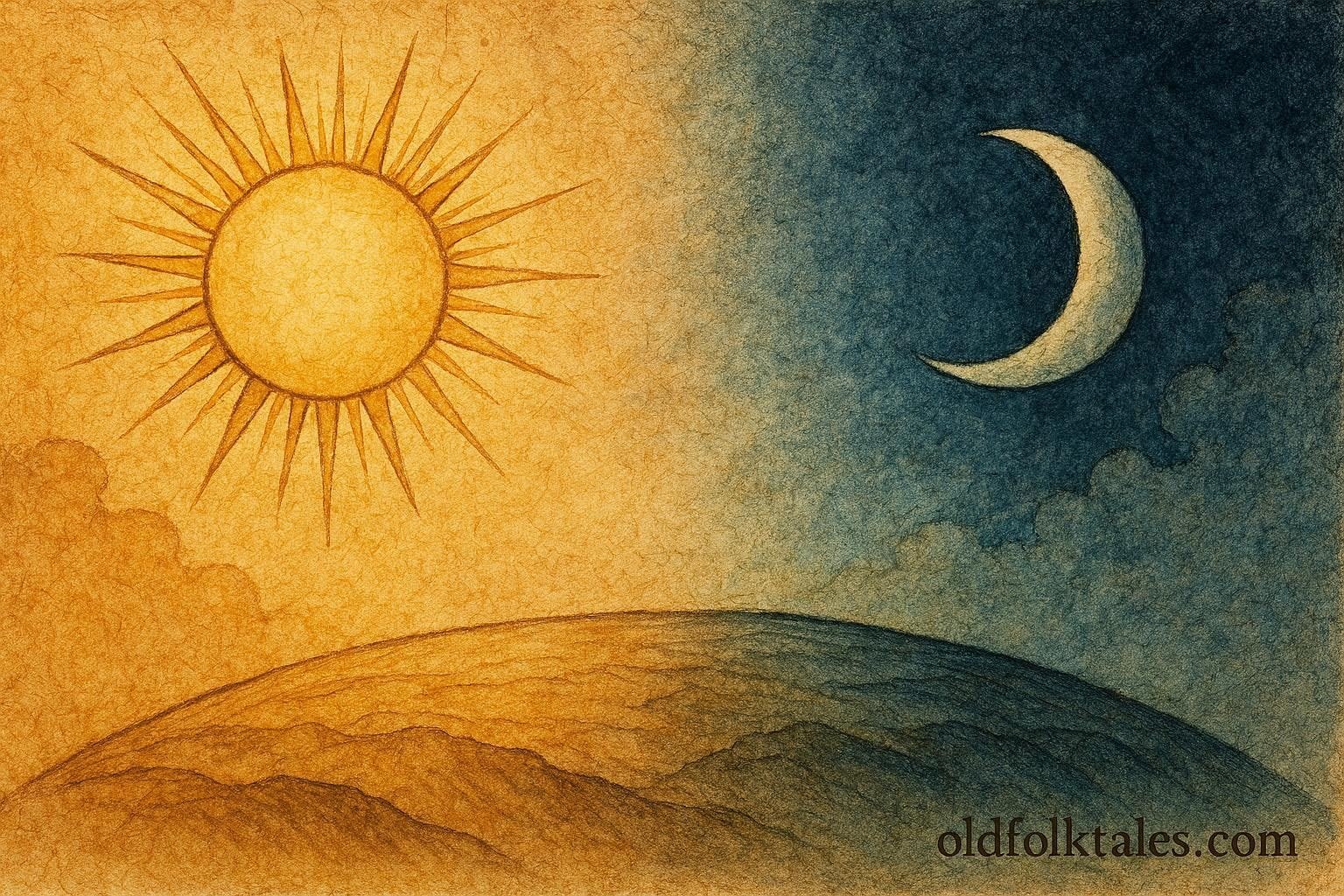
Long ago, before the sky was divided into day and night, before the rhythm of light and darkness guided the world, the Sun and the Moon lived in close companionship.
They were rarely apart.
Continue your journey: Read more East African folktales
Where one went, the other followed.
Where one shone, the other glowed beside it.
Together, they filled the sky with constant light, sometimes bright and warm, sometimes soft and gentle—but never absent.
Below them, the world existed in a single, unbroken glow.
There was no true night.
No time for deep rest.
No clear beginning or end to the day.
At first, the people and the creatures of the earth did not question it.
It was simply how things were.
But over time, the constant presence of light began to weigh on the world.
The land grew tired.
The animals restless.
The people weary.
There was no pause.
No stillness.
No balance.
Above, however, the Sun and the Moon remained as they had always been, close, inseparable, and certain of their unity.
The Sun was strong and radiant, his light bold and far-reaching. His presence warmed the earth and stirred life into motion.
The Moon was calm and reflective, her light softer, her presence quieter. She brought a gentleness that eased what the Sun stirred.
They complemented one another.
Or so it seemed.
As time passed, small differences began to grow.
The Sun moved with certainty, always forward, always bright.
The Moon moved with thought, often slowing, observing, shifting her light.
At first, these differences were unnoticed.
Then, they became points of tension.
“One must lead,” the Sun said one day. “And I am made for it.”
The Moon looked at him.
“Light does not need to lead,” she replied. “It needs to balance.”
The Sun’s brightness intensified slightly.
“Without me,” he said, “there would be no life below.”
The Moon’s glow remained steady.
“And without rest,” she answered, “there would be no life to sustain.”
The words lingered.
Not sharp.
But firm.
Still, they continued together.
But now, their unity was no longer effortless.
It required adjustment.
And sometimes, restraint.
One day, as they crossed the sky, the Sun moved ahead, faster than before.
The Moon followed, but at her own pace.
“Stay with me,” the Sun called.
“I move as I must,” the Moon replied.
The distance between them grew.
Not far at first.
But enough to be felt.
Below, the world noticed something new.
Shadows.
For the first time, the light shifted in a way that created contrast, moments where brightness softened, where shapes became defined.
The people looked up.
Something had changed.
The Sun turned back.
“You fall behind,” he said.
The Moon met his gaze.
“Or you move too quickly.”
The air between them tightened.
“If we are to remain together,” the Sun said, “you must follow my path.”
The Moon’s light dimmed slightly, not in weakness, but in thought.
“And if we are to remain together,” she said, “you must allow space.”
The words settled heavily.
For the first time, they stood not as one, but as two.
Below, the world shifted again.
The moments of softer light grew longer.
The brightness no longer constant.
The Sun moved forward once more.
The Moon slowed.
This time, neither adjusted.
The distance between them widened.
Where the Sun shone, the world was bright and active.
Where the Moon followed, the light was gentle, and the world began to quiet.
The people felt it.
The animals responded.
The land itself seemed to breathe.
But above, the separation continued.
“You choose to leave,” the Sun called across the growing space.
“I choose to be as I am,” the Moon replied.
The words were not angry.
But they were final.
From that moment, they no longer traveled side by side.
The Sun took his place in the sky, rising strong and steady, bringing day with his presence.
The Moon followed in her time, rising when the Sun had gone, bringing night with her calm light.
They did not disappear from one another entirely.
There were moments, rare and brief, when they came close again, crossing paths in the sky.
But they did not remain together.
The world below found its rhythm.
Day for work.
Night for rest.
Light for growth.
Darkness for renewal.
What had once been constant became balanced.
And though the Sun and the Moon no longer shared the sky as they once did, their separation brought harmony where there had been none.
So, when people look up and see the Sun alone in the day, and the Moon alone at night, they remember:
That even the closest companions may need space.
That difference does not always mean conflict, but when it is not understood, it can lead to separation.
And that sometimes, it is through distance that balance is found.
Click here to explore more Central African folktales
Moral Lesson
This folktale teaches that harmony does not always come from staying together, but from understanding and respecting differences. Separation, when necessary, can create balance and bring order to the world.
Knowledge Check
- Why did the Sun and Moon originally stay together?
They were close companions and naturally complemented each other in the sky. - What caused the conflict between the Sun and the Moon?
Their differences in nature, one bold and constant, the other gentle and reflective, led to disagreement. - How did their separation affect the world?
It created the cycle of day and night, bringing balance and rest to the earth. - Why does the Moon appear at night instead of day?
She chose to move separately from the Sun after their disagreement. - Do the Sun and Moon ever meet again?
Yes, but only briefly, symbolizing their past connection. - What is the main lesson of this Annobonese folktale?
It teaches that balance can come from respecting differences, even if it means separation.
Source: Annobonese oral tradition recorded in Myths and Legends of Small African Islands (1991)
Cultural Origin: Annobonese people, Annobón Island, Equatorial Guinea