In the highlands and plains of Ethiopia, where animals moved across open land and shared water, shade, and space, there was a time when disputes were settled not by force, but by judgment.
When conflict arose, the animals would gather and bring their case before the lion.
Fascinated by this tale? Discover more North African folktales
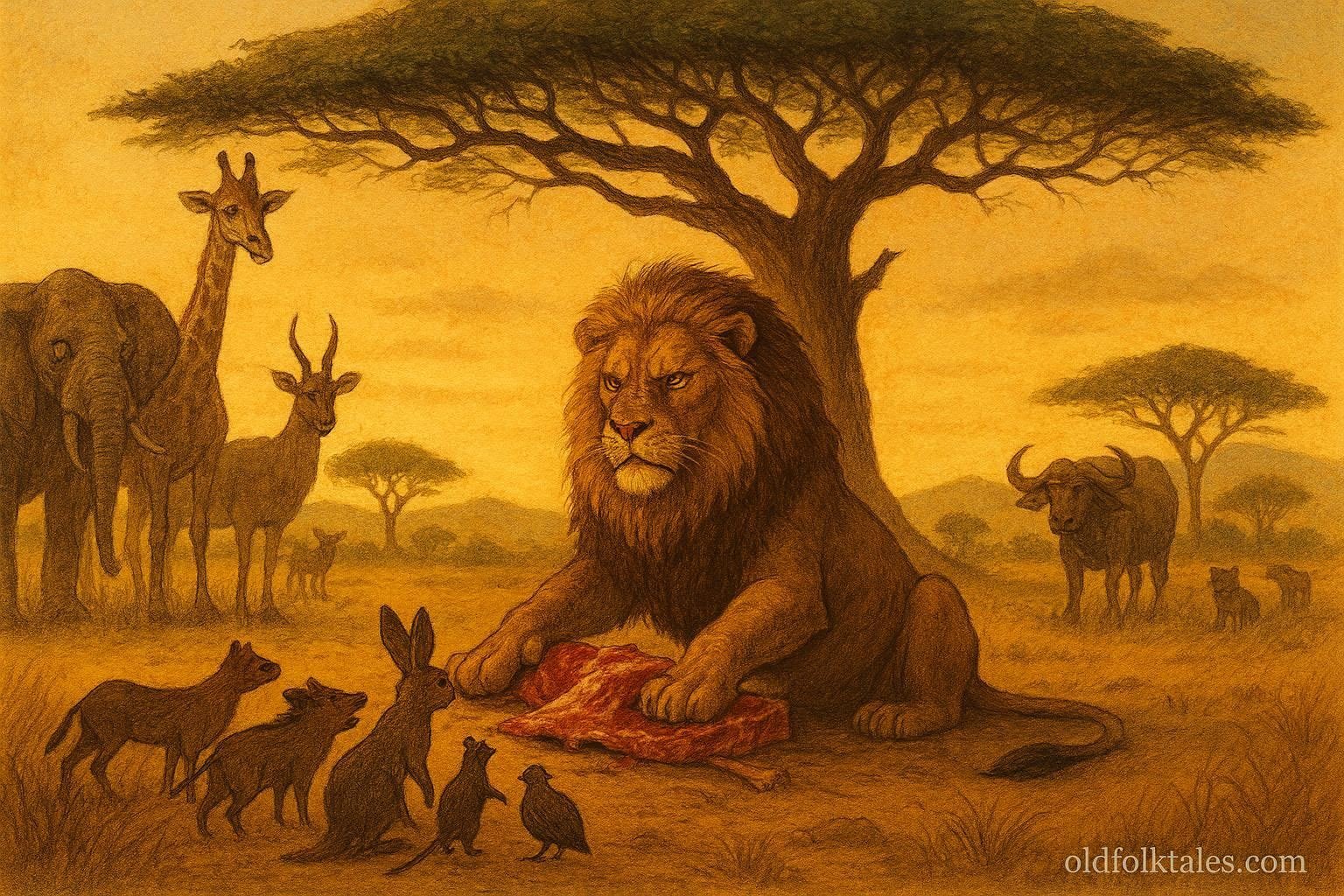
He was known as the king of beasts, and with that title came authority. His strength was unquestioned, his presence commanding. When he sat beneath the wide branches of an acacia tree, even the wind seemed to quiet itself.
And so, when disagreements grew too large to ignore, the animals turned to him.
“He is strong,” they would say. “He sees clearly. He will decide what is fair.”
At least, that is what they believed.
One season, during a time when food was scarce and the land grew dry, a dispute arose between two animals over a piece of meat.
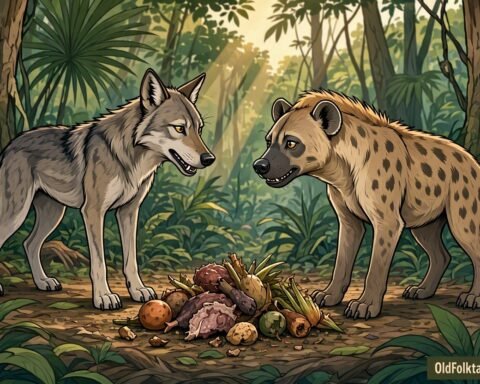
It had been found near a watering place, half-hidden, not claimed by any one creature. A jackal insisted he had discovered it first. A hyena argued that he had chased away others and secured it.
Their voices rose, each refusing to yield.
“Let the lion decide,” one said.
“Yes,” the other agreed. “He will judge what is right.”
Word spread quickly, and soon a gathering formed beneath the acacia tree. Animals of all kinds came, not only to witness the case, but to see how the lion would rule.
The lion arrived last.
He moved slowly, deliberately, his golden mane catching the light. When he sat, his gaze swept across the crowd, settling the noise into silence.
“Speak,” he commanded.
The jackal stepped forward first.
“I found the meat,” he said. “It was hidden, but I uncovered it. By right, it is mine.”
The hyena followed.
“I defended it,” he argued. “Others would have taken it, but I drove them away. Without me, there would be nothing left. It belongs to me.”
The lion listened without interruption.
When both had finished, he lowered his head slightly, as though in deep thought.
“The matter is clear,” he said at last.
The animals leaned in, waiting.
“The meat must be divided fairly.”
A murmur of approval moved through the crowd.
“Yes,” some said. “That is just.”
The lion stood and approached the meat. He examined it closely, then began to divide it.
“This portion,” he said, separating a large piece, “is for me, as the judge. It is the price of my wisdom.”
The animals exchanged glances, uncertain but silent.
The lion continued.
“This portion is for my strength, which maintains order among you.”
He set aside another large piece.
“And this portion is for my authority, which allows me to decide such matters.”
Another piece was claimed.
By the time he was finished, very little remained.
He turned to the jackal and the hyena.
“You may share what is left,” he said.
The two animals looked at the small scraps before them, their earlier confidence gone.
But neither spoke.
To challenge the lion was to risk more than loss, it was to risk everything.
So they bowed their heads and accepted what they were given.
The lion returned to his place, satisfied.
“This is justice,” he declared.
The animals did not argue.
But something had shifted.
The decision, though spoken with authority, did not feel right. The balance they had expected was not there. The fairness they had trusted seemed… distant.
Still, they said nothing.
Time passed.
And more disputes came.
Each time, the animals gathered. Each time, the lion listened. And each time, he ruled in a way that left him with the greatest share.
“If two fight over water,” he would say, “I must take the largest portion to ensure peace.”
“If three argue over shade,” he would declare, “I must claim the best place to prevent further conflict.”
His words always sounded reasonable.
But his actions told another story.
The animals began to notice.
“He takes more each time,” one whispered.
“It is always for himself,” another replied.
“But he is the judge,” a third said cautiously. “Who are we to question him?”
The fear of his power kept them silent.
But silence does not erase truth.
Among the smaller animals, the ones who felt the weight of each unfair decision most deeply, there grew a quiet understanding.
“This is not justice,” one said.
“It is control,” another answered.
They began to speak among themselves, away from the lion’s hearing.
“If we continue like this, we will have nothing left,” said a small antelope.
“If we speak alone, we will be ignored,” said a hare.
“Then we must not speak alone,” came a quiet voice from among them.
The idea spread slowly, carefully.
Unity.
Not loud, not forceful, but steady.
The next time a dispute arose, the animals gathered once more beneath the acacia tree. The lion arrived as before, confident, assured.
“Bring your case,” he said.
Two animals stepped forward, presenting their disagreement. The lion listened, then rose to give his judgment.
“The matter is simple,” he began. “I will divide,”
“Wait.”
The word came from the crowd.
The lion paused.
It was not a loud interruption, but it was enough.
He turned his gaze toward the source.
A small animal stepped forward.
“You are our judge,” it said. “But justice must serve all, not one.”
A murmur moved through the gathering.
The lion’s eyes narrowed slightly.
“You question my judgment?” he asked.
The small animal did not step back.
“We question the outcome,” it replied.
More voices joined.
“You take more than your share.”
“You call it fairness, but it leaves us with little.”
“This is not balance.”
The lion looked around.
The voices were no longer isolated. They came from many, from small animals, from cautious ones, even from some who had once remained silent.
For the first time, the lion faced not individuals, but a collective.
“You forget who I am,” he said, his voice deepening.
“We remember,” one answered. “But power does not make something right.”
The air grew still.
The lion stood, his presence heavy, his strength undeniable.
But something had changed.
The animals did not scatter.
They did not lower their heads.
They stood together.
The moment stretched.
Then, slowly, the lion’s posture shifted.
He saw what had not been there before, not fear, not submission, but unity.
And unity changes the balance of power.
“You would judge yourselves?” he asked.
“We would seek fairness,” they replied.
The lion looked at the gathering, measuring what stood before him.
At last, he stepped back.
“Then speak,” he said.
The animals did not rush.
They discussed, they listened, they considered each side carefully. The decision that followed was simple, balanced, and shared.
The meat was divided evenly.
No one took more than they needed.
The lion watched.
He did not intervene.
From that day forward, justice was no longer the voice of one, but the responsibility of many. The lion remained strong, but his role changed, not as the sole judge, but as part of a greater understanding.
And the animals remembered what they had learned.
That power without accountability leads to imbalance.
And that when voices rise together, even the strongest must listen.
Continue your journey: Read more East African folktales
Moral Lesson
Justice must be fair and shared. When power is unchecked, it becomes self-serving, but unity can restore balance and truth.
Knowledge Check
- Why did the animals go to the lion for justice in the folktale?
They believed the lion, as the king of beasts, would judge fairly and resolve disputes. - How did the lion misuse his power?
He manipulated decisions to take the largest share for himself under the guise of fairness. - What made the animals realize the lion was unjust?
They noticed a pattern where his judgments always benefited him the most. - How did the smaller animals challenge the lion’s authority?
They united and spoke together, questioning his decisions collectively. - What changed after the animals stood together?
Justice became a shared process, and decisions were made more fairly. - What is the main theme of “The Lion’s Share of Justice”?
The story highlights the dangers of unchecked power and the strength of unity in restoring fairness.
Source: Based on Ethiopian adaptations of traditional animal court tales found in “The Lion’s Whisker and Other Ethiopian Tales” by Harold Courlander and Wolf Leslau (1950).
Cultural Origin: Pan-Ethiopian animal folklore traditions