The forest was vast and alive, filled with creatures that each understood their place in the balance of nature. Among them lived the porcupines, quiet animals known for their sharp quills and cautious movements. They were not aggressive by nature, but they carried a silent confidence, believing that no creature in the forest could challenge them.
Not far from where the porcupines lived, deep within the earth, existed the war ants.
They were small, almost unnoticeable when seen alone, but together they formed a force that few could withstand. They moved in long, organized lines, disciplined and relentless. Wherever they passed, they left nothing behind.
For a long time, the porcupines and the war ants lived without conflict.
Their paths rarely crossed, and when they did, neither paid much attention to the other. The porcupines relied on their quills for protection, while the ants relied on their unity and strength in numbers.
One day, everything changed.
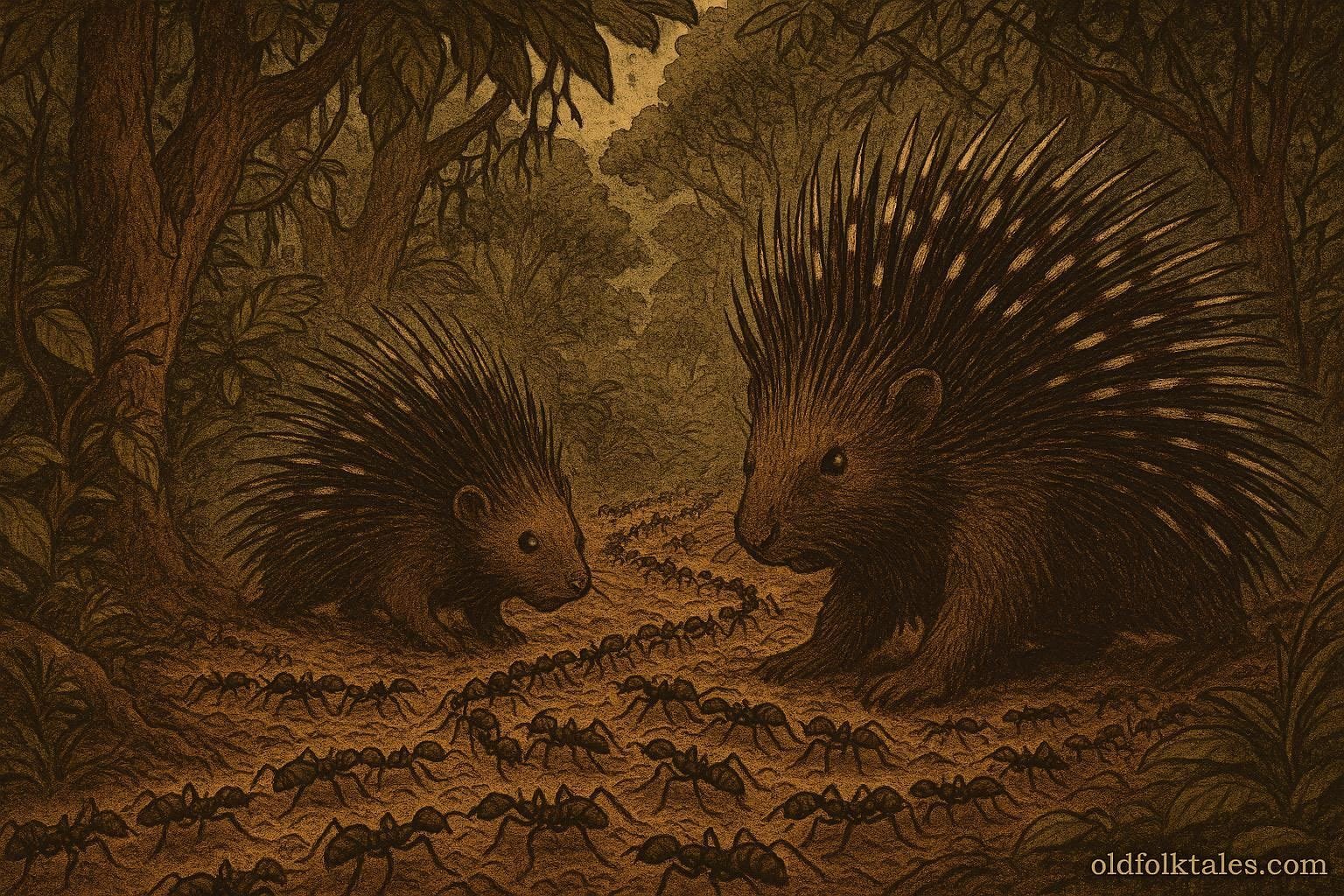
A young porcupine, curious and careless, wandered farther than usual in search of food. As it moved through the forest floor, it came across a line of marching war ants. Without thinking, it stepped directly into their path, scattering them and crushing many beneath its weight.
Want more? Read more West African folktales now
The ants reacted immediately.
They swarmed over the porcupine’s legs, biting and stinging. The young porcupine cried out in pain and ran back toward its home, shaking off as many ants as it could. Though it escaped, the damage had been done.
The war ants did not forget.
To them, the destruction of their marching line was not a small matter. It was an attack. And in their world, attacks demanded response.
That evening, the ants gathered.
They moved in greater numbers than ever before, forming a dark, shifting mass along the forest floor. Their leaders communicated through movement and instinct, organizing a response that would not be easily stopped.
They would march.
And this time, their destination was the home of the porcupines.
The forest seemed to sense what was coming. Small animals moved away from the ants’ path. Birds lifted into the air. Even the wind felt still, as though waiting to see what would happen.
The porcupines, unaware at first, continued their routines.
But as the ants approached, signs began to appear. The ground seemed to darken. A faint rustling sound grew louder. Those who looked closely could see the advancing line, stretching farther than the eye could follow.
Panic spread among the porcupines.
They had never faced an enemy like this. Their quills, which had always protected them, suddenly felt useless against creatures so small and so many.
Some suggested fleeing.
Others argued that they should stand their ground. They believed their strength and size would be enough to stop the ants.
But the ants did not slow down.
When they reached the porcupines’ territory, they spread out, surrounding the area with precision. Then they attacked.
The porcupines fought back as best they could. They shook their bodies, trying to dislodge the ants. They rolled on the ground, hoping to crush them. But for every ant that fell, many more took its place.
The bites were relentless.
The pain grew unbearable.
One by one, the porcupines began to retreat. Those who tried to stand and fight quickly realized that this was not a battle they could win through strength alone.
The forest echoed with movement and struggle.
The ants continued their advance, consuming everything in their path. They did not act out of anger as larger animals might. They acted with purpose, carrying out what they saw as necessary.
Eventually, the porcupines were forced to abandon their home.
They scattered into different parts of the forest, seeking safety wherever they could find it. The place they had once lived, a place they believed was secure, was no longer theirs.
When the ants finally stopped, they returned to their underground world.
The conflict had ended.
But its effects remained.
The porcupines, now displaced, began to reflect on what had happened. The young porcupine who had caused the initial disturbance felt the weight of responsibility. What had seemed like a small, careless act had led to the destruction of their home.
The elders spoke.
They did not speak with anger, but with understanding. They explained that in the forest, no action was truly small. Every movement, every choice, carried consequences that could grow beyond expectation.
The porcupines learned.
They became more careful, more aware of their surroundings. They understood that strength alone was not enough to protect them. Respect for others, no matter how small, was just as important.
As for the war ants, they continued their lives as they always had.
They marched, they built, and they responded to the world in the only way they knew.
The forest returned to its balance, but the story of the conflict remained.
It was told among the animals, passed from one generation to the next, as a reminder that even the smallest actions can lead to the greatest consequences.
If you liked this story, see our Central African folktales collection
Moral Lesson
Never underestimate the power of the small, and always consider the consequences of your actions.
Knowledge Check
- What caused the conflict between the porcupines and the war ants?
A young porcupine disrupted and crushed a line of marching ants - Why did the ants respond so strongly?
They saw the act as an attack that required retaliation - Could the porcupines defend themselves successfully?
No, their strength was not enough against the ants - What happened to the porcupines’ home?
They were forced to abandon it - What lesson did the porcupines learn?
That even small actions can have serious consequences - What is the main message of the story?
Respect others and never underestimate small forces
Source
Central African folktale. Adapted from African Tales: Folklore of the Central African Republic by Polly Strong (1992).