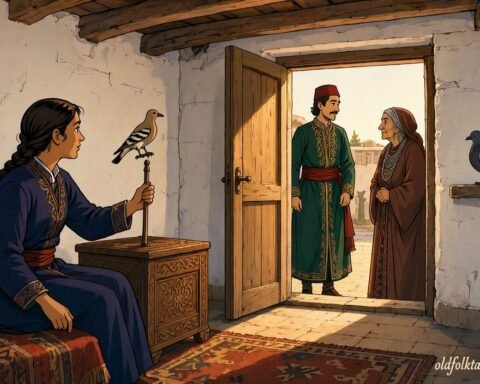
A young woman once lived in a small highland village, where the wind moved gently through the grass and the days followed a quiet rhythm. Her life had not always been difficult, but everything changed when her father remarried.
The woman who entered their home as her stepmother was not kind.
From the very beginning, there was tension between them. The stepmother spoke harshly, gave difficult tasks, and showed little warmth. No matter how hard the young woman tried to please her, nothing seemed enough. Every effort was met with criticism, and every mistake, no matter how small, was magnified.
Over time, the house became a place of discomfort.
The young woman began to feel isolated and confused. She did not understand why she was treated this way, and she struggled to find peace in her own home. Even her father seemed unaware of the depth of the conflict, believing that everything was normal.
Want more? Read more West African folktales now
One day, after a particularly difficult encounter, the young woman decided she could no longer endure the situation without seeking help.
She left the village and walked for a long distance until she reached the home of a wise elder. This elder was known for understanding matters of the heart and mind, and people often came to seek guidance.
When the young woman arrived, she explained everything.
She spoke about the tension in her home, the harsh words, and the feeling of never being accepted. Her voice carried both frustration and sadness as she asked the elder what she could do to change the situation.
The elder listened carefully.
He did not interrupt her, and he did not rush to respond. After a moment of silence, he gave her an answer that surprised her.
“If you want your stepmother’s heart to change,” he said, “you must bring me a whisker from a living lion.”
The young woman stared at him in disbelief.
A lion was not a creature one approached lightly. It was powerful, dangerous, and unpredictable. The idea of taking something from such a creature seemed impossible.
But the elder did not change his words.
He simply nodded and told her that this was the path she must take if she truly wanted to resolve her problem.
The young woman left with uncertainty, but also with determination.
She knew the task was dangerous, yet she also knew that she could not return to her old life without trying. So she set out toward the wilderness where lions were known to roam.
The first time she saw the lion, she kept her distance.
Her heart raced as she watched it move through the tall grass. She had brought a small piece of meat with her, and with trembling hands, she placed it on the ground before quickly retreating.
The lion approached slowly.
It sniffed the air, examined the offering, and then took the meat. The young woman watched from afar, her fear mixed with cautious hope.
She did not try to get closer that day.
Instead, she returned home, knowing that patience would be necessary.
The next day, she returned again.
She brought another piece of meat and placed it slightly closer to where the lion usually appeared. Again, she stepped back and waited. The lion came, ate, and left.
Days turned into weeks.
Each time, the young woman moved a little closer. Her fear did not disappear, but it changed. It became something she could manage, something she could face step by step.
The lion also changed.
It began to recognize her presence. It no longer approached with the same caution. Over time, it accepted her as a familiar figure, not a threat.
Eventually, the young woman was able to stand only a short distance away.
Her movements were calm, her breathing steady. She no longer rushed or acted out of fear. She had learned to observe, to wait, and to understand the rhythm of the lion’s behavior.
Then one day, the moment came.
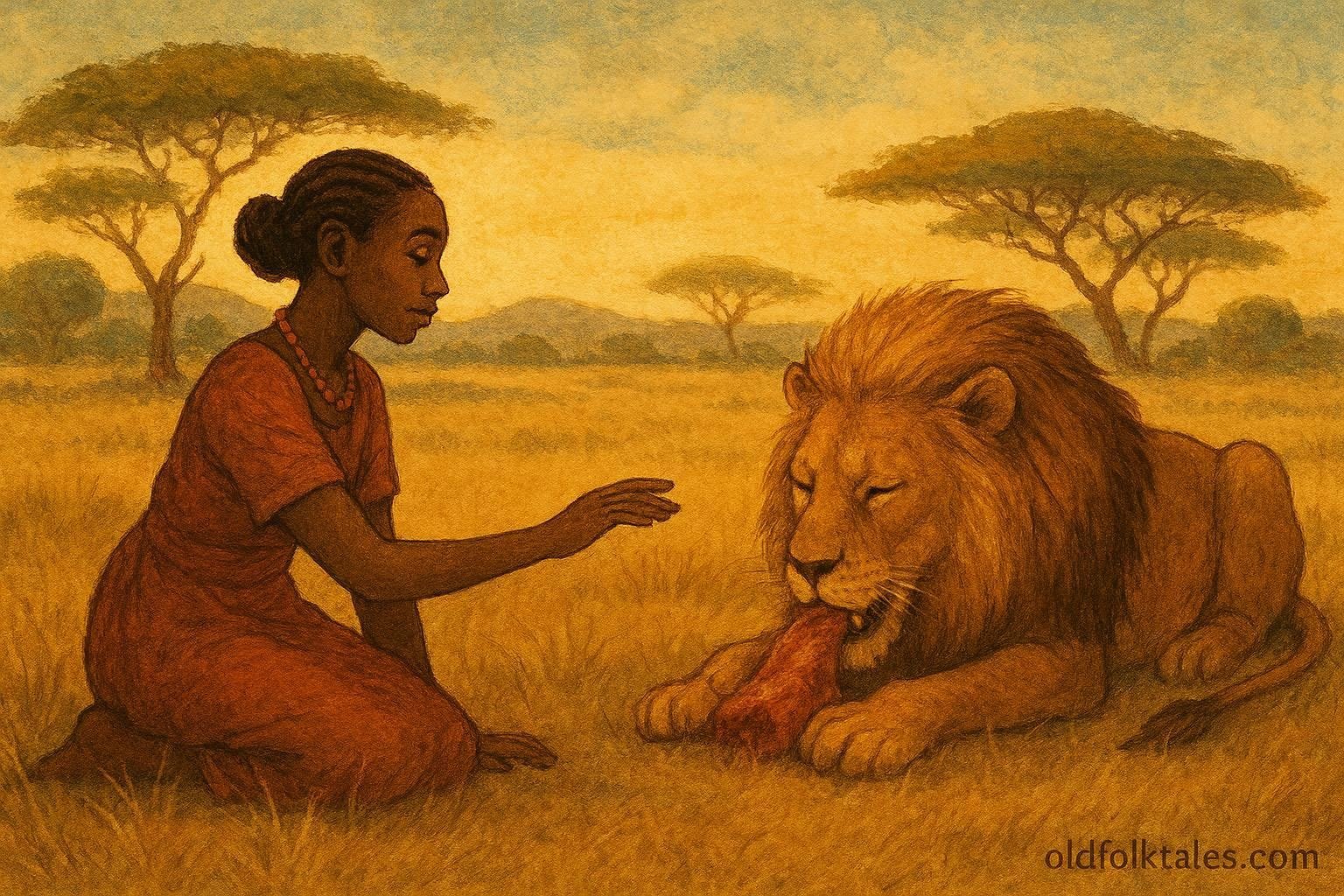
As the lion ate the food she had brought, she slowly reached out her hand. Her heart pounded, but she did not pull back. With great care, she touched the lion’s mane.
The lion did not react with anger.
It remained calm, accepting her presence. Encouraged, the young woman gently pulled a single whisker.
She stepped back immediately, holding the whisker tightly in her hand.
The lion lifted its head, but it did not chase her. Instead, it simply watched as she slowly retreated.
The task was complete.
With relief and excitement, the young woman returned to the wise elder. She presented the whisker, expecting to receive a solution that would change her situation at home.
But the elder smiled and took the whisker from her.
Then, without hesitation, he threw it into the fire.
The young woman gasped.
All her effort, all the danger she had faced, seemed wasted in that single moment. She looked at the elder, confused and frustrated.
“Why did you do that?” she asked.
The elder looked at her calmly.
“You have already learned what you needed,” he said.
The young woman did not understand.
The elder continued, explaining that approaching the lion had required patience, consistency, and understanding. She had not forced the lion to trust her. She had earned that trust over time.
“If you can approach a lion in this way,” the elder said, “then you can approach your stepmother in the same way.”
The young woman stood in silence.
Slowly, the meaning became clear. The task had never been about the lion itself. It had been about learning how to deal with something difficult without anger or fear.
She returned home with a new perspective.
Instead of reacting to her stepmother’s harshness, she began to respond differently. She showed patience, spoke calmly, and avoided unnecessary conflict. She observed, just as she had with the lion, and chose her actions carefully.
At first, nothing seemed to change.
But over time, small differences appeared. The stepmother’s tone softened slightly. The tension in the house began to ease. Gradually, the relationship improved.
It was not instant.
But just like with the lion, trust and understanding grew step by step.
In the end, the young woman found peace in her home, not because she had forced change, but because she had learned how to create it.
Looking for more? Explore the magic of East African folktales here
Moral Lesson
Patience, understanding, and consistency can solve even the most difficult human conflicts.
Knowledge Check
- Why did the young woman visit the elder?
She wanted help dealing with her stepmother - What task did the elder give her?
To bring a whisker from a living lion - How did she approach the lion?
Slowly and patiently over many days - Did she succeed in getting the whisker?
Yes, she carefully took one from the lion - What did the elder do with the whisker?
He threw it into the fire - What lesson did she learn?
Patience and understanding can resolve conflict
Source
Ethiopian folktale. Adapted from collections by Elizabeth Laird (1997–2001).