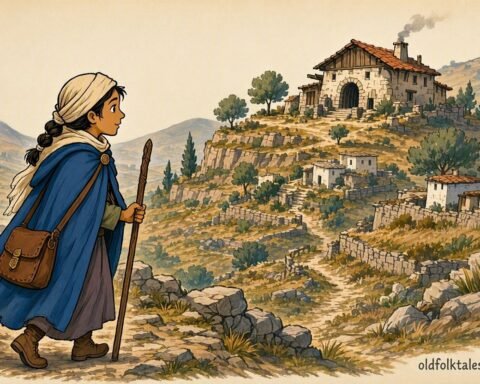
In the highlands of Eritrea, where the mountains rise in long, patient ridges and the wind moves like a living presence through valleys and villages, there once lived a boy who kept mostly to himself.
He was not known for strength or boldness. He did not lead games or call out loudly among other children. While others gathered in groups, laughing and sharing stories, he often sat apart, watching, listening, and feeling the quiet spaces between things.
If you enjoyed this story, explore our full West African folktales collection
Some said he was shy. Others said he was strange.
But the truth was simpler.
He listened to things others did not.
Each day, the boy wandered beyond the edges of his village, climbing gentle slopes and resting on rocks warmed by the sun. From there, he would look out across the land, at distant villages tucked between hills, at narrow paths that wound like threads through the earth, at trees that leaned and swayed under the touch of the wind.
And always, there was the wind.
It moved constantly, never still, brushing past his face, tugging lightly at his clothes, whispering through grass and branches. Where others heard only sound, the boy sensed something more, something like a voice that almost formed, then faded.
At first, he said nothing about it.
But over time, his curiosity grew.
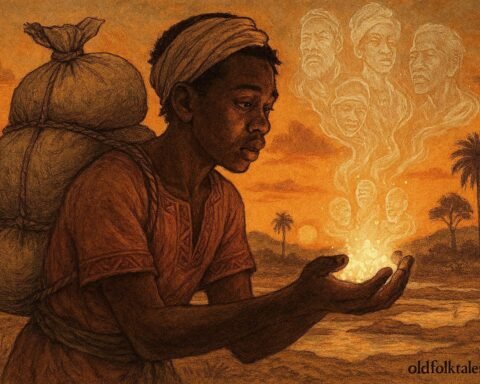
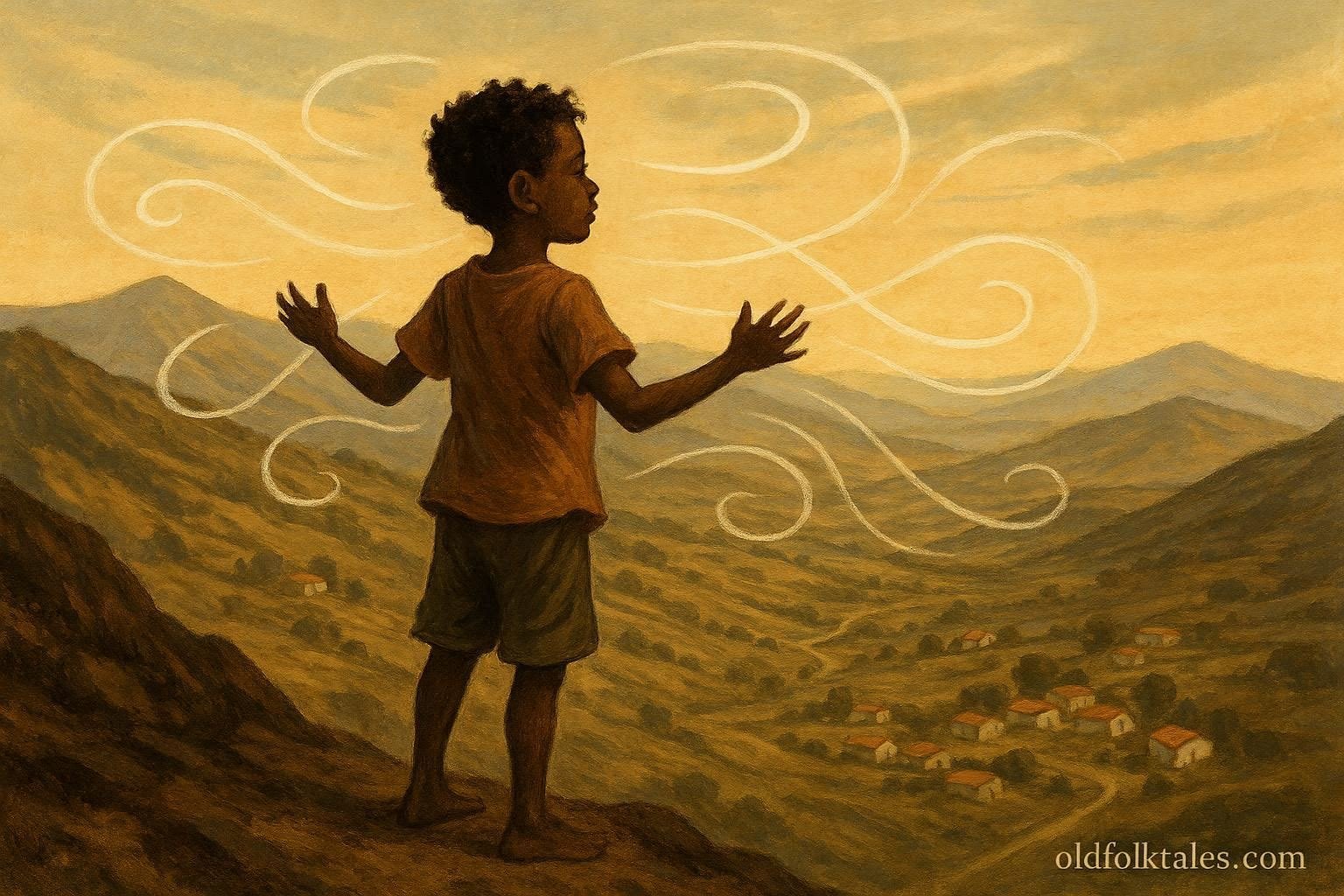
One afternoon, as the sky stretched wide and clear above him, the boy sat on his usual rock and closed his eyes. The wind passed over him in soft waves, rising and falling like breath.
He leaned forward slightly and spoke.
“Where do you go?” he asked quietly.
The wind answered.
Not in words shaped like human speech, but in a pattern, a rhythm, a feeling that settled clearly in his mind.
Everywhere.
The boy’s eyes opened slowly.
He did not move. He did not question whether he had imagined it.
Instead, he listened.
“Do you see the other villages?” he asked.
The wind brushed past him again, stronger this time, carrying the scent of distant earth and trees.
I pass them all.
The boy’s heart stirred.
From that day forward, he returned again and again to that place, speaking softly, listening carefully. With patience, he began to understand the wind, not as a voice that spoke like a person, but as something that carried meaning through movement, sound, and presence.
He learned that the wind did not belong to one place. It moved freely, crossing boundaries without hesitation. It touched every village, every field, every path.
It connected everything.
“Can you carry words?” the boy asked one day.
The wind circled around him, lifting small bits of dust into the air before letting them fall.
I carry what is given.
The boy thought for a long moment.
Then he spoke, slowly and clearly.
“Tell the village beyond the hill that the rains will come soon.”
The wind moved, rising and flowing away from him, disappearing over the ridge.
The boy waited.
Days passed.
Then, one afternoon, a traveler arrived in his village. As people gathered to greet him, he spoke of the neighboring village beyond the hill.
“They prepared early for the rains,” the traveler said. “They said a message came to them on the wind.”
The boy said nothing.
But something inside him shifted.
His gift was real.
From then on, the boy began to speak to the wind with greater purpose. He carried simple messages, warnings about weather, greetings between distant families, reminders of shared traditions.
At first, no one knew where these messages came from. Villagers simply accepted them, as they often did with things they could not fully explain.
But gradually, patterns began to emerge.
Messages arrived when they were needed most. They were clear, timely, and often brought a sense of connection between places that rarely spoke to one another directly.
Still, the boy remained quiet about his role.
He did not seek attention. He did not claim credit. For him, it was enough to listen and to help.
But the peace between the villages did not last forever.
Over time, a disagreement began to grow between two neighboring communities. It started with something small, something about land, or water, or boundaries, but like many such disagreements, it deepened quickly.
Words were exchanged, but not understood. Assumptions replaced listening. Each side began to believe that the other had acted with intention to harm.
The paths between the villages grew quiet.
Where there had once been shared gatherings and open movement, there was now distance.
The wind still passed between them.
But it carried tension.
The boy felt it.
One evening, as he sat on his rock, the wind moved differently, uneven, unsettled, as though burdened.
“They are no longer listening,” the boy said softly.
The wind circled around him, restless.
They speak, but they do not hear.
The boy lowered his gaze.
He understood that feeling.
He had known what it meant to be unheard.
“Can they be brought together again?” he asked.
The wind paused, then moved gently.
If they choose to listen.
The boy took a deep breath.
Then he made a decision.
The next day, he climbed higher than he ever had before, reaching a ridge that stood between the two villages. From there, he could see both sides, the fields, the homes, the paths that once connected them.
He stood still and waited for the wind.
When it came, he spoke with clarity and care.
“To the village of the east,” he said, “hear this: the west does not wish you harm. They guard what they believe is theirs, as you do.”
The wind lifted, carrying his words.
Then he turned.
“To the village of the west,” he said, “hear this: the east does not seek to take from you. They protect what they need, just as you do.”
Again, the wind moved.
The boy did not stop.
He spoke of shared harvests from years before. Of times when families had crossed between villages without fear. Of the ways both sides depended on the same land, the same rains, the same sky.
Each message was carried, shaped by the wind, delivered not as accusation, but as understanding.
Days passed.
At first, nothing changed.
The tension remained.
But something had begun.
In small ways, people started to pause before speaking. They began to question their assumptions. Some remembered the messages that had come, not harsh, not blaming, but steady and thoughtful.
“They sound like truth,” one elder said quietly.
“They sound like us,” another replied.
Gradually, the voices of anger softened.
The wind continued to carry the boy’s words, but now, it also carried something else, responses.
Not direct, not spoken aloud to him, but present in the way the villages began to act.
A path was cleared between them.
A meeting was suggested.
When the day came, people from both villages gathered at the space between their lands. They did not arrive with certainty. They did not arrive without doubt.
But they arrived willing to listen.
The boy watched from a distance.
He did not step forward. He did not reveal himself.
This was not his place.
His role had been to open the path.
The rest belonged to them.
As the two sides spoke, the wind moved gently among them, not restless now, but calm, steady.
Words were shared. Misunderstandings were uncovered. Apologies, though not easy, were given.
And slowly, the divide began to close.
By the time the sun lowered in the sky, the villages had agreed, not on everything, but on enough to move forward together.
Peace, once fragile, began to take root again.
That evening, the boy returned to his rock.
The wind came as it always did, soft and present.
“You carried more than words,” he said quietly.
The wind moved around him, warm and light.
You listened.
The boy smiled faintly.
He understood now.
It was not just the speaking that mattered.
It was the listening.
From that day forward, the boy continued to speak to the wind, but he also listened more deeply than ever before. And though many never knew the source of the messages that helped restore their unity, they felt their impact.
The villages remained connected, not just by paths and land, but by a renewed understanding of one another.
And the wind continued to move across the highlands, carrying with it the quiet reminder that no distance is too great when people are willing to listen.
Don’t stop yet! See our complete East African folktales collection
Moral Lesson
True communication requires both speaking and listening. When understanding replaces assumption, unity can grow even in times of conflict.
Knowledge Check
- What special ability did the boy have in this Eritrean folktale?
He could communicate with the wind and send messages across villages. - How did the boy use the wind to help others?
He used it to deliver messages, warnings, and eventually to resolve conflict between communities. - What caused the conflict between the villages?
Misunderstanding, lack of communication, and assumptions about each other’s intentions. - How did the boy restore peace between the villages?
He sent balanced, thoughtful messages through the wind that encouraged understanding and dialogue. - What role does nature play in the story?
Nature, through the wind, acts as a bridge connecting people and carrying truth between them. - What is the main theme of “The Boy Who Spoke to the Wind”?
The power of communication and listening in creating unity and resolving conflict.
Source: African folktale, Eritrea. Preserved through oral storytelling and recorded in regional folklore studies (1970s–1990s collections).
Cultural Origin: Highland Eritrean (Tigrinya-speaking) oral tradition, Eritrea