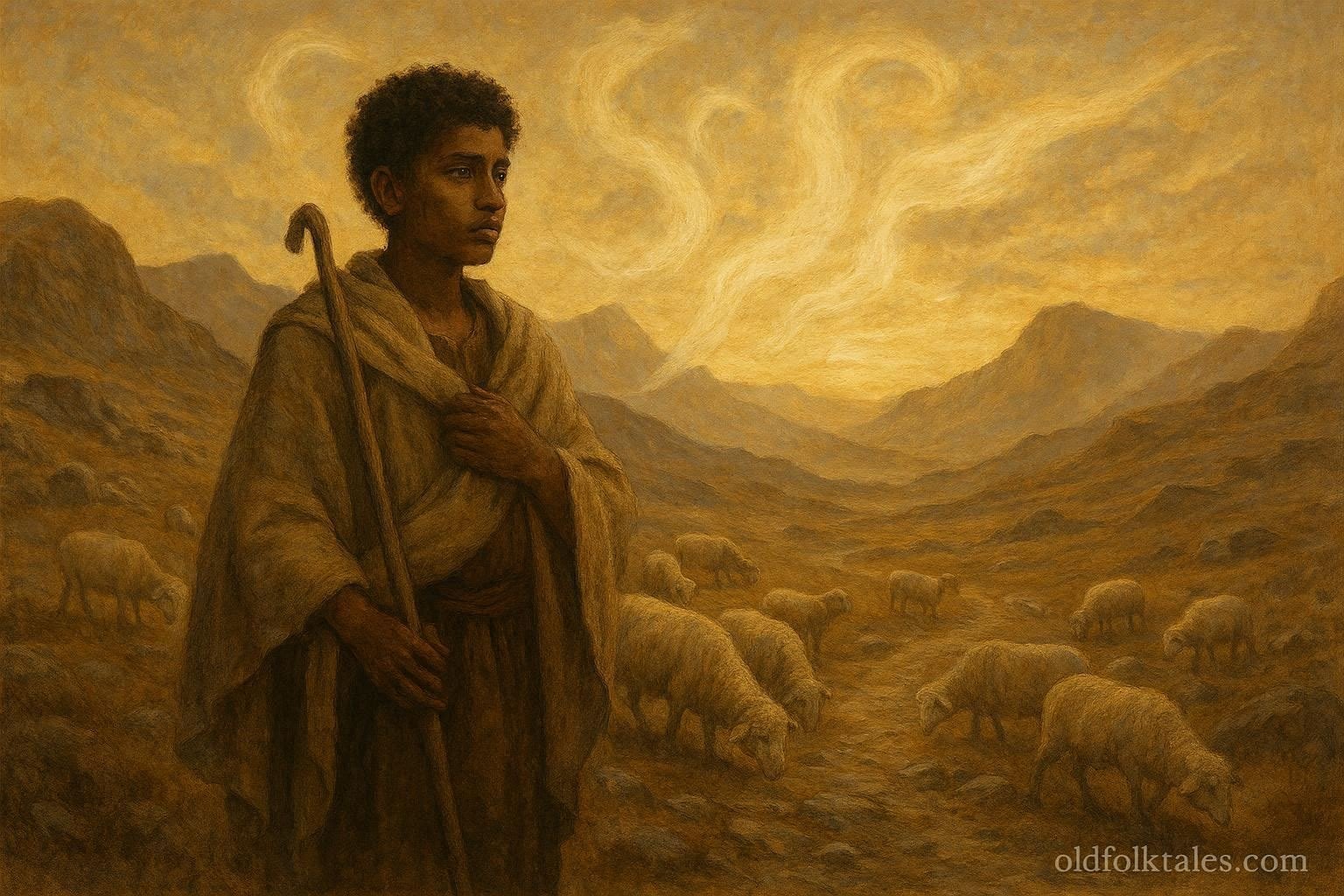
In the highlands of Eritrea, where the mountains rise like ancient guardians and the wind carries whispers older than memory, there lived a young shepherd. His days were simple, marked by the steady rhythm of tending sheep, walking familiar paths, and listening to the quiet language of the land.
He knew the hills well, or at least he believed he did.
Want to dive deeper? Read more North African folktales today
Each morning, he led his flock up the slopes, where the grass grew greener and the air felt lighter. The mountains stretched endlessly, layered in soft blues and browns, their peaks sometimes hidden behind drifting clouds. The shepherd walked with confidence, his staff in hand, his voice occasionally rising in song as the sheep grazed peacefully.
But the mountains, as the elders often said, were not just land. They were alive with memory.
One afternoon, as the sun climbed high and shadows shortened, the shepherd noticed that one of his sheep had wandered farther than the rest. It moved toward a narrow path that curved around a rocky ridge, a path the shepherd had never taken before.
Without much thought, he followed.
The path twisted and dipped, weaving between large stones and patches of tall grass. The air grew quieter, as though the mountain itself was holding its breath. When the shepherd finally caught up with the sheep, he turned to look behind him.
The familiar landscape was gone.
The hills he knew had disappeared into a maze of unfamiliar ridges. The path he had taken seemed to vanish, blending into countless others that all looked the same. For a moment, he stood still, trying to recognize something, anything, that could guide him back.
But there was nothing.
The shepherd felt a tightening in his chest. The sun, once a comforting presence, now seemed too bright, casting harsh light on the endless terrain. He called out, hoping for an answer, but only the wind replied.
He tried to retrace his steps, but each turn led him deeper into uncertainty. The mountains no longer felt like home; they felt vast, distant, and unknowable.
As the hours passed, fear began to settle in.
The shepherd’s thoughts raced. He imagined night falling, the cold creeping in, the silence growing heavier. He thought of his family, of the warmth of home, of the stories told by elders about the mountains and their hidden truths.
Those stories returned to him now, not as distant tales, but as something closer, something real.
He remembered the elders speaking of the ancestors, those who had walked these lands long before, whose spirits were said to remain, watching, guiding, and protecting.
But in that moment, alone and uncertain, the shepherd did not feel guided.
He felt lost.
As the sun began its slow descent, painting the sky in shades of gold and amber, the shepherd sank onto a rock. His legs were tired, his voice hoarse from calling, and his heart heavy with worry.
Then, in the stillness, something changed.
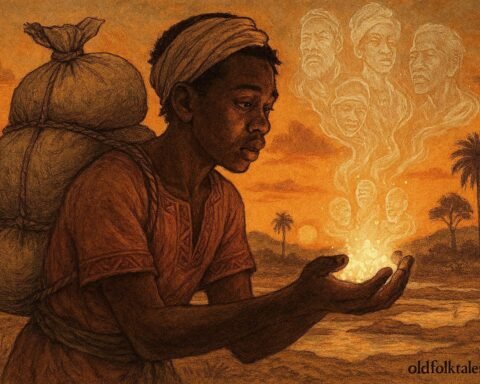
At first, it was subtle, a shift in the air, a quiet presence that seemed to settle around him. The wind, which had been restless, grew calm. The silence deepened, but it was no longer empty.
It felt full.
The shepherd lifted his head.
And then he heard it.
A voice.
It was not loud, nor was it distant. It was clear, steady, and calm, as though it had always been there, waiting to be heard.
“Do not be afraid.”
The shepherd’s breath caught. He looked around, but saw no one. The mountains stood as they had before, silent, unmoving.
Yet the voice remained.
“You are not alone.”
The shepherd’s fear did not disappear at once, but it softened, replaced by something else, something steady and grounding.
“Who is there?” he asked, his voice trembling.
The answer came gently.
“We are those who came before you.”
The shepherd’s heart began to beat differently now, not with panic, but with recognition. The words of the elders echoed in his mind. The ancestors.
“You have walked too quickly,” the voice continued. “You have followed without seeing.”
The shepherd lowered his gaze. It was true. He had chased the wandering sheep without thought, without awareness of where he was going.
“What should I do?” he asked.
“Be still,” the voice said.
The shepherd hesitated, then obeyed. He sat quietly, letting the moment settle. The mountains, once overwhelming, began to feel different. He noticed the shape of the rocks, the direction of the wind, the way the light fell across the slopes.
“Look,” the voice instructed.
The shepherd lifted his eyes. The sun was now lower, casting long shadows that stretched across the land. The ridges, which had seemed identical before, now revealed subtle differences, curves, lines, and patterns that he had not noticed in his haste.
“The land speaks,” the voice said. “But only to those who listen.”
The shepherd nodded slowly.
“Stand,” the voice continued.
He rose to his feet, gripping his staff.
“Walk with care. Do not rush. Trust what you see, and trust what you know.”
The shepherd took a step forward. This time, he did not move blindly. He watched the ground beneath him, the direction of the slopes, the position of the sun.
Each step felt deliberate.
“Courage is not the absence of fear,” the voice said softly. “It is the choice to move with understanding.”
The shepherd felt a quiet strength begin to grow within him. The fear was still there, but it no longer controlled him.
He walked on.
As he moved through the mountains, the voice remained with him, not constantly speaking, but present, guiding when needed.
“Turn here,” it would say.
“Wait.”
“Listen.”
At times, the shepherd paused, uncertain. But each time, he remembered the words: Be still. Look. Listen.
Gradually, the land began to feel familiar again, not because it had changed, but because he had.
He noticed paths that aligned with the direction of the valley. He recognized the way certain rocks marked the edges of known routes. He followed the flow of the land, rather than forcing his way through it.
Night approached, but the shepherd no longer feared it as he had before. The sky deepened into rich blues, and the first stars began to appear.
“Do not lose patience,” the voice reminded him. “The journey takes time.”
The shepherd continued, steady and calm.
And then, in the distance, he saw it.
A shape he recognized.
A ridge that curved like a resting arm. A cluster of trees that stood near the path he often took. The outline of home.
His heart lifted.
“You have found your way,” the voice said.
The shepherd stopped, looking toward the familiar land. Gratitude filled him, not just for the path ahead, but for the journey itself.
“Will you stay?” he asked quietly.
The answer came, gentle and certain.
“We have always been here.”
The shepherd closed his eyes for a moment, letting the words settle within him.
When he opened them, the mountains were silent once more. But the silence was no longer empty.
It was full of presence.
He guided his flock down the familiar path, his steps sure and steady. When he finally reached home, the warmth of the fire and the voices of his family welcomed him back.
But something within him had changed.
He no longer walked the land as one who simply knew it. He walked as one who understood it.
From that day on, the shepherd moved with patience. He listened more carefully, to the wind, to the الأرض, and to the quiet wisdom within himself. And though he did not always hear the voice again as he had that day, he carried its guidance with him always.
For he knew now that he was never truly alone.
Continue your journey: Read more East African folktales
Moral Lesson
True guidance often comes from within and from those who came before us. When we move with patience, courage, and respect for our heritage, we find our way, even in the most uncertain moments.
Knowledge Check
- What caused the shepherd to get lost in the Eritrean folktale?
He followed a wandering sheep without paying attention to his surroundings, leading him into unfamiliar mountain paths. - Who guided the shepherd back home?
The voice of his ancestors guided him, offering wisdom, patience, and direction. - What role do ancestors play in this African folktale?
They represent spiritual guidance, cultural memory, and protection rooted in heritage. - What lessons did the shepherd learn in the mountains?
He learned courage, patience, awareness, and respect for the land and his heritage. - How does the story reflect Eritrean cultural beliefs?
It highlights the strong connection between the living and their ancestors, a key element in Eritrean oral traditions. - What is the main theme of “The Lost Shepherd and the Ancestral Voice”?
The story emphasizes identity, ancestral guidance, and inner strength through cultural roots.
Source: African folktale, Eritrea. Adapted from Eritrean oral literature documentation projects and regional folklore studies (1970s–1990s ethnographic records).
Cultural Origin: Highland Eritrean oral tradition (Tigrinya-speaking communities), Eritrea