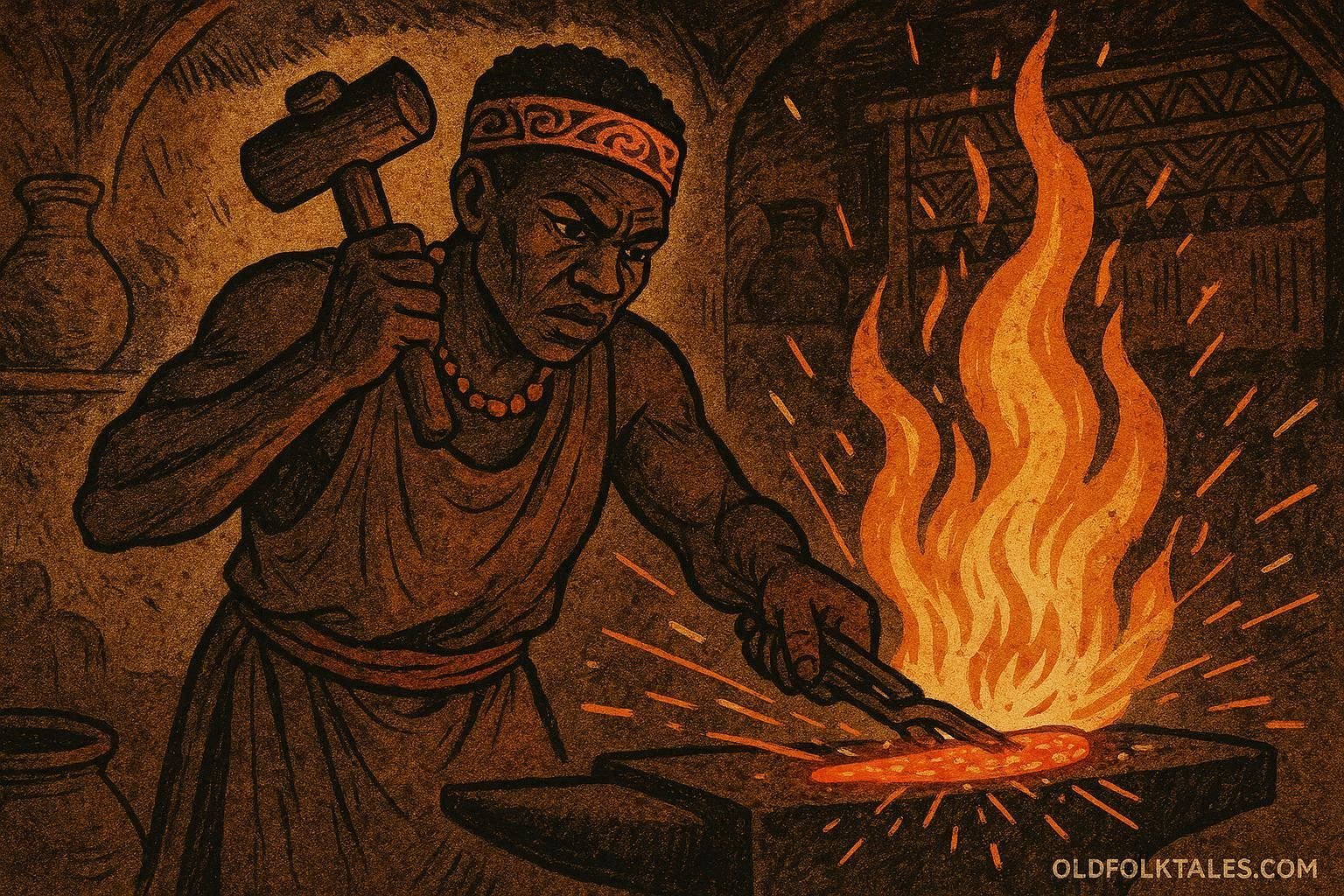
Among the communities of the Bwa and Mossi regions, there existed a lineage set apart from others. This family was not known for farming or trade, but for a craft that carried both practical value and spiritual weight.
They were blacksmiths.
Their work shaped tools, weapons, and objects that supported everyday life. Yet their role went beyond skill. People believed that iron itself held power, and those who could shape it were entrusted with knowledge that was not given lightly.
The story of this lineage began long before the present generation.
It was said that in the early days, when people depended only on simple tools, a man from the community wandered far beyond familiar lands. He was known for his curiosity and his willingness to explore what others avoided.
During one of his journeys, he came upon a place unlike any he had seen.
The ground there was dark and heavy, and strange stones lay scattered across the earth. As he examined them, he noticed something unusual. When struck against each other, they produced sparks.
Keep reading: Discover more Central African folktales
He watched closely.
Curiosity led him to experiment. He gathered the stones, built a fire, and observed how they reacted to heat. What began as simple observation turned into discovery.
The stones changed.
Under fire, they softened. With effort, he shaped them, and when they cooled, they became stronger than anything he had seen before. He had found iron.
But the discovery did not feel entirely his own.
That night, as he rested near the fire, he dreamed. In the dream, a presence spoke to him. It did not threaten him, but it carried authority. The voice explained that the knowledge he had discovered was not meant for careless use.
It was a gift.
And with it came responsibility.
He was told that the power of iron could build or destroy. It could support life or bring harm, depending on how it was used. The knowledge must be protected, passed only to those who understood its weight.
When he awoke, the dream remained clear in his mind.
He returned to his people, carrying both the iron and the knowledge of how to shape it. At first, the community watched with wonder as he demonstrated what he had learned. Tools became stronger. Work became easier.
But he did not teach everyone.
Instead, he chose carefully.
He passed the knowledge only to his children and those within his family who showed discipline and respect. Over time, this became a tradition. The craft of ironworking remained within the lineage, protected and preserved.
Generations passed.
The blacksmith family grew, and their role became firmly established within the community. They were respected, but also approached with caution. People understood that their work connected them to something deeper than ordinary skill.
The training of a new blacksmith was never simple.
Young members of the lineage were taught not only how to work with iron, but how to understand its meaning. They learned patience, control, and responsibility. They were reminded that their actions affected more than just the objects they created.
One young boy in the lineage stood out.
From an early age, he showed great interest in the craft. He watched closely as the elders worked, observing every movement, every decision. His eagerness was clear, but so was his impatience.
He wanted to learn quickly.
The elders noticed this.
They did not deny him the opportunity, but they did not rush his training. Instead, they guided him slowly, teaching him that mastery could not be forced. The boy struggled at times, frustrated by the pace.
One day, he made a mistake.
While working alone, he attempted to shape iron without following the proper process. He ignored the steps he had been taught, believing he understood enough to succeed.
The result was failure.
The iron cracked, and the tool he was shaping became useless. More importantly, the fire reacted in a way that startled him, reminding him of the danger involved.
The elders were informed.
They did not respond with anger. Instead, they gathered the boy and spoke to him about the true nature of the craft. They reminded him of the original knowledge, the dream, and the responsibility that came with it.
The lesson was clear.
Skill without understanding could lead to harm.
From that moment, the boy changed.
He became more patient, more attentive. He listened carefully and followed the teachings with respect. Over time, his skill improved, and he earned his place within the lineage.
The story of the first blacksmith and the lessons that followed became part of the tradition.
It was told not only to preserve history, but to guide future generations. The knowledge of iron was never treated as ordinary. It remained a symbol of power, responsibility, and connection to something beyond the visible world.
Even as time moved forward, the role of the blacksmith remained significant.
Their work continued to support the community, and their knowledge continued to be passed carefully from one generation to the next.
The story endured as a reminder.
Some knowledge is not meant to be used lightly, and true mastery requires not only skill, but respect for what has been given.
If you enjoyed this story, explore our full West African folktales collection
Moral Lesson
Knowledge is a powerful gift, and it must be used with responsibility, patience, and respect.
Knowledge Check
- What made the blacksmith lineage special?
They possessed the secret knowledge of working with iron - How was iron first discovered?
A man found stones that changed under fire - What warning came with the knowledge?
It must be used responsibly - Why was the knowledge kept within a family?
To protect and preserve its proper use - What mistake did the young boy make?
He tried to work without following the proper process - What is the lesson of the story?
Knowledge requires responsibility and patience
Source
Burkinabè folktale. Adapted from Bwa and Mossi traditions documented by Christopher D. Roy (1987).