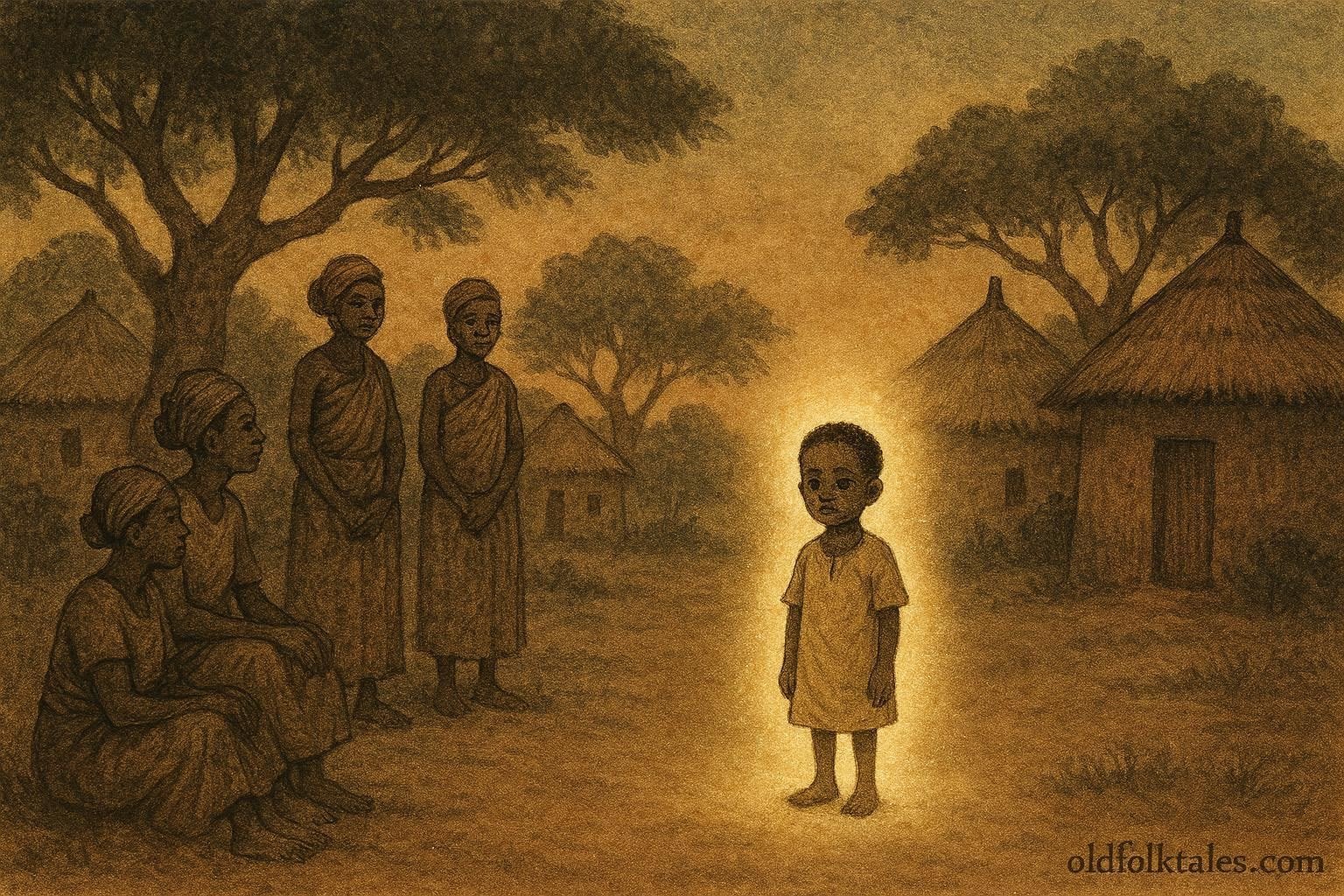
A child was born into a quiet Bobo community, and from the very beginning, there was something unusual about him. His birth itself did not bring trouble or fear, yet those who observed him closely could sense that he carried a presence that felt different from other children.
His mother noticed it first.
While other infants cried loudly or reached eagerly for attention, this child often remained calm and watchful. His eyes seemed to follow movements that no one else could see. At times, he would smile or react as though someone stood nearby, even when the space around him was empty.
At first, these moments were dismissed.
Families often believe children see the world differently, and such behavior did not immediately raise alarm. But as the child grew, the signs became more difficult to ignore.
He spoke earlier than expected.
Not only did he speak, but he sometimes used words and expressions that no one had taught him. He mentioned things that had not been discussed in his presence. On certain days, he described events before they happened, leaving those around him unsettled.
His father grew concerned.
Want to dive deeper? Read more North African folktales today
He began to watch the child more closely, trying to understand what was happening. The boy’s behavior did not follow a pattern that could be easily explained. At times, he would sit alone, whispering softly as though engaged in conversation with unseen companions.
Other children avoided him.
They sensed the difference even if they could not explain it. While they played freely, the marked child often remained at a distance, neither fully part of their world nor completely separate from it.
As the years passed, the tension in the household increased.
The mother felt both fear and protection. She believed that whatever marked her child was not entirely harmful, yet she could not deny the strangeness of it. The father, however, worried about what it might mean for the family and how the community would respond.
Eventually, the matter was taken to the elders.
The elders listened carefully as the parents described the child’s behavior. They did not react with shock. Instead, they nodded with quiet understanding, as though they had heard such stories before.
One elder spoke.
He explained that some children are believed to carry a connection to the spirit world. Such children are not entirely bound to the human realm. They may move between understanding what is seen and what is unseen.
The room grew silent.
The parents listened closely as the elder continued. He explained that this connection could bring both knowledge and difficulty. The child might see things others could not, but he might also struggle to belong fully in the human world.
The question then became clear.
Would the child remain among the living, or would he drift further into the unseen?
The elders advised careful observation.
They instructed the family to guide the child gently, not to force him into ways that felt unnatural to him, but also not to ignore his connection. Balance, they said, would be necessary.
Life continued, but with greater awareness.
The child grew older, and his behavior evolved. He became quieter, more thoughtful. At times, he spoke with clarity beyond his years, offering insights that surprised even the elders. Yet there were also moments when he seemed distant, as though his mind had traveled far beyond the present.
His mother remained close to him.
She watched over him with patience, learning to accept his differences. She no longer saw him as strange, but as someone carrying a path that was not easily understood.
His father changed as well.
Where there had once been fear, there was now cautious respect. He began to see that the child’s presence did not bring harm, but rather a different kind of awareness.
Still, the question of belonging remained.
One day, the child spoke in a way that would shape everything that followed.
He told his mother that he felt pulled between two worlds. He described the human world as warm and familiar, yet limited. The spirit world, he said, felt vast and quiet, filled with knowledge but distant from the life he lived.
His words were calm, not fearful.
The mother listened with a heavy heart. She understood that her child’s experience was real to him, even if she could not fully see what he saw.
The elders were consulted again.
They explained that such a child must eventually choose where he belongs. Some remain fully in the human world, learning to quiet their connection. Others move closer to the spirit world, becoming distant from ordinary life.
The choice would not be forced.
Time passed, and the child continued to grow. Slowly, his connection began to change. He spoke less of the unseen, and his attention turned more toward the life around him. He began to interact more with others, to participate in daily activities, and to find his place within the community.
The shift was gradual.
It did not mean the connection was gone, but it became less dominant. The child found a balance that allowed him to remain among his people while carrying the awareness he had been given.
The family found peace.
They no longer feared what they did not understand. Instead, they accepted that some lives follow paths that are not easily explained.
The story of the child spread quietly through the community.
It was not told with fear, but with respect. It reminded people that the world is larger than what is seen, and that some individuals carry a deeper connection to that unseen reality.
Click here to discover more legendary tales from West Africa
Moral Lesson
Not everyone experiences the world in the same way, and true understanding comes from acceptance and balance.
Knowledge Check
- What made the child different from birth?
He showed unusual awareness and behavior - What unusual ability did the child have?
He seemed to see and communicate with unseen beings - How did the parents react at first?
They were confused and concerned - What did the elders say about the child?
He was connected to the spirit world - Did the child remain in the spirit world?
No, he found balance in the human world - What is the lesson of the story?
Acceptance and understanding are important
Source
Burkinabè folktale. Adapted from Bobo oral traditions documented in West African folklore studies (20th century).