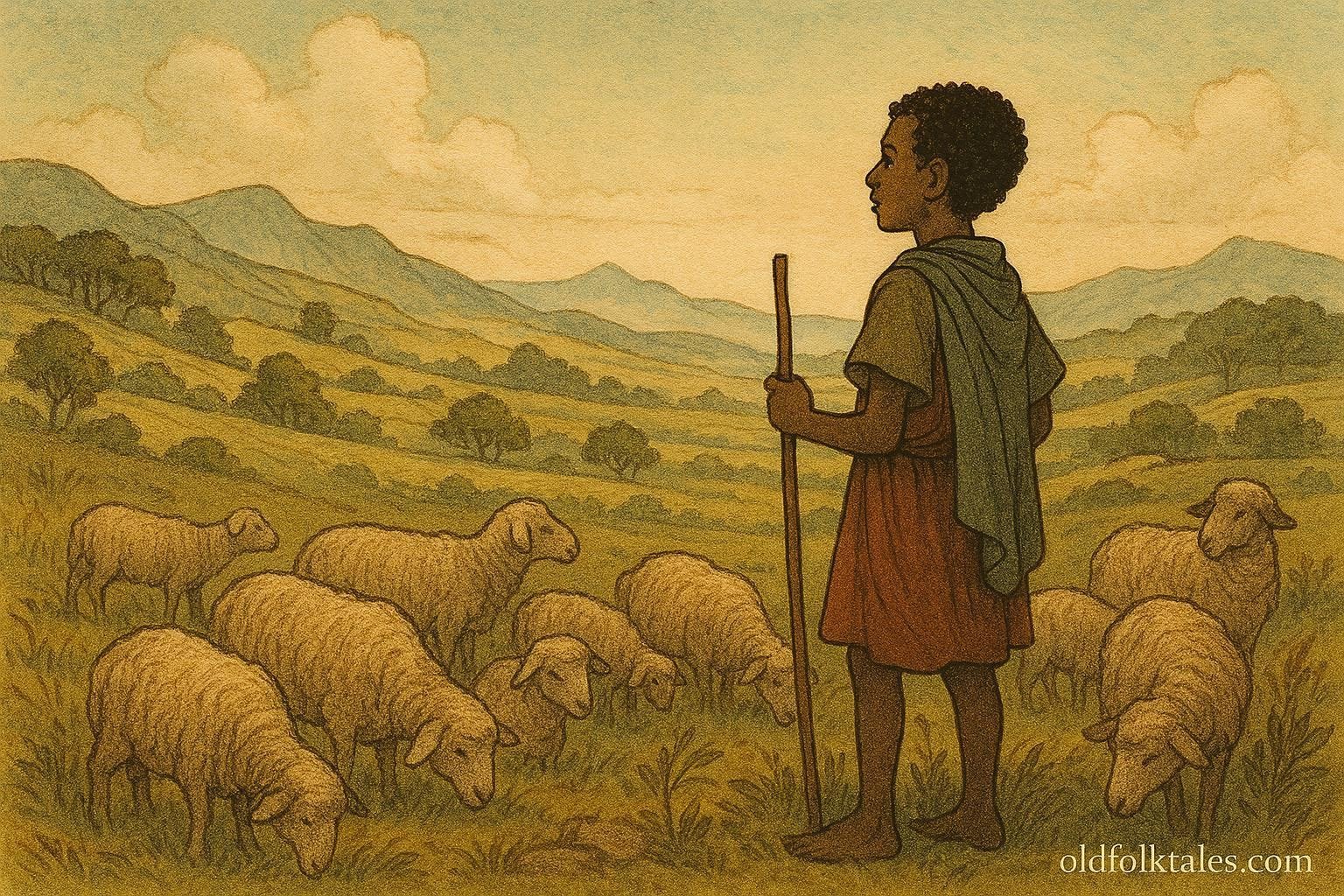
The hills stretched wide and quiet, covered in soft grass that moved with the wind. A young shepherd spent his days there, watching over his flock from sunrise until the sky began to fade into evening. His life was simple and predictable, shaped by routine and silence.
He was not known for anything special.
Among the people in his village, he was seen as just another young man doing ordinary work. He spoke little, kept to himself, and rarely drew attention. Yet there was something about him that made him different, though even he did not fully understand it.
He listened.
Not just to people, but to the land itself. To the wind passing through the hills. To the distant sounds that others ignored. Where others heard noise, he heard meaning.
One afternoon, as the sun stood high and the flock grazed peacefully, he heard something unusual.
At first, it was faint.
A voice.
Explore the wisdom and wonder of North African folktales
He looked around quickly, expecting to see someone nearby, but there was no one. The hills were empty except for his animals. He waited, thinking perhaps he had imagined it.
Then it came again.
Clearer this time.
It called his name.
A chill moved through him. He stood still, unsure of what to do. The voice did not sound like anyone he knew. It carried a calm authority, neither harsh nor soft, but impossible to ignore.
He spoke aloud, his voice uncertain.
“Who is there?”
There was no immediate answer. Only silence returned, stretching across the hills. After a moment, he shook his head and tried to return to his work, convincing himself that it had been nothing more than a passing thought.
But the voice returned the next day.
And the day after that.
Each time, it called him.
Each time, it spoke with purpose, though not always with clear instruction. Sometimes it asked him to move to a different part of the hills. Sometimes it told him to wait. Sometimes it simply spoke his name and fell silent again.
The shepherd began to change.
He became more attentive, more thoughtful. He followed the voice cautiously at first, testing whether it led him into danger. But nothing harmful happened. Instead, he noticed something strange.
Whenever he followed the voice, things seemed to go right.
Lost animals were found more easily. Storms were avoided. Paths that would have led to trouble were replaced with safer ones. Slowly, his fear began to give way to trust.
Still, he told no one.
He knew how such a story would sound. People might laugh, or worse, they might become afraid of him. So he kept the experience to himself, carrying it quietly as part of his daily life.
One evening, as the sun began to set, the voice spoke differently.
It did not simply call him. It gave a clear instruction.
“Leave the hills and go to the village.”
The shepherd hesitated.
This was unusual. His responsibility was to remain with his flock until nightfall. Leaving them unattended would go against everything he had been taught.
He stood there, torn between duty and the voice he had come to trust.
After a long moment, he made his decision.
He gathered the flock quickly and guided them toward a safer enclosure before heading toward the village. His steps were uncertain, but he did not turn back.
When he arrived, he found the village in confusion.
A problem had arisen. A child was missing, and the people were searching in different directions without success. Fear had spread quickly, and no one seemed to know where to look.
The shepherd stepped forward.
For a moment, he said nothing. Then he spoke quietly, suggesting a place where they should search. His voice was calm, though inside he felt the weight of what he was doing.
Some people hesitated, but others followed.
They moved toward the area he had described, calling out as they went. After a short time, they found the child, frightened but unharmed.
Relief spread through the group.
The shepherd stood back, watching as the child was reunited with family. No one asked how he had known where to look, but some began to see him differently.
From that day, things began to change.
The voice continued to guide him, but now its purpose seemed clearer. It was no longer only about his own path. It began to involve others.
He found himself helping in small ways at first. Offering guidance. Noticing things others overlooked. Speaking when it mattered, and remaining silent when it did not.
People began to trust him.
They came to him with questions, with concerns, with situations they could not resolve. He did not claim to have answers, but when he listened, the voice often returned, offering direction.
He never spoke of it directly.
Instead, he allowed his actions to speak for him.
Years passed, and the shepherd was no longer seen as ordinary. Yet he did not change his way of living. He remained humble, continuing his work, caring for his flock, and listening as he always had.
The voice did not make him powerful.
It made him responsible.
There were times when the guidance was difficult. Times when the path was unclear, or when the choice required courage. But he had learned to trust, not blindly, but with understanding.
He knew that the voice was not meant to control him, but to guide him.
In time, the story of the shepherd spread beyond the village.
People spoke of a man who listened differently. A man who acted with quiet certainty. A man whose life had been changed not by force, but by a voice that asked him to pay attention.
And though many wondered about the source of that voice, the shepherd himself never tried to explain it.
For him, it was enough that he had heard it.
And that he had chosen to listen.
Don’t stop yet! See our complete East African folktales collection
Moral Lesson
True guidance comes to those who listen carefully and act with humility and responsibility.
Knowledge Check
1. What made the shepherd different from others?
He listened carefully to his surroundings
2. What did he hear on the hills?
A mysterious voice calling his name
3. Did he trust the voice immediately?
No, he was cautious at first
4. What happened when he followed the voice?
It guided him toward good decisions
5. How did the shepherd help the village?
He helped find a missing child
6. What is the lesson of the story?
Listening and humility lead to guidance
Source
Ethiopian folktale. Adapted from oral traditions of Tigray, Ethiopia (20th century folklore documentation).