In the green and fertile lands of southern Ethiopia, where lakes shimmer beneath the sun and forests stretch deep with quiet mystery, there lay a village that lived in the shadow of a presence it could not fully understand.
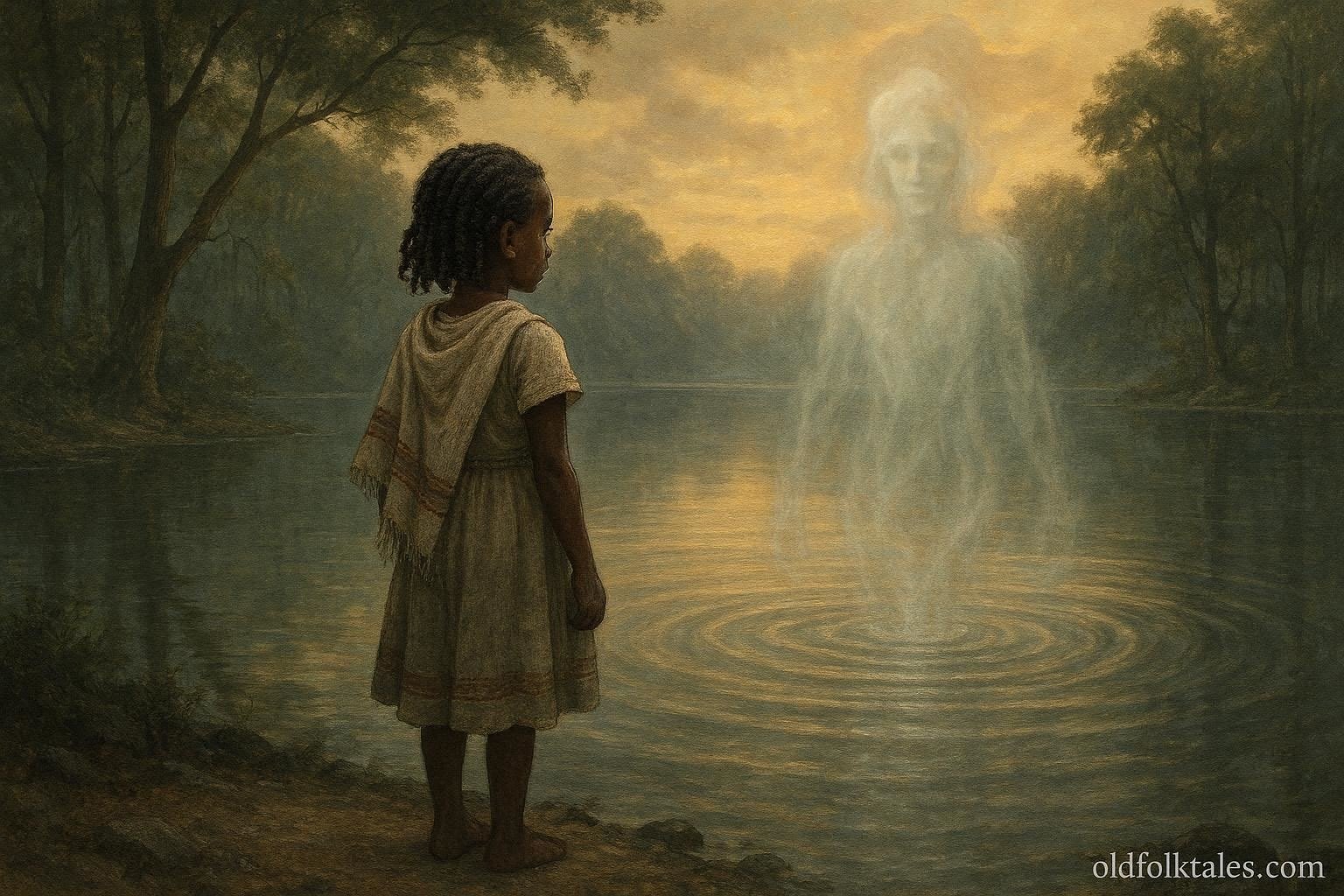
At the edge of the village rested a wide, still lake.
Want more? Read more West African folktales now
Its waters were calm, almost too calm, reflecting the sky with such clarity that it seemed to hold another world beneath its surface. During the day, it appeared peaceful. But as evening approached, the air around it would change. The wind would grow still, the birds would fall silent, and the water would darken as though something beneath it stirred.
The people of the village believed the lake was not empty.
They believed it was inhabited.
For many seasons, stories had been told of a spirit that lived within its depths, a spirit that watched, that listened, and that demanded.
At first, the demands were small.
A basket of grain left by the shore. A calabash of milk placed carefully at the water’s edge. The villagers obeyed, uncertain but cautious. It seemed easier to give than to question.
And for a time, nothing more was asked.
But over the years, the demands grew.
More food. More offerings. More attention.
Fear began to take root.
“If we refuse,” the elders would say, “the spirit will be angered.”
“What will happen then?” the younger ones would ask.
No one had an answer.
And so, the offerings continued.
Among those who lived in that village was a young girl who listened closely to the stories, but did not accept them without thought.
She was not loud, nor did she challenge the elders openly. But she observed. She watched the lake from a distance. She noticed how the people approached it, with bowed heads, with hesitation, with fear that seemed to grow with each passing season.
She began to wonder.
One evening, as the sun lowered and the shadows lengthened, the girl followed the path toward the lake. She did not carry an offering. She carried only her curiosity.
The air was quiet.
When she reached the water’s edge, she stood still, studying the surface. It was as calm as ever, reflecting the fading light of the sky.
For a long moment, nothing happened.
Then, slowly, the water began to ripple.
The girl did not step back.
The ripples widened, forming circles that spread outward until the entire surface seemed to shift. From the center of the lake, a presence emerged, not fully seen, but unmistakably there.
A voice rose from the water.
“You come without an offering.”
The girl’s heart beat faster, but her voice remained steady.
“I come with a question.”
There was a pause.
Few had ever spoken to the spirit this way.
“What question?” the voice asked.
“Why do you demand from us?” the girl said.
The water darkened slightly, as though the question itself had stirred something deeper.
“Because I am the spirit of this lake,” the voice replied. “This land is under my watch. Those who live near me must give.”
The girl tilted her head slightly.
“Must?” she repeated.
“Yes,” the voice said, firmer now. “It is the way of things.”
The girl remained still, considering.
“Then show me,” she said.
Silence followed.
“Show you what?” the spirit asked.
“That it is truly your power that requires this,” the girl replied. “If you are as strong as you claim, then prove it.”
The water stirred again, more sharply this time.
“You question me?” the spirit said.
“I seek to understand,” the girl answered.
The spirit did not respond immediately.
For the first time in many years, it had been challenged, not with defiance, but with calm reasoning.
“What proof do you require?” the voice finally asked.
The girl looked around, then pointed toward the trees that lined the far edge of the lake.
“Move them,” she said. “Show that your power reaches beyond the water.”
The spirit’s voice deepened.
“The lake is my domain.”
“Then your power is limited,” the girl said gently.
The words settled like stones in still water.
The spirit reacted, sending waves across the surface.
“I do not need to prove myself to you,” it said.
“Then why do we need to prove ourselves to you with offerings?” the girl replied.
The question lingered.
The spirit had no immediate answer.
The girl took a step closer to the water.
“If your strength is real,” she continued, “then it does not depend on what we bring. And if it depends on what we bring, then it is not strength, it is need.”
The air grew heavy with silence.
The spirit’s presence shifted, uncertain.
For many seasons, it had been obeyed without question. The offerings had come regularly, reinforcing its place in the lives of the villagers.
But now, faced with clear thought and steady courage, its power felt… different.
Less certain.
“You risk angering me,” the spirit said, though its voice lacked the same force as before.
The girl did not move.
“Fear has kept us silent,” she said. “But fear is not truth.”
The water stilled.
The ripples faded.
The presence in the lake seemed to withdraw slightly, as though reconsidering itself.
“If we stop bringing offerings,” the girl added, “what will you do?”
The question was simple.
Direct.
And for the first time, it carried no fear.
The spirit did not answer.
Because it could not.
The truth, once unspoken, now stood clearly between them.
Its power had been sustained not by strength, but by belief.
By fear.
The girl waited.
The silence stretched.
Then, slowly, the presence in the water began to fade.
The ripples disappeared. The surface returned to its calm reflection.
The voice did not return.
The girl stood there for a long moment, watching, listening.
Nothing came.
The lake was still.
When she returned to the village, the people gathered around her.
“What happened?” they asked.
The girl looked at them, not with excitement, but with quiet certainty.
“The spirit does not hold power over us,” she said. “We gave it power through our fear.”
The villagers exchanged uncertain glances.
“Then what should we do?” one elder asked.
The girl answered simply.
“Stop giving what is not required.”
The next day, no offerings were brought to the lake.
The villagers watched, waiting for something to happen.
Nothing did.
The water remained still.
Days passed.
Still, nothing changed, except the people.
The fear that had once shaped their actions began to fade. The path to the lake no longer felt heavy. The air around it no longer carried the same tension.
The lake became what it had always been.
Water.
From that time on, the village lived differently, not in ignorance of the unseen, but in understanding that fear must be questioned, and that power must be proven.
And the girl, who had once stood alone at the water’s edge, was no longer seen as simply quiet or observant.
She was remembered as the one who saw clearly.
Don’t stop yet! See our complete East African folktales collection
Moral Lesson
Fear loses its power when met with courage and reason. True strength comes from understanding, not blind obedience.
Knowledge Check
- Why did the villagers fear the lake spirit in the Ethiopian folktale?
They believed the spirit demanded offerings and would bring harm if they refused. - How did the girl challenge the spirit’s power?
She questioned its authority and asked it to prove its strength beyond the lake. - What did the girl discover about the spirit?
She realized its power depended on fear and belief, not true strength. - What happened when the villagers stopped giving offerings?
Nothing harmful occurred, and the spirit’s influence disappeared. - What role does intelligence play in the story?
Intelligence and critical thinking help overcome fear and reveal truth. - What is the main theme of “The Girl Who Outwitted the Spirit of the Lake”?
The story emphasizes courage, reasoning, and the power of questioning fear.
Source: Inspired by Ethiopian folktales documented in “Ethiopian Folktales” by Richard Pankhurst (1999).
Cultural Origin: Oromo and Southern Ethiopian traditions