Far from the great cities of the ancient world, a child was born whose life would one day connect kingdoms, beliefs, and generations. His name was Menelik, and from the beginning, his story carried a quiet weight of destiny.
He was raised in a land rich with tradition and pride, under the care of a powerful and wise mother. She was a queen known for her strength, her intelligence, and her journey to a distant kingdom where she had once tested the wisdom of a great king. From that journey, she returned not only with knowledge, but with a child whose future would be unlike any other.
Menelik grew up surrounded by stories.
Stories of his mother’s journey. Stories of the king she had met. Stories of wisdom, power, and divine favor. As he listened, he began to understand that his life was connected to something far greater than his immediate world.
Yet, for many years, those stories remained distant.
Fascinated by this tale? Discover more North African folktales
He lived as a prince, trained in leadership, taught discipline, and guided in the ways of his people. But as he grew older, questions began to form within him. Questions about his origin. Questions about the father he had never met. Questions about the truth behind the stories he had heard since childhood.
One day, he could no longer ignore those questions.
With respect and determination, he approached his mother and asked about his father. The queen did not hide the truth. She spoke openly, telling him about the journey she had taken and the king she had met in a distant land.
She told him who he was.
And she told him where he came from.
The answer brought both clarity and uncertainty. Menelik now knew the truth, but that truth led him to a decision that would change his life.
He chose to go.
He prepared for a journey to the land of his father, a place filled with history, power, and expectation. It was not an easy decision, but it was one he felt compelled to make.
The journey was long.
He traveled across vast lands, through unfamiliar territories, guided by purpose and the stories he carried with him. Along the way, he faced challenges, but he did not turn back. Something within him urged him forward.
When he finally arrived, he stood before a king whose reputation had reached far beyond his kingdom.
The meeting was not ordinary.
There was recognition. Not just of appearance, but of something deeper. The connection between them was undeniable, and though many years had passed, the truth revealed itself without confusion.
Menelik had found his father.
For a time, he remained there, learning more about the kingdom, observing its ways, and building a relationship that had been absent from his life. The king welcomed him, offering him a place and a future within that land.
There was even the possibility that he would stay.
But Menelik’s path was not meant to remain there.
He remembered his home. He remembered his people. And he understood that his destiny was tied not only to his origin, but to where he had been raised.
As the time came for him to return, preparations were made.
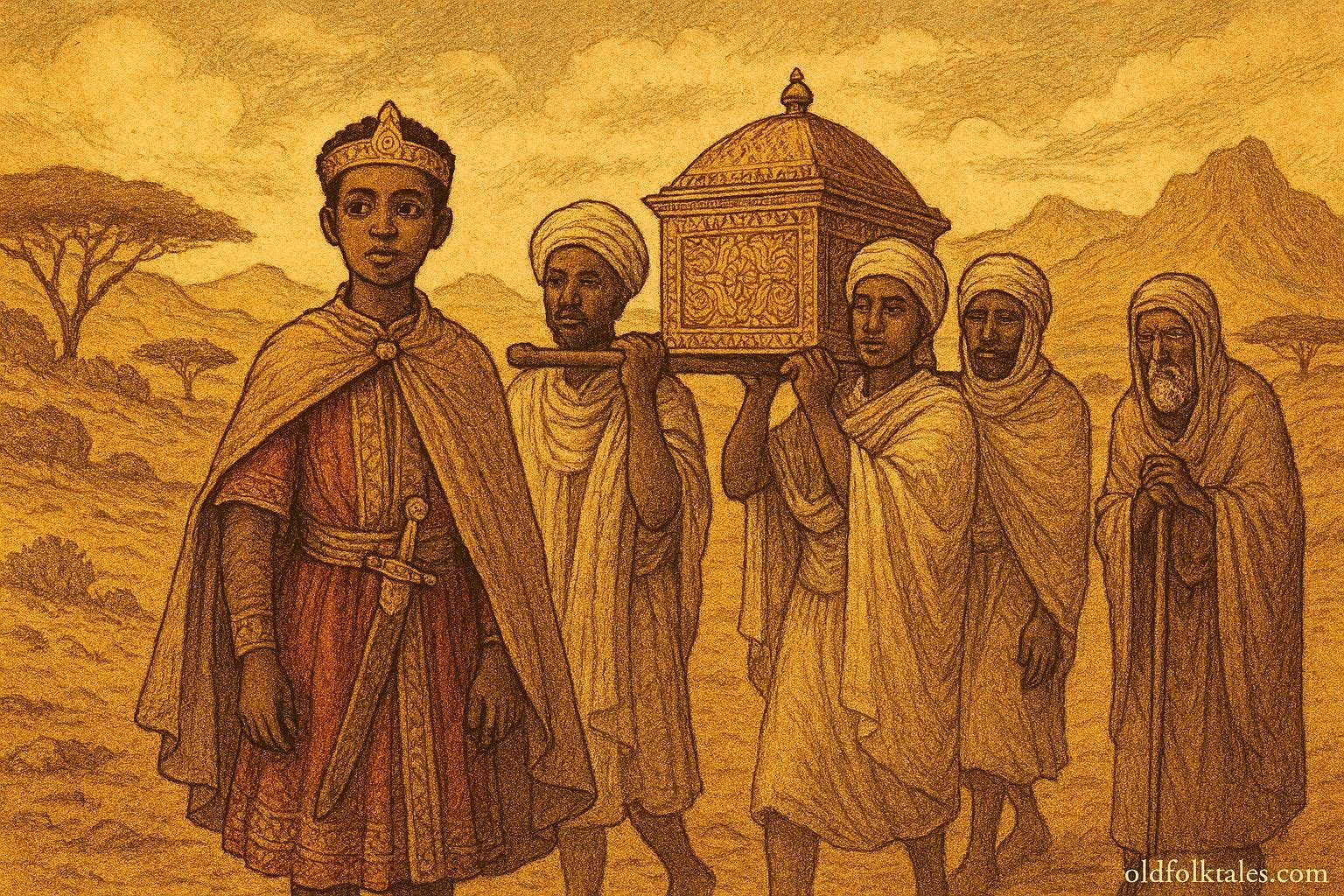
He was not sent away empty handed. He was given honor, recognition, and companions who would travel with him. The departure carried both pride and sorrow, but it was necessary.
Yet, something unexpected happened.
Among those who accompanied him were individuals who believed that Menelik’s journey was part of a greater plan. They saw his return not simply as a movement between lands, but as a transfer of something sacred.
Quietly, without public declaration, an act took place that would shape the story for generations.
A sacred object, deeply connected to faith and identity, was taken and carried along the journey.
It was not treated as an ordinary possession.
It was handled with care, with reverence, and with a sense of purpose that went beyond human decision. Those who carried it believed that its presence with Menelik was not an accident, but a fulfillment of something greater.
The journey back was different.
It was no longer just a prince returning home. It was a movement that carried meaning beyond the visible. Though many did not know what had taken place, the significance of the journey continued to grow.
When Menelik arrived, he did not return as the same person who had left.
He returned with knowledge, with experience, and with a deeper understanding of his role. The land received him not just as a prince, but as someone whose journey had connected him to something sacred.
Over time, his leadership became established.
His story spread.
And the belief in what had been carried with him became part of the identity of the people. It was not only about a physical object, but about what it represented. Faith. Continuity. Divine connection.
Menelik did not speak loudly about these things.
He ruled with quiet strength, guided by what he had learned and what he had carried. The legacy he built was not only political, but spiritual.
Generations later, his story remained.
Not just as history, but as belief.
Not just as a journey, but as a foundation.
And though many would interpret the events in different ways, one thing remained constant.
The story of Menelik was not only about where he came from.
It was about what he brought with him.
Continue your journey: Read more East African folktales
Moral Lesson
Destiny is not only about origin but about the responsibility to carry and protect what has been entrusted to you.
Knowledge Check
- Who was Menelik?
He was the son of a queen and a great king - Why did Menelik go on a journey?
To meet his father and understand his origin - What did he gain from the journey?
Knowledge, identity, and purpose - Did Menelik remain in his father’s land?
No, he chose to return home - What made his return significant?
He carried a sacred spiritual inheritance - What is the lesson of the story?
True destiny involves responsibility and purpose
Source
Ethiopian tradition. Adapted from Kebra Nagast (1922 translation).