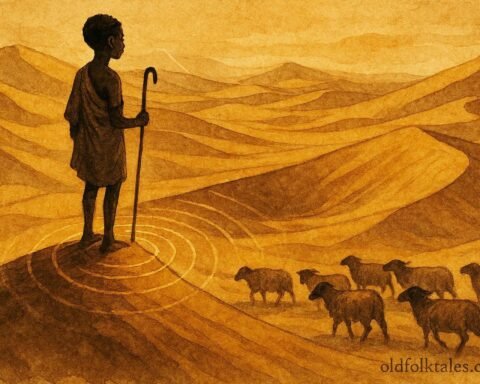
In the vast silence of the Libyan Sahara, especially in the Fezzan region, where dunes stretch like endless waves and survival depends on reading the smallest signs of wind and sand, stories are not just entertainment.
They are survival memory.
Want more? Read more West African folktales now
They teach respect for water, for movement, and for the fragile balance between life and desert.
Among Tuareg and desert Arab oral traditions, animals often serve as guides and judges of human behavior.
This is the story of a desert fox, a greedy caravan, and a landscape that enforces its own justice.
A Caravan on the Edge of Survival
A group of traders once crossed the Sahara with a large caravan.
They carried goods for trade between distant settlements.
But as they moved deeper into the desert, their behavior changed.
They discovered scarce water points—hidden wells and rare oases—and began to use them without caution.
Instead of preserving them for shared survival, they took more than needed.
They wasted water.
They ignored the warnings of experienced desert guides.
And they grew increasingly confident that they could control the desert.
But the desert does not submit to control.
It only responds.
The Desert Fox Appears
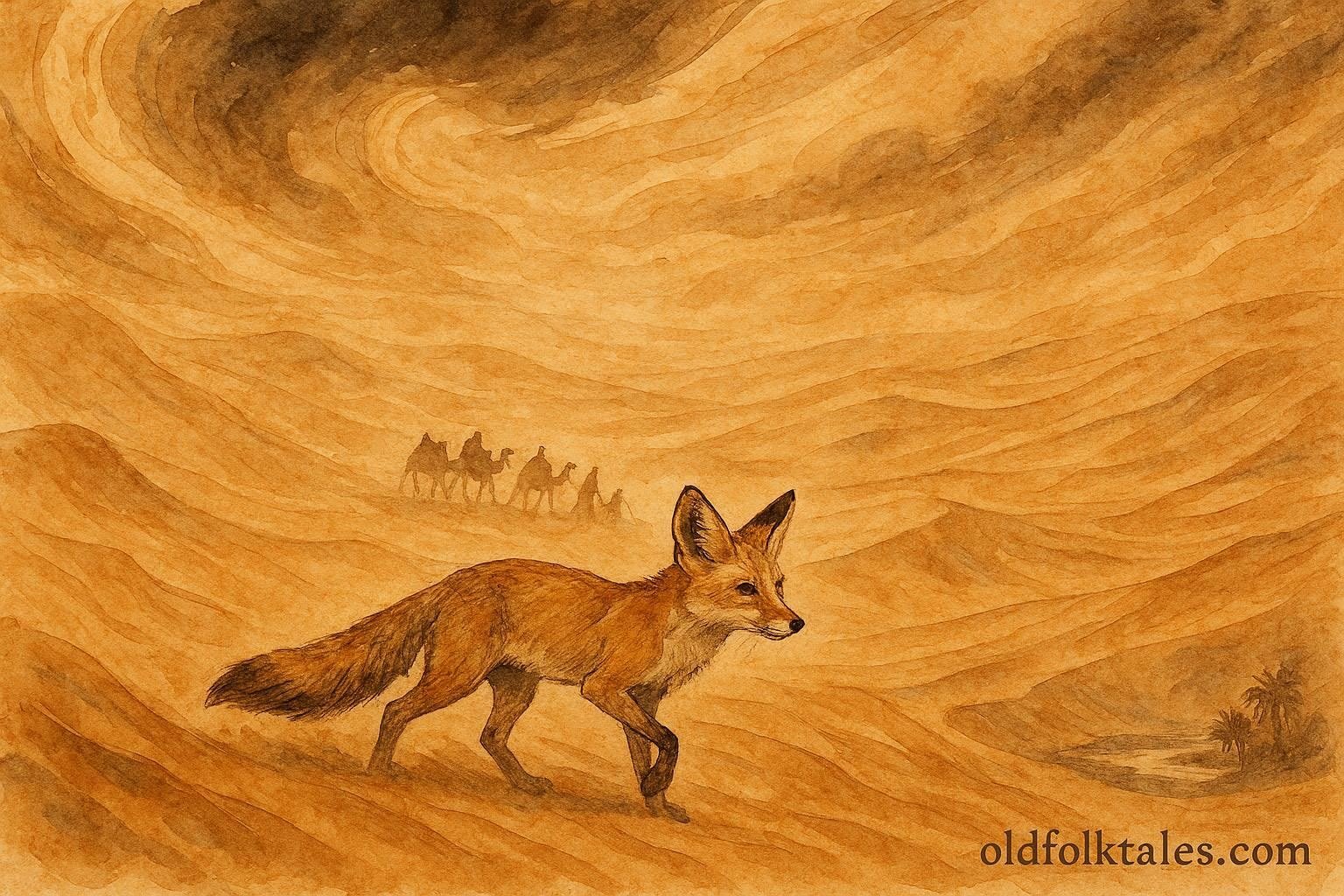
Near one of the hidden water routes lived a desert fox.
Small.
Silent.
And deeply observant.
The fox understood the desert in ways the traders did not.
It knew where water moved underground.
It knew how sand shifted with wind.
And it understood when human behavior disrupted balance.
At first, the fox simply watched the caravan.
But as their greed increased, so did the imbalance in the land.
And the fox began to act.
The First Signs of Intervention
Each time the traders reached a water source, something unusual would happen.
Paths would shift slightly.
Tracks would confuse their direction.
Small errors in navigation would accumulate until they lost certainty.
They blamed chance.
Or the harshness of the desert.
But the fox was quietly guiding outcomes, not through magic, but through awareness of patterns they ignored.
Still, the traders did not learn.
Instead, they became more careless.
The Caravan’s Greed Grows
The traders began to take more risks.
They stored less water for long journeys.
They overused certain wells.
And they dismissed warnings from older guides who understood desert limits.
“You worry too much,” they said.
“The desert is ours to cross.”
But in truth, no one owns the desert.
It allows passage, or denies it.
The Fox and the Balance of the Land
The fox continued to observe.
It noticed how each act of greed disturbed the fragile rhythm of survival.
Wells dried faster than expected.
Paths became harder to follow.
And distant dunes shifted in ways that erased familiar routes.
The desert itself was responding.
And the fox, as part of that ecosystem, moved with it.
The Arrival of the Sandstorm
One evening, the sky changed.
The wind grew heavier.
The horizon darkened.
And soon, a massive sandstorm rose across the Sahara.
It moved without warning.
Engulfing everything in its path.
The caravan, caught unprepared, became trapped in the storm’s overwhelming force.
Visibility disappeared completely.
Direction was lost.
Panic spread quickly among the traders.
The Lost Among the Dunes
As the storm intensified, the caravan broke apart.
Some wandered blindly.
Others abandoned their goods.
Fear replaced confidence.
And the desert, once underestimated, became an unforgiving presence.
But not all were lost.
Some remembered the older teachings.
They slowed their movements.
They conserved their water.
And they listened carefully to the subtle cues of the wind.
The Fox’s Guidance
Through the storm, the desert fox moved carefully between shifting dunes.
It did not fight the storm.
It understood it.
And it guided those who still respected the desert’s rules.
Not all traders followed.
Only those who had shown restraint earlier, those who had not overused water or disrespected the land, were able to perceive subtle signs of direction.
The fox led them toward safer ground.
Step by step.
Without force.
Only alignment with the desert’s rhythm.
Those Who Survived
By the time the storm passed, only part of the caravan remained intact.
Those who survived were not necessarily the strongest or richest.
They were the ones who had respected limits.
They had listened when others ignored warnings.
And they had treated the desert as something alive, not something to exploit.
They understood, too late, that survival in the Sahara is not about domination.
It is about balance.
The Fate of the Greedy
Those who had overused water and ignored guidance suffered the worst consequences.
Not because the desert punished them with intent.
But because their actions had already disrupted the fragile system they depended on.
The storm only revealed what imbalance had already created.
In the Sahara, mistakes are not hidden.
They become environment.
The Fox Becomes a Memory
After the storm, the desert fox was no longer seen as often.
Some say it returned to deeper desert paths.
Others believe it remains present whenever travelers move respectfully across the dunes.
Among desert storytellers, the fox is remembered not as a hero or villain, but as a force of awareness.
A reminder that intelligence in the desert is not measured by control, but by understanding.
Fascinated by this tale? Discover more North African folktales
Moral Lesson
Greed disrupts balance, and in harsh environments like the desert, imbalance leads to consequences. Survival depends on respect, restraint, and intelligence aligned with nature.
Knowledge Check
- What is “The Desert Fox and the Hidden Caravan” about?
It is a Fezzan Sahara folktale about a fox guiding or influencing a caravan based on their respect or greed. - Where does the story come from?
From the Libyan Sahara, specifically the Fezzan region and Tuareg desert oral traditions. - What caused the caravan’s downfall?
Their greed and misuse of scarce desert water sources. - How did the desert fox help?
It guided only those who respected desert balance toward safety during a sandstorm. - What theme does the story highlight?
Survival intelligence, greed vs wisdom, and respect for nature. - What lesson does this African folktale teach?
It teaches that survival in harsh environments depends on restraint, awareness, and respect for natural balance.
Source: African folktale, Libya.
Adapted from Fezzan region Tuareg and desert Arab oral traditions recorded in mid-20th century North African ethnographic folklore collections (1950s–1960s field notes compiled in later anthologies).
Cultural Origin: Libyan Sahara (Fezzan region, Tuareg and desert Arab oral tradition)