In the wide, sunlit expanses of the Libyan desert, across Cyrenaica and the central Saharan lands, life has always depended on reading what cannot be easily seen.
The movement of sand.
Looking for more? Explore the magic of East African folktales here
The direction of wind.
The silence between storms.
Among Arab-Berber desert communities, the wind is not merely air in motion.
It is a messenger.
A carrier of memory, warning, and change.
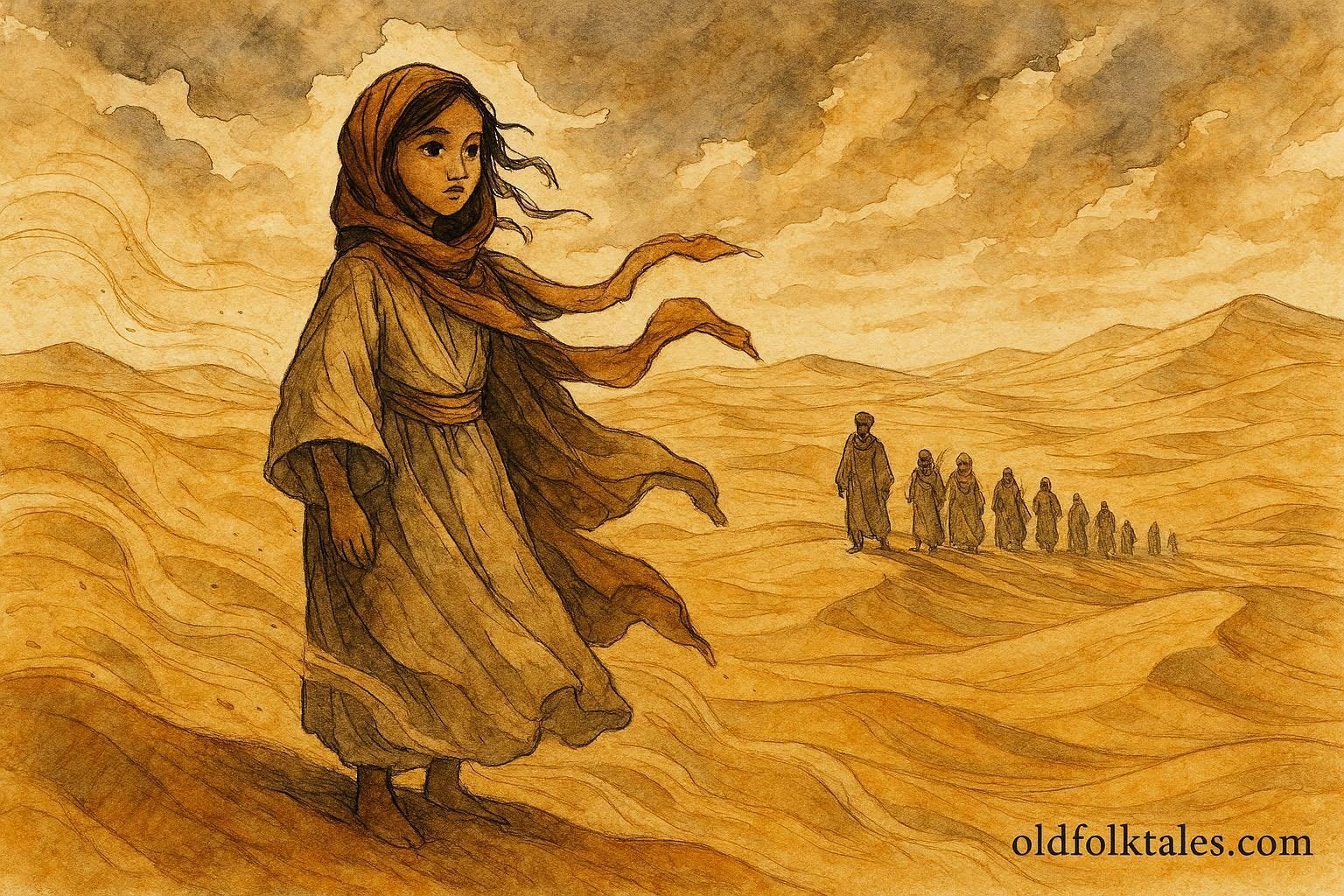
This is the story of a girl born in the middle of a great sandstorm, and how her connection to the wind became the key to her people’s survival.
A Birth in the Storm
The night the girl was born, the desert was restless.
A powerful sandstorm swept across the land, covering dunes, erasing paths, and forcing villagers to remain inside their homes.
The wind howled continuously, moving with a force that made even the most experienced elders uneasy.
When the storm finally passed, the air was still, but something about that night was remembered.
The child, born at the heart of the storm, was said to carry its presence within her.
A Child Who Listened Differently
As the girl grew, it became clear that she was not like other children.
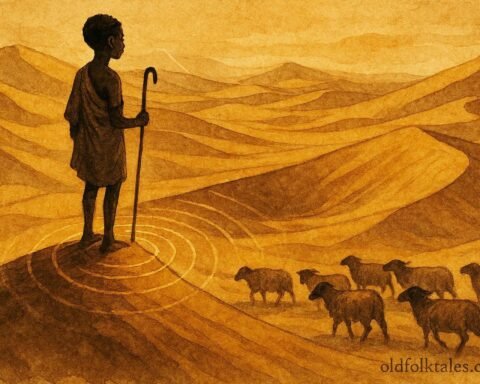
She spent long hours outside, standing quietly as the wind moved across the dunes.
While others heard only noise, she seemed to be listening.
Responding.
Sometimes, she would turn her head as if answering a distant voice.
At first, people thought little of it.
But as time passed, her awareness became more noticeable.
The Language of the Wind
One day, when a strong breeze passed through the village, the girl spoke suddenly.
“The wind says the sand will shift before nightfall,” she said.
The elders looked at her with curiosity.
And by evening, the dunes near the village had indeed changed.
It was not a large event.
But it was enough to be remembered.
From that moment on, the villagers began to watch her more closely.
The Growing Understanding
Over time, the girl’s connection to the wind deepened.
She spoke less, but when she did, her words often aligned with changes in the land.
She warned of rising heat before it came.
She sensed when distant winds carried dust from far-off storms.
And she seemed to understand something beyond ordinary observation.
The wind, to her, was not random.
It carried patterns.
Messages.
Guidance.
The Coming of Drought
Then, a long drought came upon the village.
Water sources began to dry.
The ground hardened.
And the usual signs of seasonal change did not appear.
The wind grew quieter.
Heavier.
Less frequent.
The villagers became anxious.
Without water, survival would not be possible for long.
They searched known wells.
They followed familiar routes.
But nothing remained.
The Girl’s Silence
During this time, the girl grew quiet.
She spent more time alone, standing on the edges of dunes, listening.
Some began to question her ability.
Others wondered if the wind had stopped speaking.
But she did not respond to these doubts.
She waited.
Because understanding requires patience.
The Return of the Wind’s Voice
One evening, as the sun began to set, a slow wind moved across the desert.
It was not strong.
But it carried something different.
The girl stood still, eyes focused on the horizon.
And after a long silence, she spoke:
“The water is not gone,” she said.
“It is hidden.”
The villagers listened carefully.
“Where?” they asked.
She turned toward a distant stretch of dunes.
“Beneath the sand,” she replied.
The Journey into Uncertainty
Though uncertain, the villagers chose to follow her.
They had few options left.
Carrying what little they had, they walked toward the direction she indicated.
The journey was not easy.
The terrain was unfamiliar.
And doubt remained among some.
But the girl continued to listen as they moved.
Guiding not through sight, but through what she heard in the shifting winds.
The Discovery Beneath the Sand
After hours of travel, the girl stopped.
“This is the place,” she said.
The ground looked no different from anywhere else.
Dry.
Unremarkable.
But she insisted.
The villagers began to dig.
At first, nothing changed.
But after some time, the sand beneath them softened.
And then—slowly—moisture appeared.
Not on the surface.
But below.
They had found underground water.
Hidden.
Protected.
Waiting.
A Village Restored
With careful effort, the villagers uncovered the water source.
It was not vast.
But it was enough.
Enough to sustain life.
Enough to restore hope.
The village returned with renewed strength, now aware that survival required not only physical effort, but deeper understanding.
And the girl, once quietly observed, was now seen differently.
Not as someone unusual.
But as someone who listened where others did not.
The Meaning of the Wind
The elders later reflected on what had happened.
They said the girl had not controlled the wind.
She had not commanded it.
She had simply understood it.
Because the desert does not give its secrets to those who demand them.
It reveals them to those who listen.
Want to dive deeper? Read more North African folktales today
Moral Lesson
True guidance comes from listening, not controlling. Nature offers wisdom to those who are patient, observant, and willing to understand rather than dominate.
Knowledge Check
- What is “The Girl Who Spoke to the Sand Winds” about?
It is a Libyan desert folktale about a girl who understands the wind and helps her village find water. - Where does the story originate?
From Cyrenaica and central Libyan desert communities in Arab-Berber oral traditions. - How did the girl gain her ability?
She was born during a powerful sandstorm and grew up attuned to the wind’s patterns. - What problem did the village face?
A severe drought that dried up their water sources. - How did the girl help the village survive?
She interpreted the wind’s message and guided them to an underground water source. - What lesson does this African folktale teach?
It teaches that listening to nature and respecting its signals leads to survival and wisdom.
Source: African folktale, Libya.
Adapted from Cyrenaican and central Libyan Arab-Berber oral traditions preserved in modern folklore anthologies and storytelling archives (early 2000s compilations).
Cultural Origin: Cyrenaica and central Libyan desert communities (Arab-Berber traditions)