In the heart of Libya’s central desert, where life gathered around rare and precious oases, there stood a village known for its quiet beauty and deep traditions. Palm trees arched gently over clear pools of water, and the people who lived there carried stories as carefully as they carried water, aware that both could sustain or destroy.
Among them lived a young bride.
Click here to discover more legendary tales from West Africa
She was known not for wealth or status, but for her calm presence and steady kindness. Her laughter was soft, her words thoughtful, and her respect for tradition unquestioned. When news spread that she was to be married, the village rejoiced. Weddings were not merely personal unions, they were communal celebrations, binding families, honoring ancestors, and renewing sacred customs that had endured for generations.
Her groom was a young man of promise, strong, capable, and admired. The match was seen as fitting, even blessed.
Preparations began days in advance.
The Wedding by the Oasis
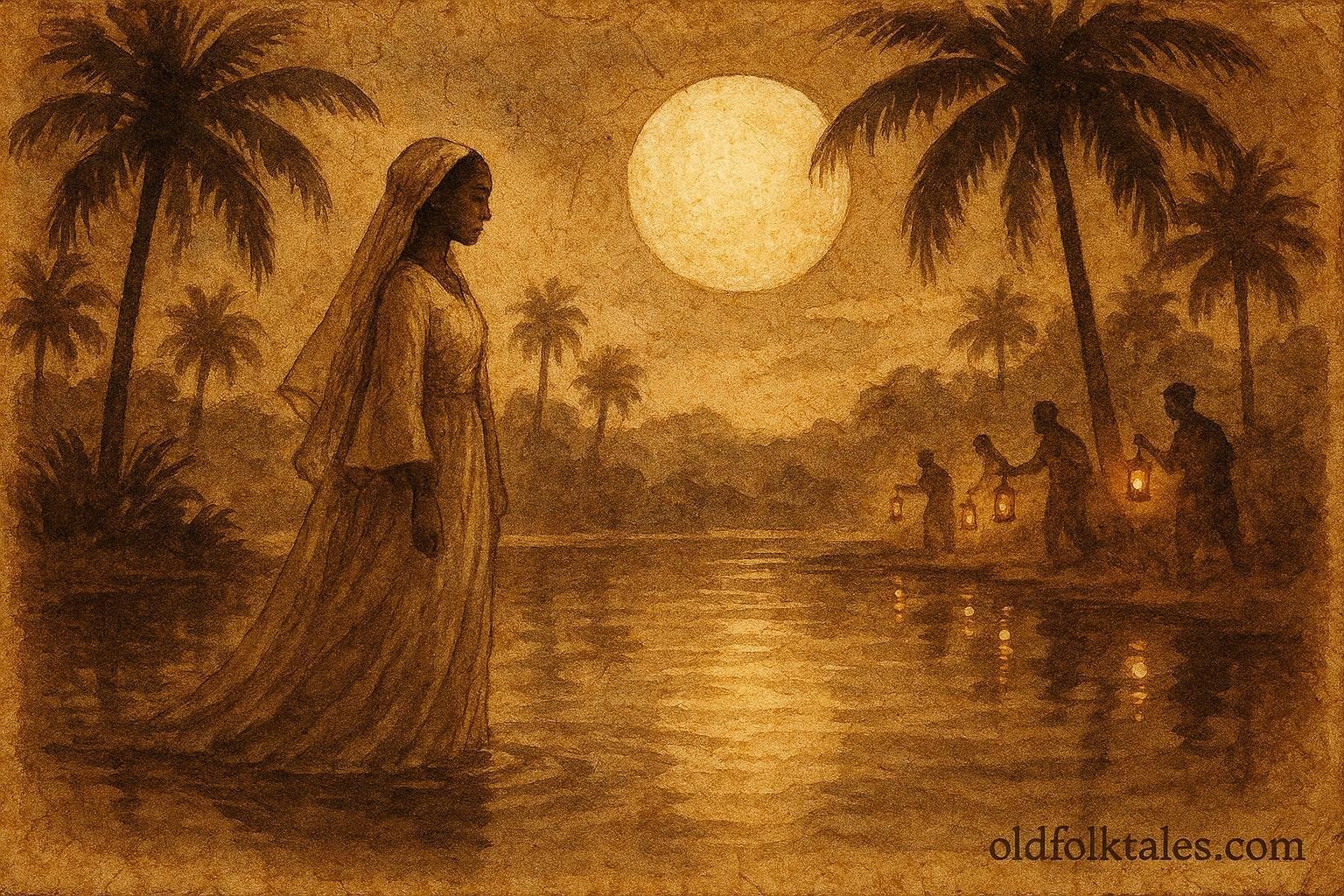
The ceremony was to take place near the oasis itself, under the open sky. This was not unusual. In many such villages, the oasis was more than a source of water, it was a place of spiritual presence, where the boundary between the visible and unseen felt thinner.
On the evening of the wedding, the moon rose full and bright, casting a silver glow across the palms and water. The air was calm, the night unusually still.
Guests gathered in celebration. Songs rose, hands clapped in rhythm, and voices carried joy into the desert beyond.
The bride, dressed in garments that shimmered softly in the moonlight, moved with quiet grace among her people. The groom stood nearby, surrounded by well-wishers, his expression proud but reserved.
Everything unfolded as tradition demanded.
Everything, except one thing.
Before the final blessings, before the last words that would seal their union, a moment of stillness fell over the gathering.
It was subtle.
But it was there.
Some of the elders exchanged glances.
The bride, too, seemed to pause, her gaze drifting briefly toward the water.
Then the moment passed.
The ceremony concluded.
The marriage was declared.
And the celebration resumed.
The Disappearance
Later that night, when the festivities had softened and the village began to settle, the bride stepped away.
No one saw exactly when.
No one noticed the direction she took.
But when her absence was finally realized, the mood shifted quickly from celebration to unease.
Voices called her name.
Lanterns were lit.
Searches began immediately, around the oasis, through the nearby paths, among the palms and beyond.
There were no signs of struggle.
No footprints leading far.
No clear indication of where she had gone.
Only the stillness of the oasis remained, reflecting the moon as though nothing had changed.
By dawn, fear had settled deeply into the hearts of the villagers.
The Belief of the Village
In the days that followed, explanations were sought, but none satisfied.
Whispers began to spread.
“She was taken.”
“By whom?”
“By those who live beyond sight.”
The idea took hold quickly.
Desert spirits, long spoken of in hushed tones, were believed to dwell near places like the oasis. They were not always harmful, but they were bound by laws older than human understanding.
To some, the explanation felt right.
The strange stillness during the ceremony.
The bride’s momentary pause.
The absence of any trace.
“It was the spirits,” many concluded.
The story settled into the village’s memory: the bride who had been taken on her wedding night beneath the moonlit oasis.
Years passed.
The groom never remarried.
The story was told again and again, sometimes as a warning, sometimes as a mystery, always with a sense of something unresolved.
The Return of the Story
Time, however, does not erase truth.
It waits.
Many years later, when the memory of that night had softened into legend, a traveler arrived in the village.
He was not from there, but he carried himself with familiarity, as though he had walked long among deserts and understood their quiet language.
He asked for water.
He was given some.
He listened to the stories shared around him.
And when he heard of the bride who had vanished, he did not dismiss it.
Instead, he asked a simple question.
“Was there a promise made before the wedding?”
The villagers were surprised.
“What promise?” they asked.
The traveler looked toward the oasis.
“A promise to the land,” he said. “Or to what resides within it.”
The elders grew thoughtful.
Memories stirred, old ones, half-forgotten.
At last, one of them spoke.
“There was… something,” he said slowly.
The Forgotten Promise
Long before the wedding, during a season of hardship when water levels had fallen dangerously low, the village had made a vow.
It was not spoken lightly.
It was made at the oasis itself.
They had asked for the water to remain, for the life of the village to be sustained.
And in return, a promise had been given.
That a sacred bond, one of purity, of union, of great significance, would be honored in a specific way.
Not altered.
Not forgotten.
But kept exactly as agreed.
Over time, as the water returned and life stabilized, the urgency of that vow faded from daily thought.
When the wedding was arranged, traditions were followed, but not all.
A small detail, one that had been part of the original promise, was overlooked.
Or perhaps dismissed.
Or perhaps deliberately ignored.
No one could say with certainty.
But it had not been fulfilled.
The Truth Revealed
The traveler listened carefully.
Then he spoke.
“The bride was not taken without cause,” he said. “She became the fulfillment of what was promised.”
The words settled heavily.
“Not as punishment,” he continued, “but as balance. A promise was made, and it was broken. The cost of that break had to be answered.”
Silence spread through the gathered villagers.
“The oasis gives life,” the traveler said. “But it does not forget.”
The realization moved slowly, but deeply.
The bride’s disappearance was no longer a mystery of random loss.
It was a consequence.
A completion.
The Weight of Understanding
The groom, now older, listened in stillness.
Grief had long since shaped his life, but now it shifted.
Not lighter.
But clearer.
The elders bowed their heads.
The villagers, too, felt the weight of what had been uncovered.
This was not a story of spirits acting without reason.
It was a story of a promise made and broken.
And of a life that became its answer.
The Memory That Remained
From that day forward, the story was told differently.
Not as a tale of fear.
But as a lesson.
The bride was remembered not as one who had been taken, but as one who had fulfilled something larger than herself, though the cost was beyond what anyone would choose.
The oasis continued to give water.
The village continued to live.
But the memory remained, woven into every ceremony, every vow, every gathering near its edge.
Nothing was forgotten again.
Want to dive deeper? Read more North African folktales today
Moral Lesson
Sacred promises carry weight beyond the moment they are made. When communities forget their vows, the consequences may come in ways they do not expect. True honor lies in remembering, respecting, and fulfilling commitments, especially those tied to the well-being of all.
Knowledge Check
- What is the main lesson of “The Bride of the Moonlit Oasis”?
The story teaches that breaking sacred promises can lead to serious consequences, even when forgotten over time. - Why did the bride disappear on her wedding night?
Her disappearance was the fulfillment of a broken vow made by the village to the oasis during a time of hardship. - What does the oasis symbolize in the folktale?
The oasis represents life, spiritual balance, and the connection between human actions and unseen forces. - What role does the traveler play in the story?
The traveler reveals the hidden truth, helping the village understand the deeper meaning behind the bride’s disappearance. - How does the story reflect themes of love and sacrifice?
The bride’s fate shows how individual lives can become tied to communal promises, highlighting the cost of broken commitments. - What cultural values are emphasized in this Libyan folktale?
The story highlights respect for tradition, the importance of vows, communal responsibility, and spiritual awareness.
Source: African folktale, Libya. Preserved in oral traditions and recorded in regional folklore collections (1980s–2000s).
Cultural Origin: Oasis communities across central Libya (Arab and Amazigh storytelling influences)