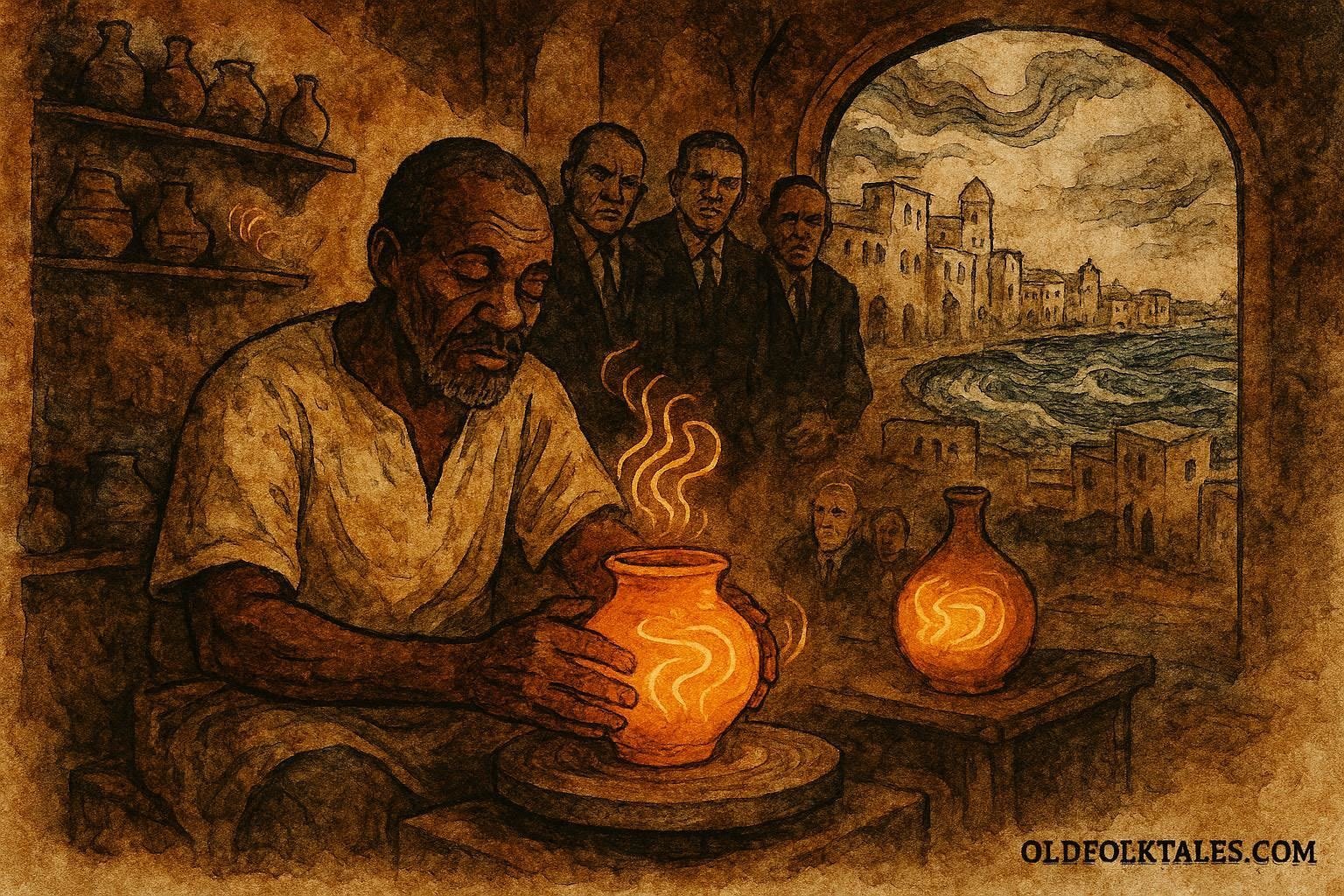
On the Atlantic coast of Morocco, where the city of Safi stands against wind, salt, and crashing waves, pottery is more than craft, it is identity. The earth there is rich with clay, and generations of artisans have shaped it into vessels that travel far beyond the shoreline.
In this city lived a blind potter.
Continue your journey: Read more East African folktales
He had not always been blind. In his youth, he once saw the world clearly, the colors of clay before firing, the shimmer of glaze in sunlight, the delicate imperfections that made each piece unique. But time took his sight, as it sometimes does, without warning or apology.
Still, he did not stop working.
Instead, he began to see differently.
Through touch.
Through sound.
Through memory.
And through clay.
The Potter Who Listened Differently
His workshop was small, tucked between narrow streets where the scent of sea salt mixed with kiln smoke. Visitors often wondered how a blind man could continue such delicate work.
But those who watched closely understood.
He did not shape clay with his eyes.
He shaped it with awareness.
He listened to its texture, its moisture, its resistance. He could tell when a vessel was balanced or flawed simply by the sound it made when turned gently in his hands.
The people of Safi respected him.
Not out of pity.
But out of quiet admiration.
For he created pottery that felt… alive.
The First Whisper in the Clay
It began on an ordinary day.
A customer came to his workshop speaking loudly, discussing local matters while selecting pieces. The potter worked as always, focused on the feel of the clay beneath his fingers.
After the customer left, something unusual happened.
As the potter shaped a new vessel, he paused.
He heard something.
A faint echo.
Not from outside.
From within the clay.
A voice.
At first, he thought it was imagination.
But then it came again.
Clearer this time.
The clay was repeating fragments of what had been spoken near it.
Words.
Tone.
Emotion.
He stopped working.
And listened.
The Clay That Remembers
Over the following days, the phenomenon repeated itself.
Whenever people spoke near the clay, it absorbed something of their voices, not just sound, but intention.
When shaped and fired, the pottery retained these echoes.
If someone had spoken truthfully, the vessel remained calm.
If someone had spoken with deceit, the clay seemed… restless.
And sometimes, when placed near the ear, faint voices could still be heard within it.
The potter realized something unsettling.
The clay was not just shaped by hands.
It was shaped by truth.
The Arrival of Power
News of his extraordinary pottery reached the ears of officials in Safi.
At first, they were intrigued.
Then they were interested.
Then they were strategic.
A blind potter whose vessels could carry influence without detection was not merely an artisan.
He was a tool.
One day, men of authority arrived at his workshop.
They brought instructions.
And expectations.
“We require a series of vessels,” they said. “For official communication.”
The potter listened quietly.
“And what will be said through them?” he asked.
“Messages of unity,” they replied.
But something in their tone did not match their words.
Still, he agreed to work.
The Hidden Messages
As the officials came and spoke near the clay, the potter sensed a disturbance in its rhythm.
The voices that entered the material were not aligned with what was spoken publicly.
There were contradictions.
Whispers of manipulation.
Statements designed for control rather than truth.
Yet the vessels were still completed.
And distributed.
At first, nothing unusual happened.
The people accepted the messages.
But then something changed.
Those who held the pottery began to notice something strange.
When they listened closely, or when the vessels were placed in quiet spaces, they could hear more than intended.
Not official declarations.
But fragments beneath them.
Truth layered under speech.
The Discovery of Corruption
It did not take long for confusion to spread.
Some vessels carried messages that contradicted others.
Some revealed inconsistencies in official statements.
Some even echoed conversations that were never meant to be repeated.
The officials grew alarmed.
They returned to the potter.
“You have altered the work,” they accused.
But the blind potter shook his head.
“I do not alter what I cannot see,” he replied.
“You have betrayed us,” they insisted.
But the clay had already spoken in its own way.
And truth, once embedded, does not easily disappear.
The Pressure to Destroy the Work
The officials demanded that he destroy his remaining pottery.
“You will stop this,” they said.
“Or you will lose everything.”
The potter stood in silence.
His workshop, once a place of calm creation, now felt heavy with tension.
He ran his hands over unfinished clay.
Each piece held fragments of voices.
Some truthful.
Some false.
All preserved.
If he destroyed them, the truth would remain buried.
If he released them, he risked chaos.
If he remained silent, he became complicit.
He was blind.
But he was not unaware.
The Decision of the Potter
That night, he sat alone in his workshop.
The sea wind moved through the streets of Safi.
The kiln cooled quietly beside him.
And the clay waited.
He placed his hands on one of the vessels.
And listened.
Within it, he heard everything.
Not just words.
But intention.
Truth layered beneath deception.
He understood then what the clay had been trying to show him all along.
The vessels were not the problem.
The voices were.
And silence would not protect anyone.
The Exposure of Truth
The next morning, he called for those who would listen.
Not officials.
Not authorities.
But ordinary people.
Fishermen.
Merchants.
Artisans.
He gathered them in the open courtyard.
And he placed the vessels before them.
One by one.
He asked them to listen.
At first, there was hesitation.
Then curiosity.
Then silence.
And finally, understanding.
Because within the clay, the truth could no longer be contained.
It had already been shaped.
Aftermath in Safi
The officials attempted to intervene.
But the voices had already spread.
People had heard too much.
Questions replaced acceptance.
Doubt replaced obedience.
And slowly, the structure of control weakened, not through violence, but through revelation.
The potter did not celebrate.
He did not claim victory.
He simply returned to his work.
But something had changed.
He was no longer only a craftsman.
He had become a witness.
The Legacy of the Blind Potter
In time, his story spread beyond Safi.
Not as a tale of rebellion.
But as a reminder.
That perception is not limited to sight.
That truth can live in materials.
And that even those without vision may see more clearly than those who rely only on authority.
His pottery continued to be made.
But it was never again used for deception.
Only for honesty.
And memory.
Fascinated by this tale? Discover more North African folktales
Moral Lesson
Truth cannot be hidden when it is shaped into the world itself. Even those who are overlooked or underestimated may become guardians of clarity when they choose integrity over silence.
Knowledge Check
- What is the main lesson of “The Blind Potter of Safi and the Clay That Remembered Voices”?
The story teaches that truth can emerge through unexpected means, and integrity is stronger than manipulation or authority. - What special ability did the potter’s clay develop?
The clay retained echoes of voices spoken near it, preserving truth and intention within the finished pottery. - Why did the officials use the pottery?
They attempted to use it as a tool for controlled communication and influence over public perception. - How did the blind potter discover corruption?
He sensed inconsistencies in the voices embedded within the clay, revealing hidden deceit in official messages. - What role does blindness play in the story?
It symbolizes heightened perception beyond sight, emphasizing intuition, awareness, and deeper understanding. - What cultural values are reflected in this Moroccan folktale?
The story highlights craftsmanship, truth, justice, resilience, and the dignity of marginalized voices.
Source: African folktale, Morocco. Inspired by Moroccan coastal craft folklore documented in Ceramics and Memory in Safi by Abdelkébir Khatibi (2001).
Cultural Origin: Safi, Morocco