In the eastern reaches of Morocco, where the Sahara stretches endlessly and the dunes of Merzouga rise like golden waves frozen in time, caravans have always moved with caution. The desert there is not simply a landscape, it is a living uncertainty. It shifts without warning, erases footprints, and reshapes direction as if testing those who dare to cross it.
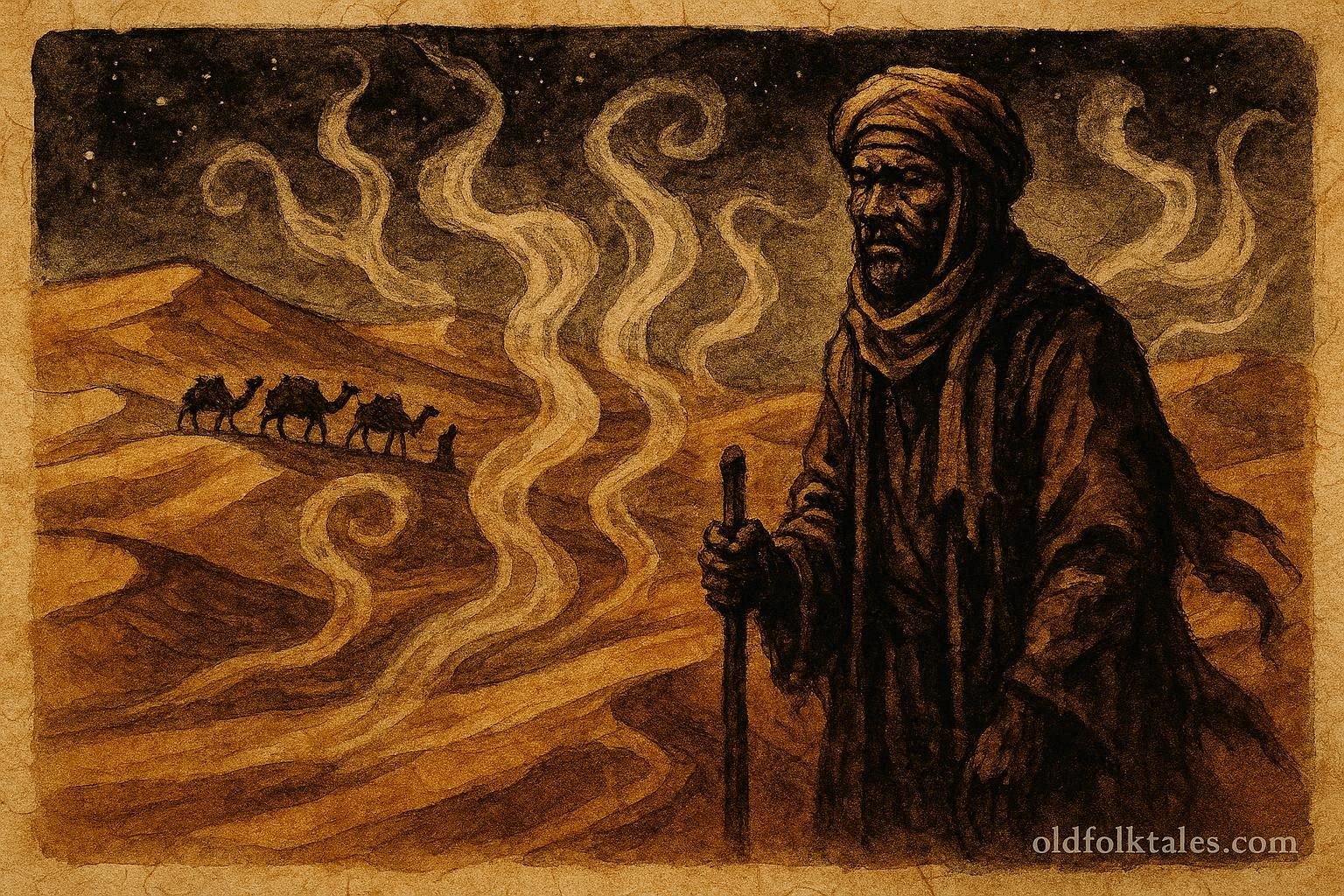
Among these shifting sands lived a seasoned caravan guide.
Want more? Read more West African folktales now
He was not young, nor inexperienced. He had crossed the desert many times, leading traders, travelers, and goods between distant points where water was rare and trust was essential. His reputation was built not on speed, but on survival. People followed him because he returned.
That, in the Sahara, is enough to earn respect.
But even the most experienced guide learns eventually that the desert does not remain familiar forever.
The Journey into Merzouga
One season, he led a caravan deeper into Merzouga than usual. The group was mixed, traders, laborers, and travelers bound for different destinations, all relying on his knowledge of the dunes.
At first, the journey was steady.
The sun rose and fell in predictable rhythm.
The sand shifted, but not aggressively.
Even the wind seemed cooperative, brushing gently across the dunes rather than striking them.
But on the third night, something changed.
The First Whisper
It began at rest.
The caravan had settled between two dunes, their silhouettes dark against a sky full of stars.
The guide sat apart from the others, as he often did, listening to the desert’s night sounds, the subtle movement of air, the distant settling of sand, the quiet breath of the world cooling.
That was when he heard it.
A whisper.
Not spoken by any person nearby.
Not carried by conversation.
But carried by the wind itself.
He turned his head slightly.
The sound faded.
Then returned.
Faint.
Unclear.
But unmistakably present.
“You are not safe,” it seemed to say.
The guide frowned.
The desert had many sounds.
But this was different.
It felt directed.
The Growing Voices of the Sand
The next night, the whisper returned.
Stronger.
Closer.
This time, it did not feel like a single voice.
It felt like many.
Fragments of speech layered within the wind.
Warnings.
Warnings that seemed to form just beyond understanding.
The guide began to pay closer attention to his caravan.
Who spoke at odd hours.
Who moved without explanation.
Who avoided eye contact.
He told himself it was caution.
But caution slowly shifted into suspicion.
And suspicion into unease.
The Warning of Betrayal
On the fifth night, the whisper became clearer than ever.
“Betrayal walks with you.”
The guide froze.
He looked across the sleeping caravan.
The words did not point to anyone specifically.
But his mind did.
He began to observe differently.
A trader who lingered too long near supplies.
A traveler who asked too many questions about routes.
A laborer who stayed awake longer than necessary.
Every action became a possible sign.
Every silence became a possible threat.
The desert, once a path, now felt like a listener.
And it was speaking too much.
Leadership Under Pressure
The guide changed his behavior.
He tightened control over decisions.
He limited conversations.
He altered routes slightly, without explanation.
The caravan noticed.
Whispers among the group began.
“Something is wrong,” they said.
“He is no longer certain.”
But the guide heard something else.
Beneath their words, he thought he heard confirmation of betrayal.
The desert whispers seemed to echo everything.
Or distort it.
He could no longer tell the difference.
The Collapse of Certainty
One night, the wind grew stronger than usual.
The dunes groaned softly as air moved across them.
The whispers returned, but now they were louder, almost overwhelming.
“Trust no one.”
The guide stood alone at the edge of the camp.
His breath felt heavy.
His thoughts no longer settled easily.
He turned to the caravan behind him.
Shapes in the dark.
Movement without clarity.
Was it coordination?
Or coincidence?
The desert gave no answers.
Only echoes.
The Breaking Point
By the seventh night, the guide was exhausted.
Not from travel.
But from listening.
He no longer trusted silence.
He no longer trusted sound.
He no longer trusted even his own interpretation of both.
That night, the whisper came again.
Closer than ever.
“Danger is within.”
The guide drew his cloak tighter.
His eyes scanned the camp repeatedly.
Then he made a decision.
He confronted the caravan.
Not with evidence.
But with fear.
He accused them of hiding intentions.
Of planning betrayal.
Of acting against him.
The camp fell silent.
Not in guilt.
But in shock.
The Desert Reacts
The wind shifted suddenly.
Stronger than before.
Sand lifted lightly around the edges of the camp.
The guide turned sharply.
The whisper was back.
But now it was different.
It no longer warned.
It repeated.
Echoed.
Multiplied.
The desert itself seemed to reflect his fear back at him.
He realized something then.
The whispers had never named anyone.
Only possibilities.
And he had filled in the rest.
The Moment of Doubt
For the first time, he questioned himself.
Had the desert been warning him?
Or had it been amplifying what was already inside him?
He stepped away from the group.
Away from the voices.
Away from the noise.
He listened again.
The wind moved through the dunes.
And in it, he heard nothing clearly.
Only shifting air.
Only sand.
Only silence.
The whispers faded.
Understanding the Desert
The guide remained awake until dawn.
As the first light touched Merzouga’s dunes, he finally understood something important.
The desert had not spoken in certainty.
It had spoken in ambiguity.
And ambiguity could become either warning or fear, depending on the mind that received it.
He returned to the caravan.
Calmer.
Not fully certain.
But no longer consumed by suspicion.
The Journey Continues
He did not accuse anyone again.
He did not dismiss the whispers entirely either.
Instead, he returned to what he had always relied on before:
observation,
patience,
and balance.
The caravan continued its journey through Merzouga.
The winds still moved.
The sands still shifted.
But the guide no longer mistook uncertainty for truth.
What the Desert Teaches
The whispers never returned in the same way again.
Or perhaps they had never been separate from the wind at all.
What changed was the guide.
He learned that isolation can amplify fear.
And that leadership requires distinguishing between warning and interpretation.
The desert, after all, does not always speak clearly.
It reflects.
Fascinated by this tale? Discover more North African folktales
Moral Lesson
In uncertainty, fear can transform ambiguity into accusation. True leadership is not about reacting to every perceived threat, but about discerning what is real from what is reflected within oneself.
Knowledge Check
- What is the main lesson of “The Caravan Guide and the Whispering Sands of Merzouga”?
The story teaches that fear can distort perception, and leadership requires clarity rather than assumption. - What do the whispers in the desert represent?
They represent uncertainty, psychological stress, and the way fear can influence interpretation of reality. - Why does the caravan guide begin to distrust his group?
He interprets ambiguous desert whispers as warnings of betrayal among his companions. - What causes the guide’s paranoia to escalate?
Isolation, exhaustion, and repeated ambiguous “whispers” from the desert amplify his suspicion. - How does the guide eventually change?
He learns to question his interpretations and return to observation rather than fear-driven assumptions. - What cultural values are reflected in this Moroccan Saharan folktale?
The story highlights survival wisdom, leadership responsibility, caution in judgment, and respect for the desert environment.
Source: African folktale, Morocco. Based on Saharan storytelling traditions compiled in Desert Echoes of Morocco by Tahar Ben Jelloun (2003).
Cultural Origin: Merzouga, Morocco