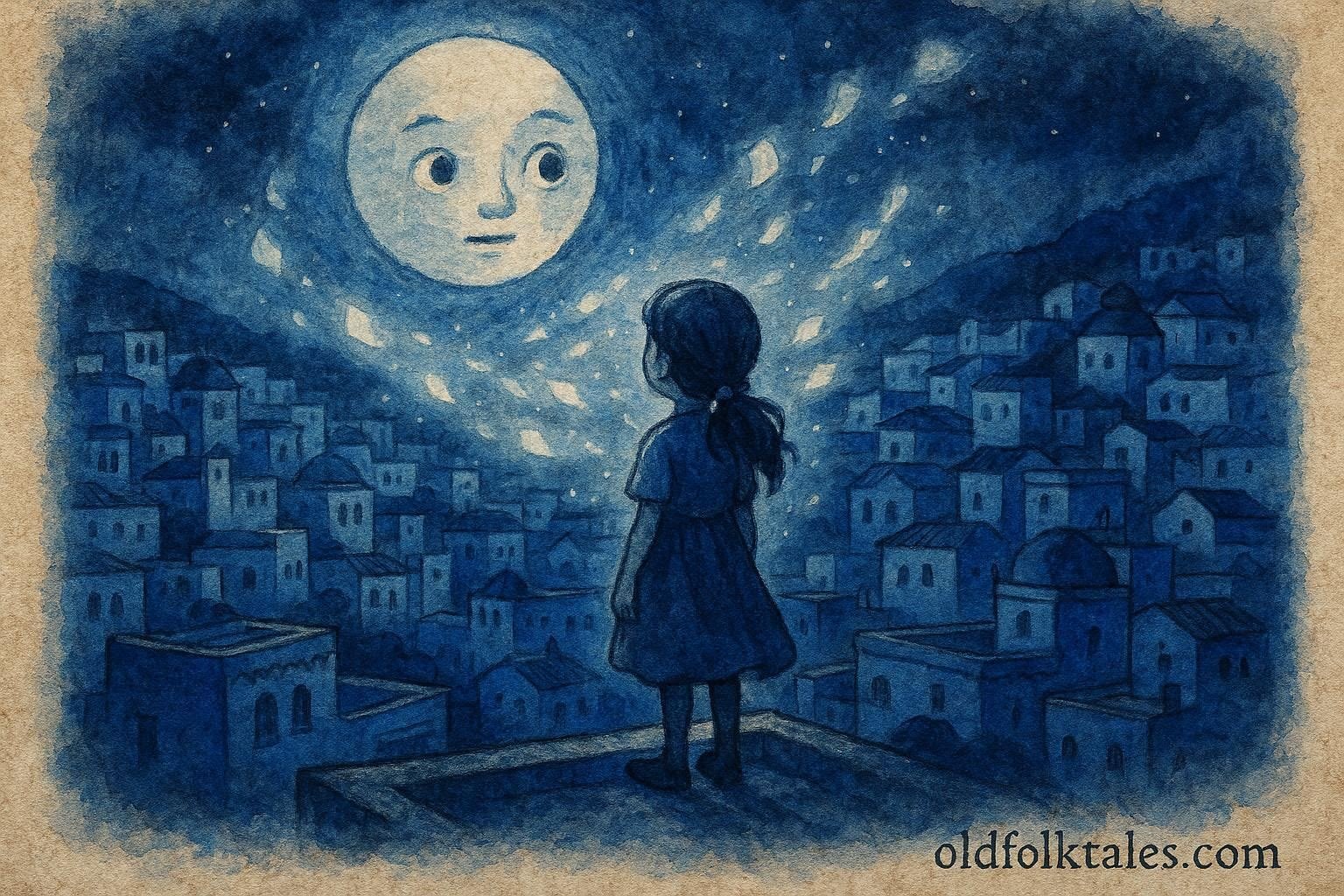
In the Rif Mountains of northern Morocco, where the city of Chefchaouen rests like a dream painted in endless shades of blue, nights are not empty. They are layered with quiet light, mountain wind, and the kind of silence that feels almost alive.
The houses there are washed in indigo and cobalt. The alleys curve gently like flowing water. Even time, it seems, moves more softly in Chefchaouen.
Want more? Read more West African folktales now
In this city lived a young girl who often felt as though she did not fully belong to the world around her.
She was not unhappy in the way sorrow is loud.
Her loneliness was quieter than that.
It sat with her at night.
And spoke only when everything else was still.
Her Conversation with the Moon
Each night, after the city grew quiet and the last footsteps faded from the blue-washed streets, the girl would climb to a small open terrace near her home.
From there, she could see the moon clearly above the Rif Mountains.
It looked close enough to touch.
She began speaking to it.
At first, it was simple.
Small wishes whispered into the night.
“I wish for company,” she said one evening.
“I wish to feel less alone,” she said another.
And sometimes, she said nothing at all, only looked up, as if hoping the moon would understand what language could not carry.
For a long time, nothing happened.
The moon remained distant.
Unchanging.
Silent.
Or so she believed.
The Night the Moon Answered
One night, the air felt different.
The wind did not move as it usually did through the alleys. Even the rooftops seemed to hold their breath.
The girl climbed to her usual place and spoke again.
“I wish,” she said softly, “to be happy.”
This time, the silence did not last.
The moonlight deepened.
Not brighter.
Not dimmer.
But… closer.
And then, impossibly, she heard a voice.
Not from below.
Not from above.
But from within the light itself.
“Your wish is heard,” the moon said.
The girl froze.
She stepped back slightly.
“Who speaks?” she whispered.
“I am what you have been looking at,” the moon replied.
The air around her trembled gently, as though the world itself was adjusting to something unfamiliar.
The moon was answering.
The Condition of Wishes
Hope rose quickly in her chest.
“If you can grant wishes,” she said carefully, “then I wish for happiness.”
The moon remained silent for a moment.
Then it spoke again.
“Happiness is not given freely,” it said.
The girl frowned.
“What do you mean?”
The moon’s light softened slightly.
“Each wish,” it said, “requires something in return.”
The girl hesitated.
“What kind of return?” she asked.
The moon answered simply:
“A forgotten memory.”
The girl did not understand at first.
“Forgotten?” she repeated.
“Yes,” the moon said. “A memory from your past will be taken each time a wish is granted.”
The terrace grew colder.
The city below remained asleep.
The girl stood still, trying to grasp what she had been told.
“If I forget,” she said slowly, “how will I know what I have lost?”
The moon did not respond immediately.
Then it said:
“You will not know.”
The First Wish
Silence stretched between them.
The girl looked out over Chefchaouen, the blue walls, the winding streets, the sleeping city that had always been her world.
Then she spoke again.
“I still wish to be happy,” she said.
The moon did not argue.
It simply glowed.
And somewhere deep within her mind, something shifted.
A memory faded.
Not dramatically.
Not painfully.
But quietly, like a page turning in a book she could no longer read.
She blinked.
For a moment, she felt lighter.
But also… uncertain.
Something important had slipped away.
Yet she could not name it.
The Change Within Her
Days passed.
The girl continued her life in Chefchaouen.
But small things began to feel unfamiliar.
She would stand in places that once felt meaningful and feel nothing.
She would hear names she should recognize and feel no connection.
It was as if her life had begun to lose edges.
Still, at night, she returned to the terrace.
And the moon waited.
She made another wish.
Then another.
Each time, the moon granted it.
And each time, something within her quietly disappeared.
The Cost Becomes Visible
One evening, she stood in her home and looked around.
The room was familiar.
Yet not fully hers.
She opened a small wooden box she had always kept beside her bed.
Inside were objects she did not recognize clearly.
A ribbon.
A small carved piece of wood.
A folded note whose words she could no longer understand.
She felt a strange ache.
Not sadness.
Not joy.
Something in between.
“I am forgetting,” she whispered.
But even that realization felt distant, as though it belonged to someone else.
The Moon’s Final Warning
That night, she did not immediately make a wish.
She sat on the terrace longer than before, watching the moon carefully.
It felt less like a distant object now.
More like a presence watching her back.
“You have received what you asked for,” the moon said.
The girl’s voice trembled slightly.
“But I don’t remember what I was before,” she said.
“That is the cost,” the moon replied.
A long silence followed.
Then she asked softly:
“Why do you take memory?”
The moon answered:
“Because desire is heavy. And memory carries it.”
The wind moved gently through Chefchaouen’s blue streets.
The girl lowered her gaze.
“I don’t know if I want to continue,” she admitted.
The Final Choice
The moon did not force her.
It simply waited.
She thought about happiness.
Not as a feeling.
But as something she was supposed to understand.
Yet understanding itself felt slippery now.
She could not clearly recall what she had lost.
Only that something essential was missing.
And then, for the first time, she made a different kind of wish.
“I wish,” she said slowly, “to remember what I have forgotten.”
The moon paused.
The light around it dimmed slightly.
“That wish has a greater cost,” it said.
The girl nodded.
“I accept.”
The Return of Memory
The moonlight deepened again.
But this time, instead of fading away, something returned.
Memories did not arrive all at once.
They came in fragments.
A laugh.
A moment of loneliness.
A feeling of standing in a room and not being seen.
Each piece settled back into her mind like rain returning to dry earth.
And with each memory, understanding grew.
She saw her wishes.
She saw her losses.
She saw herself again, not as she was now, but as she had been.
Understanding the Truth
When the moon’s light steadied once more, the girl sat quietly.
“I understand now,” she said.
The moon did not respond immediately.
Then it said:
“What do you understand?”
The girl looked out over Chefchaouen.
“Happiness without memory is not happiness,” she said. “It is absence disguised as peace.”
The moon remained silent.
“And loneliness,” she added, “is not always something to erase. Sometimes it is something to understand.”
What Remained
After that night, she no longer made wishes.
Not because the moon was gone.
But because she had changed.
She still walked through the blue city.
She still looked up at the sky.
But now she did so with awareness.
The moon remained distant.
But no longer unreachable.
And she no longer asked it to take anything from her.
Want to dive deeper? Read more North African folktales today
Moral Lesson
Wishes can change what we have, but they can also take away what makes us who we are. True fulfillment is not found in erasing pain or memory, but in understanding both as part of identity.
Knowledge Check
- What is the main lesson of “The Girl Who Bargained with the Moon in Chefchaouen”?
The story teaches that desires come with consequences, and memory is essential to identity and true happiness. - What does the moon demand in exchange for wishes?
The moon demands that each granted wish costs the girl one forgotten memory. - Why does the girl begin to feel disconnected from her life?
She loses memories with each wish, causing her experiences and identity to fade gradually. - What does the moon symbolize in the folktale?
The moon represents desire, consequence, and the emotional cost of wish fulfillment. - Why is memory important in the story?
Memory is shown as the foundation of identity, meaning, and emotional understanding. - What cultural values are reflected in this Moroccan Rif folktale?
The story emphasizes self-awareness, emotional balance, reflection, and the importance of understanding consequences.
Source: African folktale, Morocco. Inspired by Rif Mountain oral tales recorded in Songs of the Blue City by Mohammed Achaari (2010).
Cultural Origin: Chefchaouen, Rif Mountains, Morocco