In the high Atlas Mountains of Morocco, where rocky cliffs rise like ancient walls and wild thyme grows between stone cracks, beekeeping has long been more than a craft. Among the Amazigh people, bees are treated with respect, almost reverence, because honey is not just food, it is a gift from a delicate balance between earth, flower, and flight.
Deep within these mountains lived a man known for collecting honey.
Looking for more? Explore the magic of East African folktales here
But unlike the careful keepers of tradition, he was driven by something heavier than need.
He was driven by greed.
The Man Who Took Without Asking
The honey collector was skilled. He knew how to find hives hidden in cliff hollows and forested slopes, where wild bees built their homes away from human eyes.
At first, he took only what he needed.
But over time, “need” became flexible.
And “enough” disappeared entirely.
He began to take more than his share.
More than his family required.
More than the land could comfortably give.
Still, he told himself it was harmless.
The mountains were vast.
The bees were many.
And no one was watching.
But the Atlas Mountains, as the elders said, are never truly silent.
The Sacred Hive
One season, while wandering deeper than usual into the mountains, the man discovered a place he had never seen before.
A narrow path led him to a hidden cliffside hollow.
Inside, nestled between wild rock and flowering shrubs, was a beehive unlike any he had encountered.
It was larger.
Denser.
Alive with a rhythm that felt almost deliberate.
The air around it shimmered with warmth.
And the hum of the bees was not chaotic.
It was structured.
Intentional.
As if it carried meaning.
The man smiled.
“This one will be valuable,” he said to himself.
The Theft
He waited until dusk.
When the bees were calmer.
When the mountain light softened.
Then he approached.
He took more honey than he had ever taken before.
The hive resisted, not aggressively, but noticeably, as if disturbed by his presence in a way that went beyond instinct.
Still, he continued.
He filled his containers.
He left nothing in return.
Not even gratitude.
As he descended the mountain, the wind shifted behind him.
But he did not look back.
The Bee Queen Appears
That night, as he prepared the honey in his home, something unusual happened.
The honey no longer smelled sweet.
It carried a strange bitterness.
He tasted it.
And recoiled.
“What is this?” he muttered.
But before he could understand, the air in his home changed.
The room grew warmer.
Not in temperature, but in presence.
A soft buzzing filled the space.
Then silence.
Then voice.
“You took without balance,” it said.
The man froze.
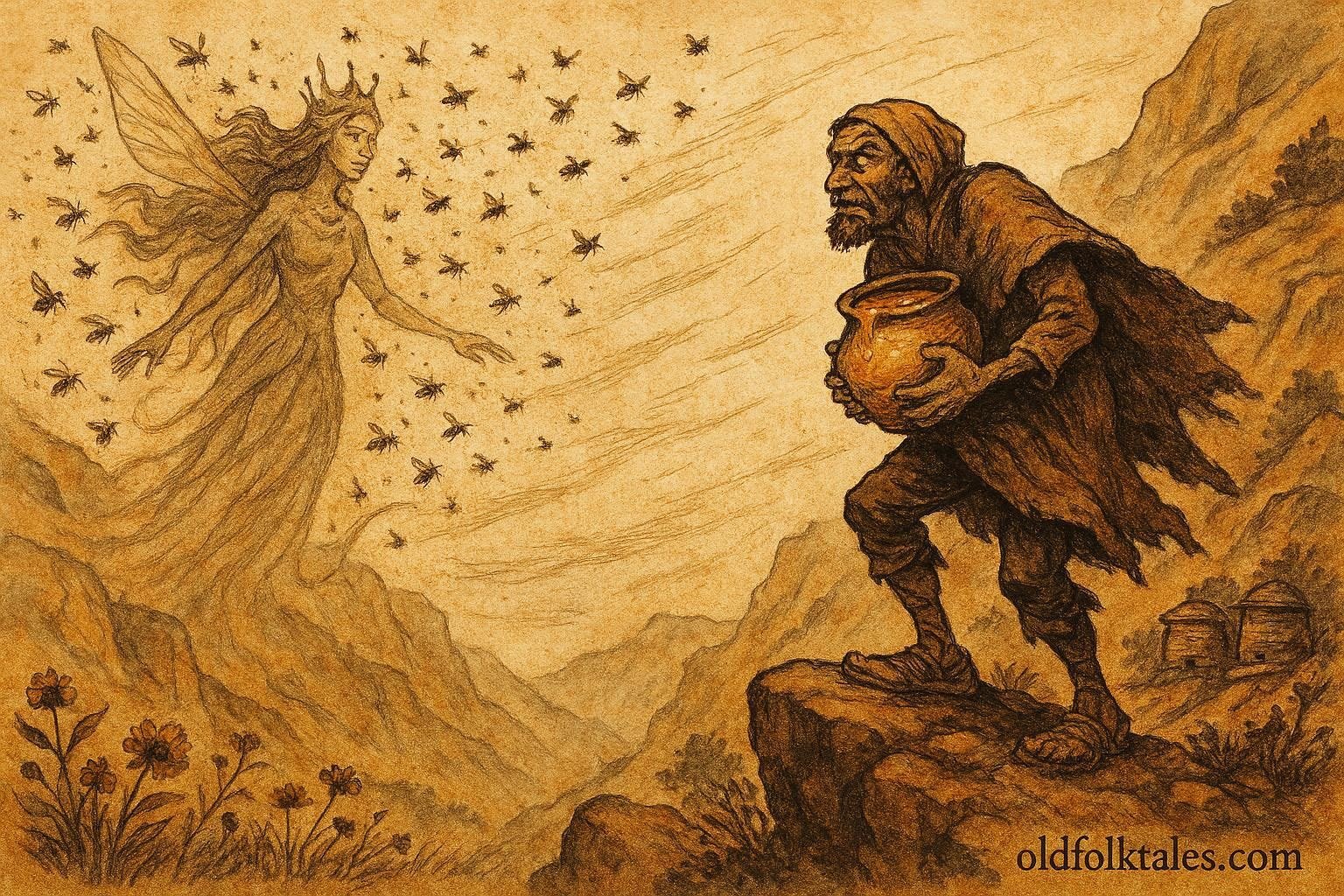
Standing before him, though not fully human in form, was the presence of the Bee Queen.
She was not large in the way a creature might be large.
She was vast in the way authority feels when it fills a space.
Her presence carried both sweetness and warning.
The Curse of Bitterness
The man tried to speak.
But no words came easily.
The Bee Queen looked at him steadily.
“You have disturbed what was shared,” she said.
“You have taken without return.”
The man fell to his knees.
“I needed it,” he said quickly. “I will repay,”
But the Bee Queen raised her hand.
“It is already decided.”
And with that, the curse was placed.
From that moment onward, every sweet thing the man consumed turned bitter in his mouth.
Honey.
Fruit.
Milk.
Even bread carried a taste of loss.
Nothing satisfied him.
Nothing comforted him.
What once brought pleasure now reminded him only of emptiness.
The Life of Bitterness
Days passed.
Then weeks.
The man tried to ignore the change.
He continued eating.
But everything reminded him of the same truth:
he had taken more than he should have.
His body remained fed.
But his experience of life became increasingly hollow.
Friends noticed his silence.
His withdrawal.
But he spoke little of what had happened.
Because how does one explain that sweetness itself has abandoned you?
The Return to the Mountain
Eventually, he could no longer endure it.
Not physically.
But inwardly.
So, he returned to the Atlas Mountains.
Back to the cliffs.
Back to the hive.
The journey was longer than he remembered.
Or perhaps he simply moved more slowly.
When he reached the hollow, he found it unchanged.
The bees still moved with calm precision.
The hive still hummed with quiet life.
And then she appeared again.
The Bee Queen.
The Request for Restoration
He bowed his head.
“I understand now,” he said.
The Bee Queen did not respond immediately.
Understanding alone is not repair.
“I took more than I needed,” he continued. “I did not respect the balance.”
The wind moved gently through the cliffs.
“What do you seek?” she asked.
The man hesitated.
“I want the bitterness to end,” he said finally.
The Bee Queen observed him for a long moment.
Then she spoke.
“Bitterness is not punishment,” she said. “It is memory.”
The man looked up slowly.
“Then how do I end it?” he asked.
The Path of Giving Back
The Bee Queen turned toward the hive.
“If you wish to restore balance,” she said, “you must return more than you took.”
The man frowned.
“How can I return what is already consumed?”
The Bee Queen answered simply:
“Through action that restores what you broke.”
She did not give him honey.
She gave him responsibility.
The Act of Restoration
From that day forward, the man changed his way of living.
He no longer took from hives carelessly.
When he collected honey, he left more than before.
He began protecting hives rather than exploiting them.
He guided others away from destructive harvesting.
He taught younger collectors to take only what the bees could afford to lose.
Slowly, something shifted.
Not in the world alone.
But within him.
The Lifting of the Curse
One morning, he tasted bread.
And for the first time in a long while, it was not bitter.
He paused.
Then took another bite.
Still sweet.
He closed his eyes.
And understood.
The curse had not been lifted.
It had been resolved.
Not through removal.
But through correction.
The Balance Restored
When he returned once more to the Bee Queen, she did not appear in anger.
Nor in celebration.
She simply observed him.
“You learned,” she said.
The man nodded.
“Yes,” he replied.
The Bee Queen’s presence softened slightly.
“Take only what you need,” she said, “and the land will remain generous.”
Then she was gone.
What Remained
The man continued to live in the Atlas Mountains.
But he was no longer known as a thief.
He became a keeper of hives.
A protector of balance.
And in time, others learned from his change.
The bees were no longer feared as something to exploit.
But respected as partners in survival.
And the mountains, once again, carried a quieter harmony.
Explore the wisdom and wonder of North African folktales
Moral Lesson
Nature does not punish greed out of anger, but restores balance through consequence. True harmony comes when humans take only what they need—and give back more than they consume.
Knowledge Check
- What is the main lesson of “The Honey Thief of the Atlas and the Bee Queen’s Curse”?
The story teaches that greed disrupts natural balance, and harmony can only be restored through responsibility and giving back. - Why was the honey considered sacred in the story?
It was produced by bees in a delicate ecological balance, representing harmony between nature and human survival. - What curse did the Bee Queen place on the thief?
She caused all sweet things he consumed to taste bitter until he learned to restore balance. - How did the man begin to redeem himself?
He changed his behavior by protecting bees, taking less honey, and teaching others sustainable practices. - What does the Bee Queen symbolize?
She symbolizes nature’s authority, ecological balance, and the consequences of exploitation. - What cultural values are reflected in this Moroccan Amazigh folktale?
The story emphasizes environmental respect, balance with nature, responsibility, and sustainable living.
Source: African folktale, Morocco. Inspired by Amazigh ecological myths recorded in Myths of the Atlas Beekeepers by Mohamed Chafik (2006).
Cultural Origin: Atlas Mountains, Morocco