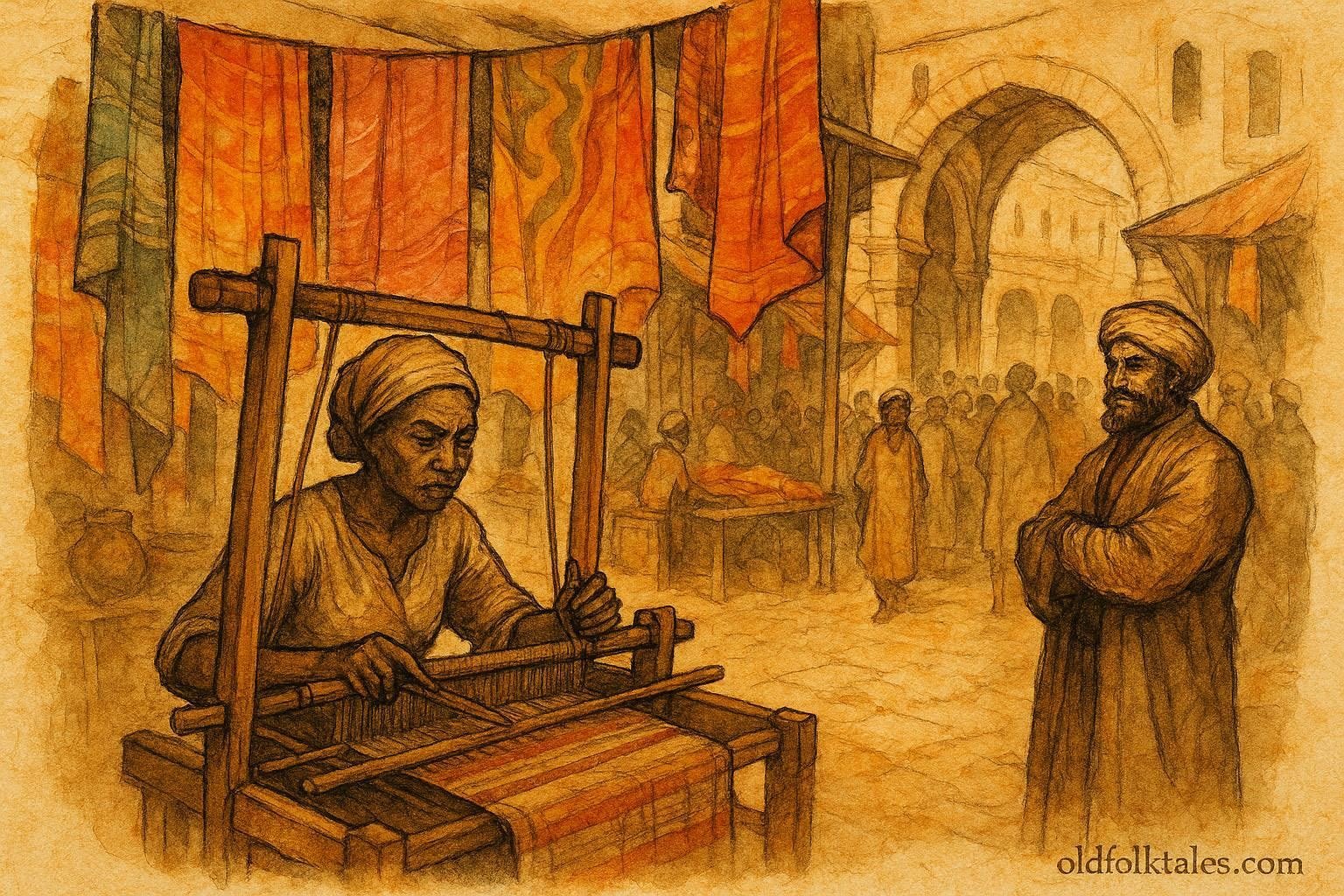
In the heart of Tunis, where the medina wound like a living tapestry of narrow alleys, shaded archways, and bustling market stalls, there lived a weaver whose work spoke more loudly than her voice ever could.
Her home was small, tucked between workshops filled with the sounds of hammering metal and carved wood. But within her modest space stood a loom unlike any other, well-worn, carefully maintained, and always in motion. From it came fabrics of remarkable beauty, threads woven so precisely that they seemed to hold light within them.
Don’t stop yet! See our complete East African folktales collection
People came from different parts of the city to see her work. Some came to buy, others simply to admire. Her fabrics were not the most expensive in the market, nor were they the most widely displayed, but those who understood craftsmanship recognized something rare in them, patience, care, and quiet mastery.
The weaver did not rush her work. Each thread was placed with intention, each pattern built slowly, like a story unfolding over time. She believed that beauty could not be forced, and that the dignity of her labor was as important as the finished cloth itself.
Her reputation grew steadily.
In the same medina, there lived a wealthy merchant whose shop stood near the central market square. His space was large, filled with goods from distant lands, silks, spices, and ornaments that attracted attention and admiration. He was known for his success, but also for his sharp dealings. Where others saw trade as an exchange, he saw it as a game to be won.
It was inevitable that he would hear of the weaver.
At first, he dismissed the stories.
“A simple artisan cannot produce anything beyond what is already known,” he said.
But curiosity, mixed with the quiet pressure of comparison, led him to visit her workshop.
He entered without ceremony, his eyes scanning the space before settling on the loom.
The weaver greeted him with calm respect.
“Welcome,” she said. “How may I assist you?”
“I have come to see your work,” he replied.
She nodded and stepped aside, allowing him to observe the fabric she was weaving. The merchant moved closer, examining the patterns, the texture, the precision.
Something in his expression shifted.
This was not ordinary work.
The designs were intricate, yet balanced. The colors seemed to move together as though guided by something more than skill alone.
“You made this?” he asked.
“Yes,” she replied simply.
The merchant straightened, his mind already turning.
“I would like to purchase your fabrics,” he said. “In large quantity.”
The weaver considered this.
“I produce only what I can complete with care,” she said. “I do not rush my work.”
“I will pay well,” he insisted.
“I do not doubt it,” she answered. “But my work is not measured only in coin.”
The merchant forced a smile.
“Very well,” he said. “Then I will take what you have available.”
Their exchange was brief, but as he left, his thoughts lingered not on what he had bought, but on what he had seen.
“This could bring great profit,” he thought. “If it were in my hands.”
In the days that followed, the merchant began to study her work more closely. He examined the fabrics he had purchased, tracing the patterns, attempting to understand how they were made.
Then, quietly, he began to act.
He commissioned other weavers, those who worked for him or depended on his trade, to replicate the designs. He showed them the fabrics, instructing them to produce similar patterns as quickly as possible.
“Make them look the same,” he said. “The market will not know the difference.”
And soon, fabrics resembling the weaver’s designs began to appear in his shop.
At first glance, they seemed identical. The colors were similar, the patterns closely copied. But something was missing, a subtle quality that could not be easily imitated.
Still, many buyers did not notice.
They saw the designs, the merchant’s large display, and the lower prices. They purchased without question.
Word began to spread that the merchant now sold the finest fabrics in the medina.
The weaver noticed the change.
Customers who once visited her workshop came less frequently. Those who did often mentioned the merchant’s shop.
“They say he has fabrics like yours,” one woman said.
The weaver listened quietly.
She did not rush to respond. She did not accuse or confront.
Instead, she continued her work.
Day after day, she wove as she always had, patiently, carefully, without compromise.
The elders of the medina, those who had seen many seasons of trade, began to take note of the situation.
They visited both shops.
In the merchant’s store, they saw abundance, rows of fabrics displayed for quick sale. In the weaver’s workshop, they saw something different, a slower process, a deeper attention to detail.
One elder ran his hand across the merchant’s fabric.
“It looks the same,” he said.
“But it does not feel the same,” another replied.
The difference, though subtle, began to reveal itself.
Customers who had purchased from the merchant returned with quiet dissatisfaction. The fabrics wore more quickly, their colors fading, their threads loosening.
“It is not what it seemed,” they said.
Gradually, questions arose.
“Where did these designs come from?”
“Who made them first?”
The merchant grew uneasy.
He increased his efforts, pushing his workers to produce more, faster, better. But the essence of the designs remained beyond their reach.
Meanwhile, the weaver’s reputation, though challenged, did not disappear. Those who valued quality returned to her, drawn by the consistency of her work.
At last, the matter reached a point where it could no longer remain unspoken.
The elders called for a gathering in the market square.
Both the merchant and the weaver were summoned.
The square filled with people, buyers, artisans, traders, all eager to witness what would unfold.
An elder stepped forward.
“There is confusion in our market,” he said. “Two sources claim the same work. Today, we seek clarity.”
He turned to the merchant.
“Where do your designs come from?”
The merchant stood tall, his expression composed.
“They are produced by my workshop,” he said. “I have invested in their creation.”
The elder nodded, then turned to the weaver.
“And you?”
“I create my work at my loom,” she said. “As I always have.”
The elder paused.
“Then we will test not the words, but the work.”
A loom was brought into the square.
Threads were prepared.
The weaver stepped forward first.
Without haste, she began to work. Her hands moved with quiet confidence, guiding each thread into place. The pattern emerged gradually, precise and balanced, as though it had always existed within the loom itself.
The crowd watched in silence.
Then, the merchant’s weavers were asked to do the same.
They worked quickly, attempting to replicate what they had seen before. But without the understanding behind the patterns, their efforts faltered. The design did not hold. The threads shifted, the balance lost.
The difference was clear.
A murmur spread through the crowd.
The elder raised his hand.
“The truth reveals itself through the work,” he said.
He turned to the merchant.
“You have taken what is not yours, not with your hands, but through imitation without understanding.”
The merchant’s composure faltered.
“I only sought to meet demand,” he said weakly.
“At the cost of honesty,” the elder replied.
The merchant lowered his gaze.
The elder then addressed the crowd.
“Let it be known that true craftsmanship cannot be stolen. It lives in the hands and the heart of the maker.”
The weaver said nothing. She simply stepped back from the loom, her work complete.
From that day forward, her reputation grew stronger than before. People came not only for her fabrics, but for what they represented, integrity, patience, and the dignity of honest labor.
As for the merchant, he continued his trade, but with a lesson that could not be undone.
In the medina of Tunis, where voices rose and fell like woven threads, the story of the weaver endured, a quiet but powerful reminder that what is built with integrity will always stand, even when imitation tries to take its place.
Want to dive deeper? Read more North African folktales today
Moral Lesson
True craftsmanship and integrity cannot be copied or stolen. Honest work, built with patience and dignity, will always outlast deceit.
Knowledge Check
- What is the main lesson of The Weaver of Tunis?
The story teaches that integrity and true craftsmanship cannot be imitated or stolen, and honesty leads to lasting success. - Why did the merchant try to copy the weaver’s designs?
He wanted to profit from her unique work without investing the same effort or skill. - How was the merchant’s deceit revealed?
The elders tested both parties by having them weave publicly, exposing the difference in skill and authenticity. - What makes the weaver’s fabrics unique?
Her patience, attention to detail, and deep understanding of her craft make her work unmatched. - What does the loom symbolize in the story?
The loom represents honest labor, creativity, and the connection between skill and identity. - What cultural values are reflected in this Tunisian folktale?
The story highlights values of integrity, dignity in labor, fairness in trade, and respect for artisanship.
Source: African folktale, Tunisia. Adapted from urban Tunisian folktales centered on artisan life, recorded in folklore anthologies (c. 1970s–1980s).
Cultural Origin: Tunisian city-based storytelling traditions influenced by Ottoman-era markets