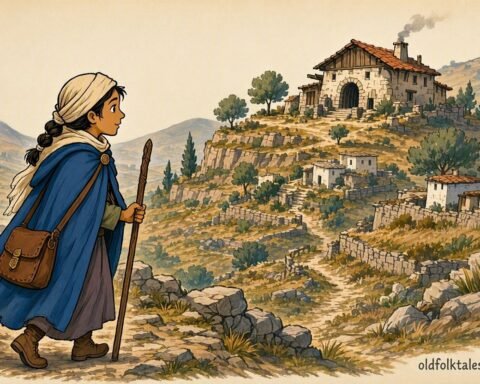
At the foothills of the Atlas Mountains, where rugged slopes met patches of green forest and streams ran clear over stone, there lived a boy who was known more for his silence than for his words.
He lived with his family on the edge of a small Amazigh village, where homes were built from earth and stone, and life followed the steady rhythm of the land. The people farmed what they could, gathered what the mountains offered, and respected the forests that surrounded them. Those forests were not seen as empty wilderness, but as living spaces, shared, watched, and understood in ways that had been passed down through generations.
Continue your journey: Read more East African folktales
The boy, however, often stood apart.
While other children played in the open spaces near the village, he wandered toward the trees. He preferred the quiet of the forest, the rustle of leaves, the soft movement of animals, the subtle sounds that most people did not notice.
At first, his family thought it was simply his nature. Some children, they said, are drawn inward, content in their own company.
But as time passed, something unusual became clear.
The boy did not merely sit in silence among the animals.
He listened.
And somehow… he understood.
It began with small moments.
A bird perched nearby, chirping in a pattern that seemed almost deliberate. The boy tilted his head, as though following a conversation.
A goat wandered from its herd, bleating softly. The boy approached, not with caution, but with calm assurance, and the animal responded, settling as though comforted.
Soon, the pattern could not be ignored.
Animals did not flee from him as they did from others. They lingered, approached, and moved with an ease that suggested recognition.
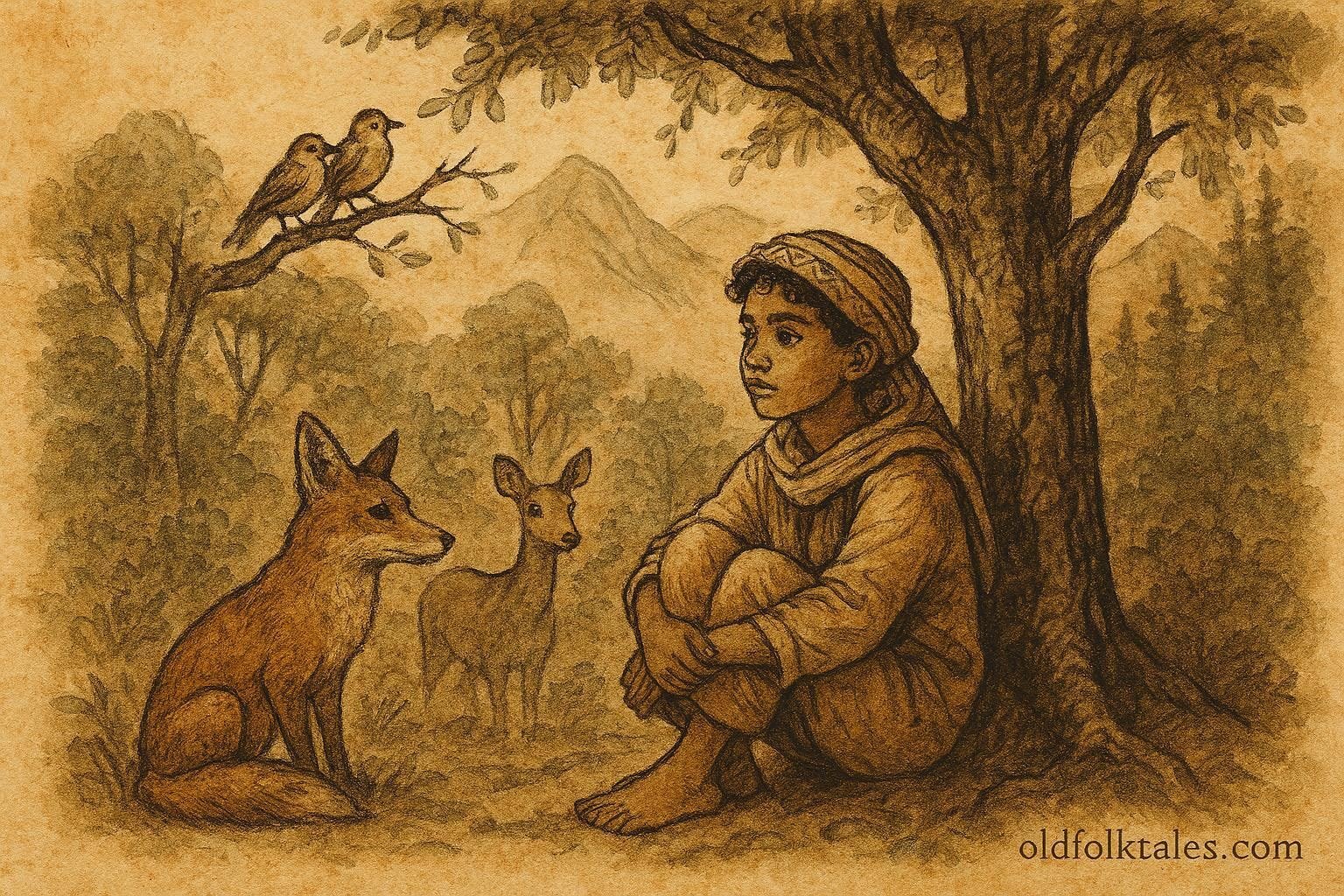
One day, his mother watched as he sat beneath a tree, surrounded by small forest creatures, birds on branches above him, a fox at a distance, even a shy hare closer than it would normally dare.
“What do you hear?” she asked him gently.
The boy looked up.
“They speak,” he said simply.
His mother smiled at first, thinking it the imagination of a child.
But the boy did not laugh or play.
“They tell me where they go,” he continued. “What they fear. What they need.”
The smile faded, replaced by quiet concern.
This was not something easily explained.
Word spread slowly through the village. Some dismissed it, others watched more closely. The elders, who held knowledge of old ways and stories long told, listened with greater attention.
“There are gifts that come quietly,” one elder said. “And they are not always meant to be ignored.”
So the boy was left to his wandering, though he was watched with new awareness.
Seasons passed, and his understanding deepened.
He learned the warning calls of birds, the cautious signals of small animals, the steady language of creatures that lived close to the earth. He did not command them, nor did he seek to control. He listened, and in listening, he became part of something larger than himself.
It was during one such season that the balance began to shift.
Hunters came to the region.
They were not from the village, nor from neighboring communities. They came from farther lands, drawn by stories of the forest’s abundance. They carried tools of skill and intent, moving with purpose, not for need, but for gain.
At first, their presence was distant.
But the animals felt it immediately.
The forest changed.
Birds grew quieter. Herds moved more cautiously. Paths once used freely were abandoned. The boy sensed the unease before he understood its cause.
One morning, a deer approached him at the edge of the forest. It stood still, its gaze fixed, its body tense.
“They are coming deeper,” the boy understood.
He followed the signs, moving carefully through the trees until he saw them, men moving with precision, setting traps, watching the movement of animals with practiced eyes.
The boy’s heart tightened.
This was not like the occasional hunting done by his own people, guided by respect and necessity. This was different, faster, heavier, driven by something that did not pause.
He returned to the village.
“There are hunters in the forest,” he said.
The villagers nodded. “There have always been hunters,” one man replied.
But the boy shook his head.
“They do not take only what they need,” he said. “They take what they can.”
Some listened. Others were uncertain.
The elders, however, grew thoughtful.
“The forest will tell us if something is wrong,” one said.
“It already has,” the boy replied quietly.
Still, action did not come quickly.
So, the boy turned again to the forest.
If the village could not yet see the danger, then he would do what he could.
He began to move among the animals, carrying messages, not with words spoken aloud, but through presence and understanding. He guided them away from certain paths, toward safer ground. He listened for warnings and passed them along.
The forest responded.
Movements shifted. Patterns changed. The hunters found fewer tracks, fewer signs of life.
Frustration grew among them.
“They are avoiding us,” one said.
“Then we go deeper,” another replied.
And so they did.
The deeper they went, the greater the risk, not only to the animals, but to the balance of the land itself.
The boy knew he could not do this alone.
At last, he returned once more to the elders.
“This will not stop,” he said. “They will take until nothing is left.”
The elders listened more carefully now.
“What would you have us do?” one asked.
The boy paused.
“We must act together,” he said. “Not just as people, but with the forest.”
There was silence.
Then, slowly, the elders nodded.
That evening, the village gathered.
They did not rush into the forest with force. Instead, they moved with intention. They marked their presence clearly, making it known that the land was watched, that it was not empty or unclaimed.
They followed the boy’s guidance, avoiding disruption where it was not needed, focusing instead on protecting the paths and spaces most at risk.
The hunters noticed.
“This land is not as open as we thought,” one said.
“They are watching us,” another added.
The ease they had relied upon began to fade.
Meanwhile, the animals, guided by the boy, continued to shift their movements, staying beyond the reach of danger.
Days passed.
The hunters’ success diminished. Their efforts grew heavier, their progress slower.
At last, they made a decision.
“This is not worth the struggle,” one said.
And gradually, they left.
The forest settled once more.
The birds returned to their songs. The animals moved with greater ease. The balance, though shaken, began to restore itself.
The villagers saw it.
They saw how close they had come to losing something they had long taken for granted.
And they saw the role the boy had played, not through force, but through understanding.
The elders called him forward.
“You have listened where others did not,” one said. “You have acted with care, not control.”
The boy lowered his gaze.
“I only did what I could,” he said.
“That is often what is needed most,” the elder replied.
From that day on, the boy was no longer seen as distant or strange. He was understood, perhaps not fully, but enough.
He continued to walk among the trees, to listen, to learn.
And the village, too, changed.
They watched more closely. They listened more carefully. They remembered that the land was not theirs alone, but something shared, something living, something that required care.
As for the boy, his gift remained what it had always been, not a power to command, but a responsibility to understand.
And in that understanding, the forest found its voice, and its protection.
Explore the wisdom and wonder of North African folktales
Moral Lesson
True strength lies in empathy, responsibility, and harmony with nature. Protecting the environment requires listening, understanding, and collective action.
Knowledge Check
- What is the main message of The Boy Who Spoke to Animals?
The story teaches that empathy, responsibility, and respect for nature are essential to maintaining balance and protecting the environment. - What special ability does the boy have?
He can understand and communicate with animals, allowing him to learn their needs and warnings. - Why were the hunters a threat to the forest?
They hunted excessively, taking more than needed and disrupting the natural balance. - How did the boy help protect the animals?
He guided them to safety and helped the village understand the danger, leading to collective action. - What role do the elders play in the story?
They represent wisdom and eventually support the boy’s efforts to restore balance. - What cultural values are reflected in this Amazigh folktale?
The story emphasizes harmony with nature, communal responsibility, respect for life, and the importance of listening.
Source & Cultural Origin
Source: African folktale, Tunisia. Adapted from Berber oral folklore passed through generations, documented in ethnographic collections (mid-20th century).
Cultural Origin: Amazigh (Berber) communities in Tunisia’s mountainous regions