Along the northwestern coast of Madagascar stood the historic port city of Mahajanga, a place shaped for centuries by trade, migration, and cultural exchange across the Indian Ocean. Sailors from distant lands arrived at its harbors carrying spices, cloth, stories, and beliefs that blended with Malagasy traditions already rooted deeply within the region.
The city thrived through commerce.
Merchant boats crowded the coastline while traders filled busy markets with goods arriving from East Africa, Arabia, and inland Madagascar. Wealth flowed steadily through Mahajanga, attracting influential families, ambitious officials, and powerful merchants competing for influence over the growing coastal city.
Yet beneath the prosperity, corruption quietly spread.
Bribes influenced trade agreements. Taxes intended for public projects disappeared into private hands. Poor fishermen and laborers struggled increasingly while wealthy elites expanded their influence through secret alliances and dishonest dealings.
Don’t miss out: Read more Southern African folktales
Many ordinary people complained quietly but feared speaking openly against powerful figures controlling the city.
It was during this uneasy period that the stranger arrived.
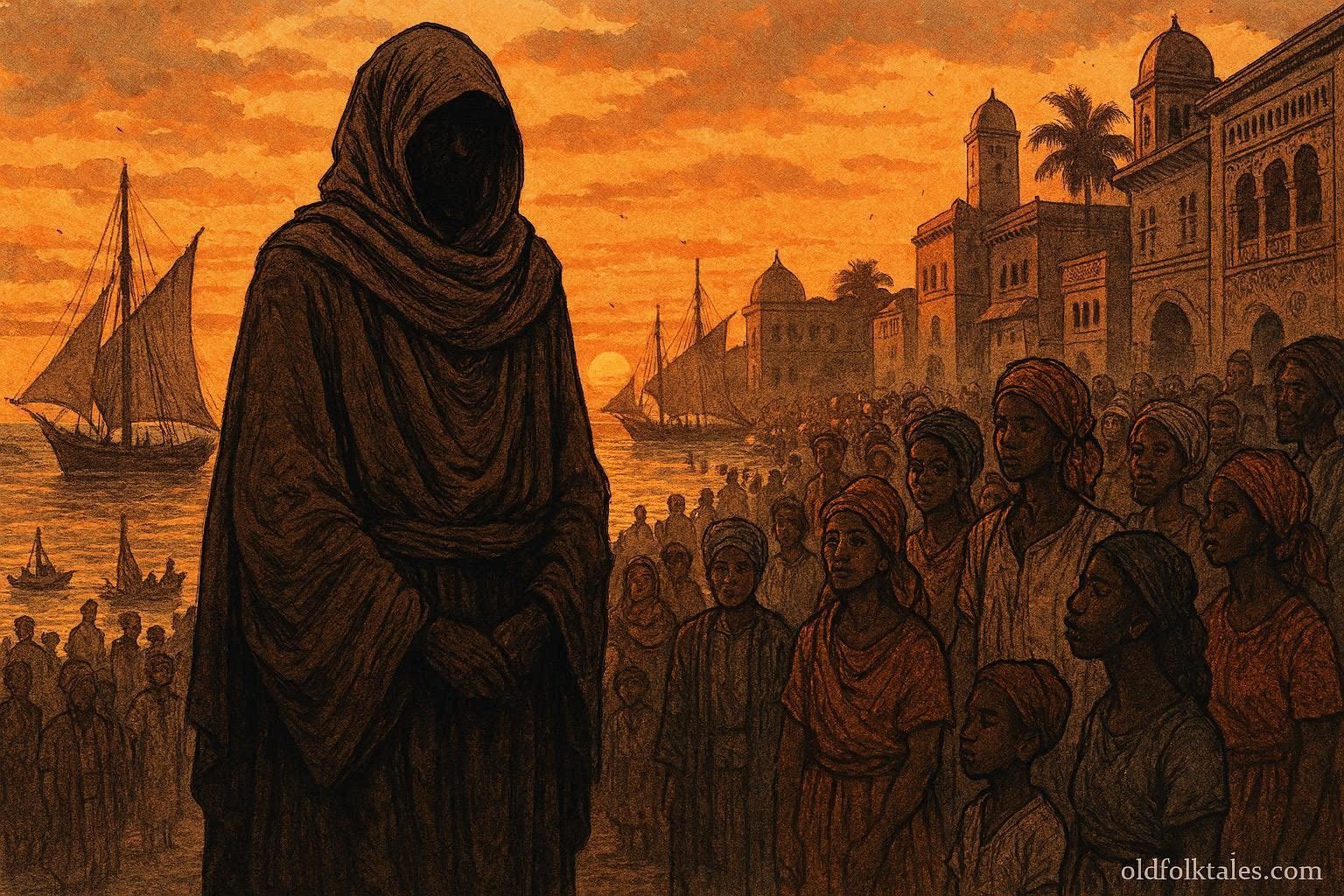
According to oral tradition, the man appeared in Mahajanga shortly before the beginning of the rainy season. He wore long dark robes and kept part of his face covered beneath a light veil despite the coastal heat. No one knew where he came from, though some believed he arrived aboard a foreign trading vessel during the night.
Others insisted he simply appeared at dawn near the harbor without explanation.
The stranger carried no possessions except a carved wooden staff decorated with unfamiliar symbols.
At first, most people ignored him.
Mahajanga welcomed travelers regularly, and wandering spiritual figures were not uncommon along Indian Ocean trade routes. Yet the mysterious man quickly attracted attention because of his unusual behavior.
He spoke rarely.
But whenever he did speak, his words unsettled listeners deeply.
Standing within crowded marketplaces or near government compounds, the stranger warned openly about dishonesty spreading throughout the city.
“A harbor built upon corruption cannot survive the storm,” he declared one afternoon before disappearing back into the crowded streets.
On another day, he warned wealthy merchants publicly:
“The sea returns what greed steals from the poor.”
Rumors about him spread rapidly.
Some believed he was a holy man.
Others suspected he was a mad wanderer seeking attention.
A few feared he possessed supernatural knowledge.
Because strangely, several of his warnings soon appeared to come true.
One corrupt customs official accused publicly by the prophet lost an entire warehouse of illegal goods during a sudden fire near the harbor. A merchant known for exploiting fishermen suffered devastating financial losses after several trade ships disappeared during severe coastal storms.
People began whispering that the veiled stranger could see hidden truths ordinary people could not.
As fear and curiosity spread through Mahajanga, city authorities grew increasingly uncomfortable.
At the center of the city’s political leadership stood Governor Ramanantsoa, a powerful administrator whose influence depended partly upon secret agreements with wealthy merchants and traders benefiting from corruption throughout the port.
The governor dismissed the prophet publicly as a dangerous troublemaker.
But privately, the stranger’s warnings disturbed him deeply.
Especially because some messages seemed directed specifically toward the ruling elite themselves.
One evening during a public gathering near the harbor, the prophet delivered his most troubling warning yet.
“Mahajanga stands upon the edge of betrayal,” he announced before a silent crowd. “Those who sell justice for wealth will soon face judgment from both sea and people.”
The crowd reacted immediately.
Some shouted in fear.
Others demanded explanations.
But before guards could approach him, the veiled man disappeared once again into the city.
The prophecy spread across Mahajanga by morning.
Tension increased rapidly afterward.
Merchants accused rivals of conspiracy while political advisers warned Governor Ramanantsoa that unrest could erupt if the prophet continued influencing public opinion. The governor ordered guards to locate and arrest the stranger quietly before panic spread further.
Yet despite searching throughout the city, authorities failed repeatedly to capture him.
Witnesses reported seeing the prophet in different parts of Mahajanga almost simultaneously near the harbor, inside marketplaces, beside mosques, and along narrow coastal streets.
Some believed ordinary people secretly protected him.
Others insisted supernatural forces concealed his movements.
Meanwhile, the city’s divisions deepened.
Poor laborers and fishermen increasingly viewed the prophet as a voice exposing injustice ignored by the wealthy. Powerful officials, however, feared the warnings threatened their authority.
Then the betrayal occurred.
One of Governor Ramanantsoa’s closest advisers secretly negotiated with foreign traders to seize control over important sections of the harbor for personal profit. The agreement involved raising taxes heavily against local fishermen and removing several community leaders opposing the plan.
But before the arrangement could become official, documents revealing the conspiracy appeared mysteriously throughout the city.
Copies spread rapidly across markets, docks, and gathering places.
Outrage exploded across Mahajanga.
Crowds gathered angrily outside government compounds demanding accountability while merchants accused one another of involvement. Trust within the ruling council collapsed almost overnight.
Governor Ramanantsoa realized too late that the prophet’s warnings had described events already unfolding beneath the surface.
Fearful of rebellion, the governor finally ordered a massive search across the city to capture the veiled stranger responsible for exposing the corruption.
That night, guards surrounded an abandoned structure near the shoreline where witnesses claimed the prophet had been seen entering.
The building stood empty except for a single object left behind.
At the center rested the prophet’s carved wooden staff.
Nothing else remained.
No footprints.
No sign of escape.
Only the sound of waves crashing against the harbor outside.
The prophet vanished completely from Mahajanga after that night.
Some believed he escaped secretly aboard a ship before dawn.
Others insisted he had never been an ordinary man at all.
Yet his warnings transformed the city permanently.
The political conspiracy collapsed, several corrupt officials lost their positions, and public pressure forced new agreements protecting fishermen and local communities from exploitation.
Though corruption never disappeared entirely, people remembered the events for generations afterward as proof that hidden injustice eventually reveals itself no matter how powerful those responsible may appear.
Even years later, coastal storytellers continued repeating the legend of the Veiled Prophet of Mahajanga.
According to old belief, during seasons of political unrest or dishonesty, mysterious figures sometimes still appear near the harbor warning the city before disaster arrives.
Because in the old Swahili-Malagasy traditions of the coast, truth may remain hidden for a time, but never forever.
Don’t stop yet! See our complete East African folktales collection
Moral Lesson
Greed and corruption eventually expose themselves, while truth and justice cannot remain hidden forever.
Knowledge Check
- Where did the story take place?
The story took place in the coastal city of Mahajanga in Madagascar. - Why did the prophet attract attention?
He delivered warnings about corruption, betrayal, and injustice within the city. - What made people fear the prophet?
Several of his predictions appeared to come true. - Who was Governor Ramanantsoa?
He was a powerful city leader connected to corrupt political dealings. - What happened after the conspiracy was exposed?
Public outrage forced political changes and weakened corrupt officials. - What lesson does the story teach?
Truth and justice eventually overcome corruption and dishonesty.
Source
Madagascan coastal folklore. Adapted from Swahili-Malagasy oral traditions preserved in coastal historical and ethnographic studies.