Off the northwestern coast of Madagascar lies the island of Nosy Be, a place long known for its warm waters, fishing villages, fragrant forests, and stories carried across the Indian Ocean by traders, sailors, and generations of coastal families. By day, the island bustled with fishermen preparing nets and wooden canoes along the beaches. But at night, when moonlight stretched across the sea, older stories returned to life.
The people of Nosy Be believed the ocean possessed memory.
Certain tides were considered sacred, and some stretches of water were approached with caution because elders believed unseen spirits moved beneath the waves. Fishermen often left offerings before dangerous journeys, asking the sea for protection and safe return.
Among the island’s oldest legends was the story of the Moon Bride.
According to tradition, she appeared only during certain full moons when the sea remained unusually calm and silver light covered the shoreline like mist. Some believed she belonged to the ocean itself. Others claimed she came from a hidden spirit world existing beneath the waters surrounding the island.
No one knew her true origin.
Yet many insisted she was real.
The legend began during a difficult season for one coastal village on Nosy Be. Storms repeatedly damaged fishing boats, catches became dangerously small, and hunger slowly spread among families depending entirely on the sea.
Looking for more? Explore the magic of East African folktales here
Fear and frustration grew throughout the community.
Some fishermen blamed changing tides.
Others believed the ancestors had become displeased.
At the center of the village lived a young fisherman named Mahery. Unlike many others, Mahery was thoughtful and quiet, known for spending long hours alone near the shore watching the sea at night.
One evening during a full moon, after returning unsuccessfully from fishing, Mahery sat beside the water long after the rest of the village had fallen asleep.
The ocean appeared strangely calm.
Then he saw her.
Far out upon the shoreline stood a woman dressed in pale flowing cloth that reflected the moonlight almost like water itself. Her dark hair moved gently in the ocean breeze while small waves touched her feet without disturbing her balance.
Mahery stared in disbelief.
The woman seemed both real and unreal at the same time.
Slowly, she turned toward him.
Though separated by distance, her eyes appeared strangely bright beneath the moonlight.
Without fear, she walked calmly across the shore toward him.
“My name is Volana,” she said softly.
The name itself meant “moon.”
Mahery became deeply fascinated by the mysterious stranger. Over the following nights, Volana continued appearing near the shoreline whenever the moon shone brightly above the sea.
She spoke little about herself.
Whenever Mahery asked where she came from, she answered only with vague references to the ocean and tides. Yet despite the mystery surrounding her, he found peace in her presence unlike anything he had known before.
Gradually, affection grew between them.
At the same time, strange changes began affecting the village.
The sea became calmer.
Fishing catches suddenly improved.
Storms that once threatened the coastline disappeared for weeks at a time.
People began whispering about unusual fortune blessing the community.
Some fishermen even claimed silver light sometimes surrounded their boats at night while fishing successfully far beyond ordinary waters.
Rumors about Volana spread quickly.
Certain villagers believed she was a spirit sent to help the island. Others feared her presence carried hidden danger.
Among the most suspicious was an elderly diviner named Rasoavelona.
After observing Volana carefully during several moonlit gatherings near the shore, the old woman privately warned Mahery.
“She does not belong fully to the human world,” the diviner whispered. “The sea gives gifts, but it also demands balance.”
Mahery ignored the warning.
Eventually, he asked Volana to become his wife.
For several moments, she remained silent while moonlight reflected across the waves behind her.
Finally, she agreed but with one condition.
“You must never follow me into the sea after midnight,” she warned softly. “No matter what you see or hear.”
Though confused, Mahery promised faithfully.
Soon afterward, the village celebrated their union with music, dancing, and ceremonies beside the beach. Volana quickly became admired throughout the community for her beauty, kindness, and mysterious calmness.
And still, prosperity continued improving.
Fishing nets returned full.
Trade boats arrived more frequently.
For the first time in many seasons, hope returned to the island.
Yet beneath the happiness, curiosity slowly consumed Mahery.
Certain nights, Volana disappeared quietly from their home after midnight and returned only before dawn. Whenever he questioned her, she smiled gently without explanation.
The old diviner’s warning returned often to his thoughts.
One night during the brightest full moon of the season, Mahery finally decided to follow her secretly.
After midnight, he watched Volana walk silently toward the beach beneath silver moonlight. Keeping distance carefully, he followed her across the sand until she reached the water’s edge.
Then something impossible happened.
The sea itself seemed to open before her.
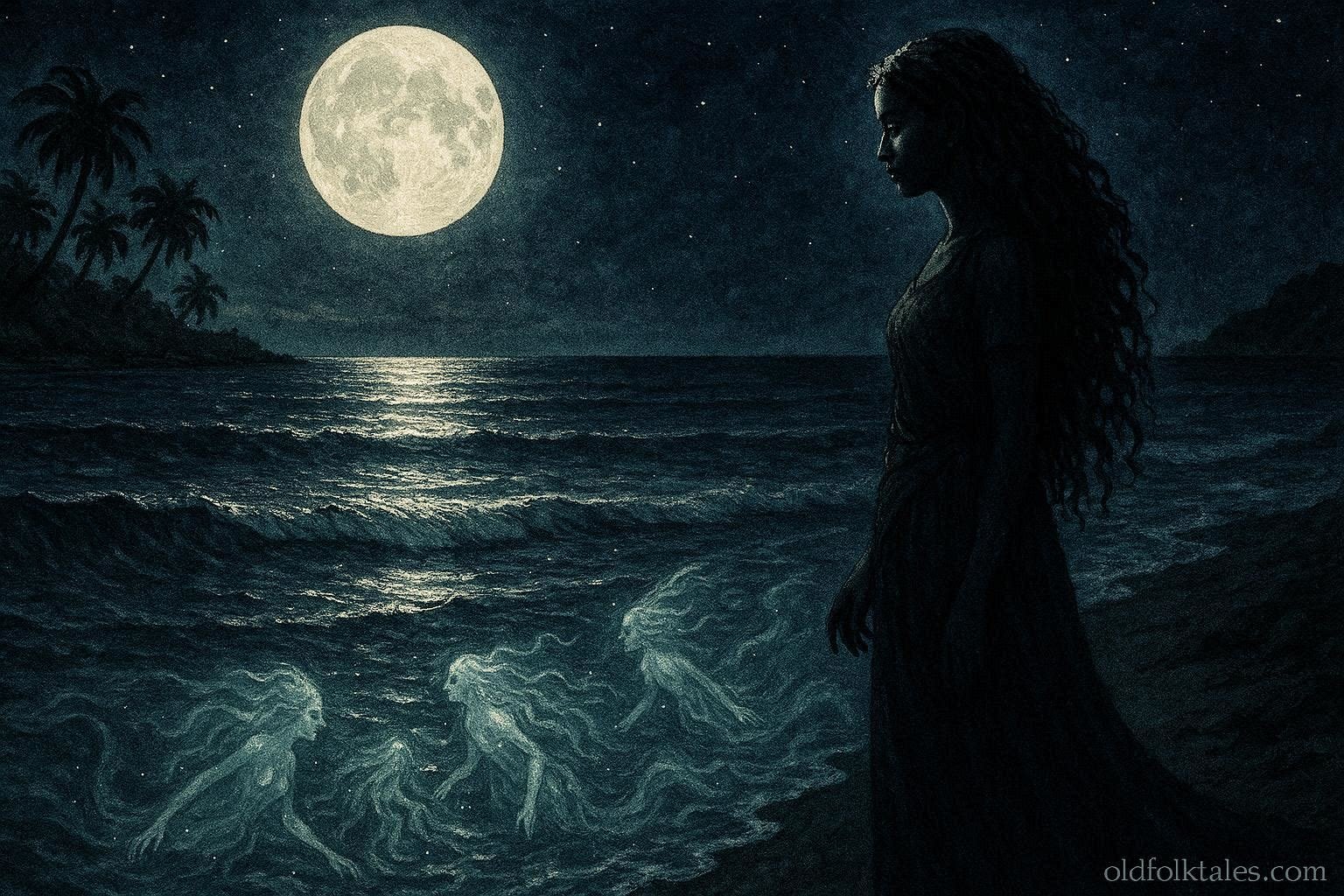
Moonlight spread across the waves unnaturally while shadows moved beneath the surface like living shapes circling around her. Volana stepped calmly into the ocean, and instead of sinking, she appeared surrounded by glowing water.
Mahery moved closer in shock.
Suddenly, he heard singing rising from beneath the sea.
Dozens of voices echoed through the waves while pale figures appeared moving below the water like spirits dancing beneath moonlight.
At the center stood Volana.
She no longer seemed entirely human.
Silver light surrounded her body while the ocean itself responded to her presence.
Terrified and overwhelmed, Mahery accidentally stepped onto loose rocks near the shore.
The sound broke the silence.
Immediately, Volana turned toward him.
Sadness filled her face.
“You followed me,” she whispered.
The ocean began changing violently.
Strong waves crashed suddenly against the shore while dark clouds covered the moon above Nosy Be. The glowing figures beneath the water disappeared instantly.
Mahery begged forgiveness, realizing too late he had broken the sacred condition.
Volana approached him one final time.
“I loved your world,” she said softly. “But some boundaries cannot be crossed.”
Tears filled Mahery’s eyes as the sea wind grew stronger around them.
Then slowly, Volana stepped backward into the waves.
The ocean closed around her.
And she vanished forever beneath the water.
The storms returned briefly afterward, and sorrow spread across the village after Mahery revealed the truth. Yet over time, the sea gradually calmed once more.
Though Volana never returned, many islanders believed the Moon Bride continued watching over Nosy Be from beneath the ocean.
Even generations later, fishermen still speak quietly about unusual lights moving across the water during full moons.
And according to local legend, when the sea shines silver beneath the moonlight, the Moon Bride may still be walking somewhere along the shores of Nosy Be.
Want to dive deeper? Read more North African folktales today
Moral Lesson
Love cannot survive without trust, respect for boundaries, and acceptance of what cannot fully be controlled or understood.
Knowledge Check
- Where did the story take place?
The story took place on the island of Nosy Be in Madagascar. - Who was Volana?
Volana was a mysterious woman connected to the moon and the sea. - Why did the villagers become interested in Volana?
Good fortune and successful fishing returned after her arrival. - What condition did Volana give Mahery?
He must never follow her into the sea after midnight. - What happened when Mahery broke the promise?
Volana returned permanently to the spirit world beneath the ocean. - What lesson does the story teach?
Trust and respect for boundaries are essential in love and relationships.
Source
Madagascan coastal folklore. Adapted from coastal Malagasy oral traditions preserved in Indian Ocean folklore and island cultural studies.