Along the western plains of Madagascar, where towering baobab trees rose like ancient guardians above the dry earth, lay the historic region of Menabe. The land belonged to the Sakalava people, whose kings, warriors, fishermen, and storytellers preserved generations of tradition through ceremony, music, and oral history.
In Menabe, drums carried power far beyond entertainment.
They announced royal gatherings, honored ancestors, warned villages of danger, and guided spiritual rituals performed beneath sacred trees and moonlit skies. Elders believed rhythms could speak to both the living and the dead.
Among the most respected ceremonial spaces stood the Great Baobab Grove, a circle of enormous ancient trees hidden beyond the villages near the edge of the forest.
The Sakalava believed the grove belonged to the ancestors.
No one cut its trees.
No one entered carelessly.
Ceremonies held there followed strict customs passed down over many generations.
Love this story? Discover our full Southern African folktales collection
At the center of the legend was a young man named Tsiory.
Tsiory was known throughout Menabe for his remarkable talent with drums. Even as a child, he could reproduce complex rhythms after hearing them only once. During festivals, people gathered eagerly whenever he performed because his drumming carried unusual emotion and intensity.
But despite his talent, Tsiory felt restless.
He wanted to learn the sacred rhythms used by the old ceremonial drummers whose music, according to legend, could communicate with ancestral spirits themselves.
Most elders refused to teach such knowledge openly.
“The sacred rhythms are not ordinary songs,” one old drummer warned him. “They carry memory older than living people.”
Yet Tsiory remained determined.
One evening, during a royal funeral ceremony, he noticed an elderly drummer named Bemanonga performing rhythms unlike anything he had ever heard before. The sounds echoed deeply through the night air beneath the baobab trees while mourners fell silent around the ceremonial grounds.
The rhythms seemed alive.
For brief moments, Tsiory almost believed the ancient trees themselves were listening.
After the ceremony ended, he approached the old drummer respectfully.
“Teach me,” Tsiory requested.
Bemanonga studied him carefully before answering.
“Sacred rhythms are not learned through talent alone,” the elder replied. “They require discipline, humility, and respect for the ancestors.”
Still, the old man agreed to train him.
From that time onward, Tsiory traveled regularly to the Great Baobab Grove where Bemanonga instructed him privately beneath the massive trees. The lessons were difficult and unlike ordinary musical training.
The elder taught that every sacred rhythm carried meaning connected to history, ancestry, and spiritual memory.
Some rhythms honored kings.
Others guided funeral rites.
Certain patterns were believed to calm fear during war or restore unity after conflict.
And a few rhythms, according to legend, could awaken the attention of ancestral spirits.
“You do not command the ancestors,” Bemanonga warned repeatedly. “You invite them with respect.”
Months passed as Tsiory practiced tirelessly.
The deeper he learned, the more he understood the sacred role music held within Sakalava tradition. Drumming was not simply performance — it preserved history in a world where memory lived primarily through spoken words and ritual.
Then one dry season, trouble came to Menabe.
A severe drought spread across the region.
Rivers shrank, crops weakened, and tensions rose between villages competing for resources. Elders worried the ancestors had become displeased because younger generations increasingly neglected traditional ceremonies and sacred customs.
Fear slowly spread through the communities.
Many demanded large rituals to restore spiritual balance.
During a council gathering beneath the baobab grove, several elders requested that Bemanonga perform the ancient ancestral rhythms during the coming full moon ceremony. According to tradition, the sacred music could strengthen unity and remind the people of their connection to those who came before them.
But the old drummer revealed troubling news.
His health had become too weak to lead the ceremony.
Silence filled the gathering.
Without the proper rhythms, many feared the ritual would lose its spiritual power.
Then Bemanonga spoke quietly.
“Tsiory will play.”
Shock spread immediately through the elders.
Some protested at once.
“He is too young,” one chief argued.
“Sacred rhythms should not be entrusted so easily,” another warned.
But Bemanonga remained firm.
“The ancestors decide who carries memory forward,” he answered calmly.
As the full moon approached, anxiety spread throughout Menabe. Tsiory himself felt overwhelmed by fear and responsibility. He understood the importance of the ceremony and worried about failing both the elders and the spirits connected to the grove.
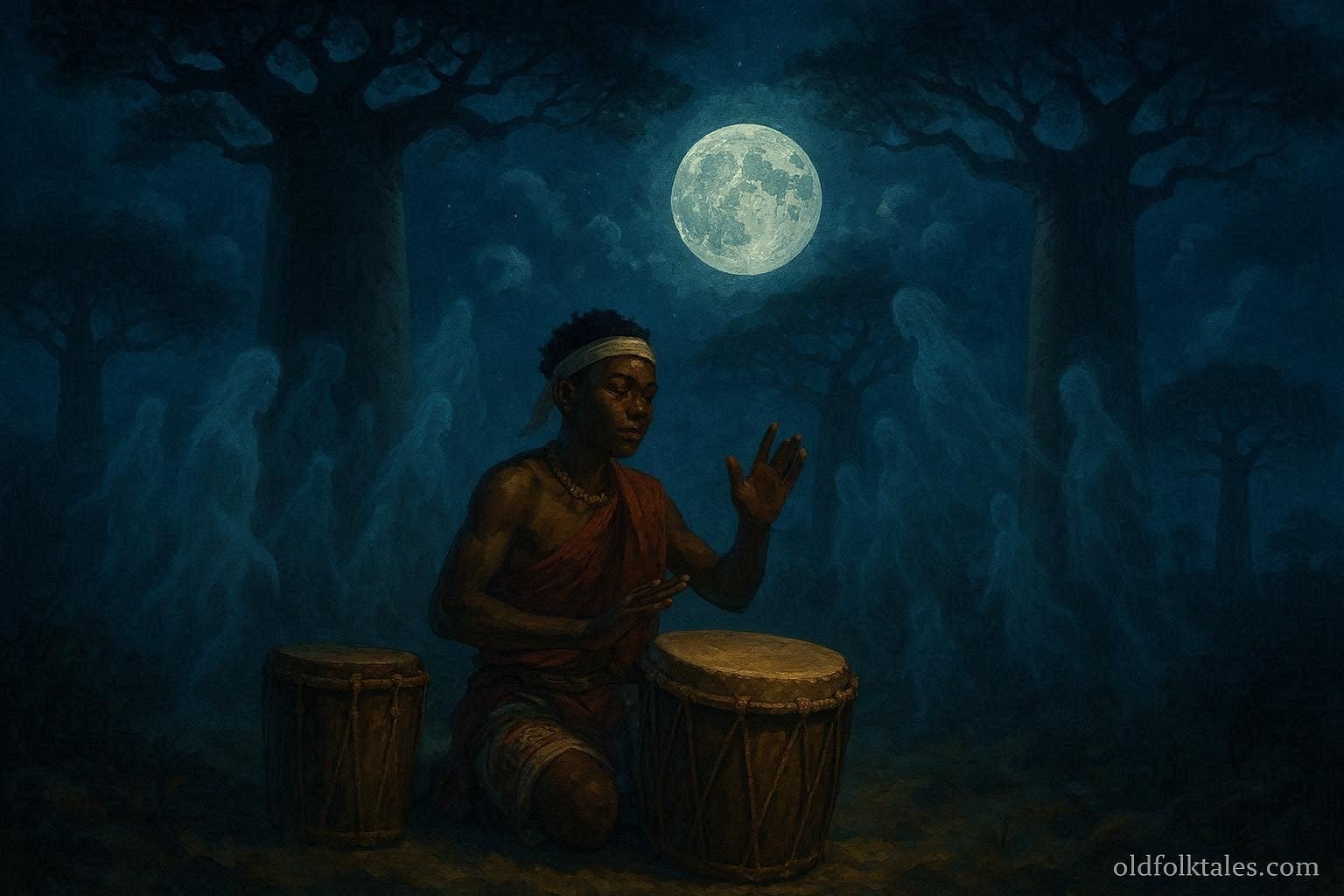
On the night of the ritual, villagers gathered beneath the towering baobab trees carrying lanterns and ceremonial offerings. Moonlight illuminated the ancient trunks while silence settled across the grove.
At the center sat Tsiory beside the sacred drums.
For several moments, he remained motionless.
Then he began to play.
The first rhythms echoed slowly through the trees like distant thunder. Deep drumbeats rolled across the dry earth while softer patterns moved between them like whispered voices.
Gradually, the atmosphere changed.
Wind stirred gently through the baobab branches despite the still night air. Elders lowered their heads respectfully while listeners felt strange emotion rising within them — grief, memory, pride, longing.
The rhythms seemed to awaken forgotten history itself.
Tsiory continued playing for hours.
Some villagers later claimed they saw shadowy figures moving silently between the trees during the ceremony. Others believed they heard voices joining the rhythms from deep within the grove.
Whether spirit or imagination, no one could fully explain what happened that night.
But by dawn, something had changed.
The tension dividing the villages eased gradually in the weeks that followed. Families resumed cooperation, ceremonies returned, and younger generations renewed interest in preserving old traditions.
Soon afterward, rain finally returned to Menabe.
The people credited the ancestors.
As for Tsiory, he became known thereafter as the Baobab Drummer of Menabe, the musician who carried sacred memory forward during a dangerous time of forgetting.
Years later, long after his death, Sakalava storytellers continued repeating the legend beside fires and ceremonial gatherings. The story reminded future generations that culture survives only when memory, tradition, and respect for ancestors remain alive.
And according to local belief, on quiet nights beneath the ancient baobab trees, distant drumming can still sometimes be heard moving through the wind across Menabe.
Looking for more? Explore the magic of East African folktales here
Moral Lesson
Traditions and ancestral knowledge survive only when younger generations preserve them with humility and respect.
Knowledge Check
- Where did the story take place?
The story took place in Menabe, a historic region of western Madagascar. - Why were drums important to the Sakalava people?
Drums preserved history, guided ceremonies, and honored ancestors. - Who trained Tsiory?
An elderly ceremonial drummer named Bemanonga trained him. - What made the sacred rhythms special?
They were believed to connect the living with ancestral spirits. - Why was the full moon ceremony important?
The community hoped the ritual would restore unity and spiritual balance. - What lesson does the story teach?
Cultural traditions survive through respect, discipline, and preservation of memory.
Source
Madagascan musical folklore. Adapted from Sakalava oral performance traditions documented in Malagasy folklore and performance research archives.