In the great kingdoms of the Akan people, stools carried meanings far beyond ordinary furniture. A royal stool represented authority, ancestry, spiritual continuity, and the soul of leadership itself. Chiefs sat upon carved stools during important ceremonies, while sacred blackened stools preserved the memory of rulers who had passed into the world of the ancestors.
Among the Ashanti, no royal ritual was treated casually.
Every symbol inside the palace carried history and meaning.
The placement of umbrellas, the rhythm of ceremonial drums, the order of greetings, and even the arrangement of stools during court gatherings reflected the balance of power within the kingdom. Elders believed that disrespect toward sacred customs could disturb both political order and spiritual harmony.
One particular ceremony held deep importance within the royal court.
It was known as the Empty Stool Ceremony.
The ritual took place whenever an important ruler or chief remained absent during a major gathering because of illness, war, diplomatic travel, or death not yet formally announced. Instead of removing the ruler’s presence completely, an empty stool covered in rich cloth would be placed at the center of the ceremony.
If you liked this story, see our Central African folktales collection
The empty stool symbolized continuing authority.
It reminded the people that leadership belonged not merely to an individual, but to the office and traditions connected to the kingdom itself.
For generations, the ceremony reinforced unity during uncertain times.
But one famous ceremony nearly divided the kingdom entirely.
At that time, the Ashanti kingdom was governed by an aging ruler named Nana Kwadwo Agyeman, a respected chief known for maintaining peace among powerful families within the region. Though wise and experienced, the ruler had grown seriously ill after many years on the stool.
As his condition worsened, uncertainty spread quietly through the royal court.
Different branches of the royal family began considering the question no one wished to discuss openly: who would eventually succeed him?
Among the possible heirs were two influential men.
The first was Nana Osei Baffour, a wealthy and politically connected royal respected by traders and several important chiefs. He was confident, ambitious, and skilled at gaining support within the palace.
The second was Nana Kwabena Frimpong, a calmer and more traditional figure admired by many elders for his wisdom and respect for Ashanti customs.
Though neither openly challenged the other, rivalry slowly developed between their supporters.
At first, the tension remained hidden beneath polite ceremony and public respect.
But inside the palace, whispers spread constantly.
Then came the Festival of Ancestors, one of the kingdom’s most sacred annual gatherings.
Chiefs from surrounding regions arrived wearing rich kente cloth while drummers filled the palace grounds with ceremonial rhythms. Crowds gathered outside the royal compound as preparations continued for the grand procession.
Yet one problem overshadowed the entire event.
Nana Kwadwo Agyeman was too weak to appear publicly.
The royal council therefore announced that the Empty Stool Ceremony would be performed in his honor during the festival.
The news immediately unsettled the palace.
An empty stool could symbolize continuity.
But during periods of uncertainty, it could also become a dangerous political symbol.
Supporters of different royal factions began interpreting the ceremony in conflicting ways. Some believed the ruler’s absence signaled the beginning of transition. Others feared ambitious families might use the occasion to strengthen their own claims to future leadership.
By the morning of the ceremony, tension hung heavily across the palace grounds.
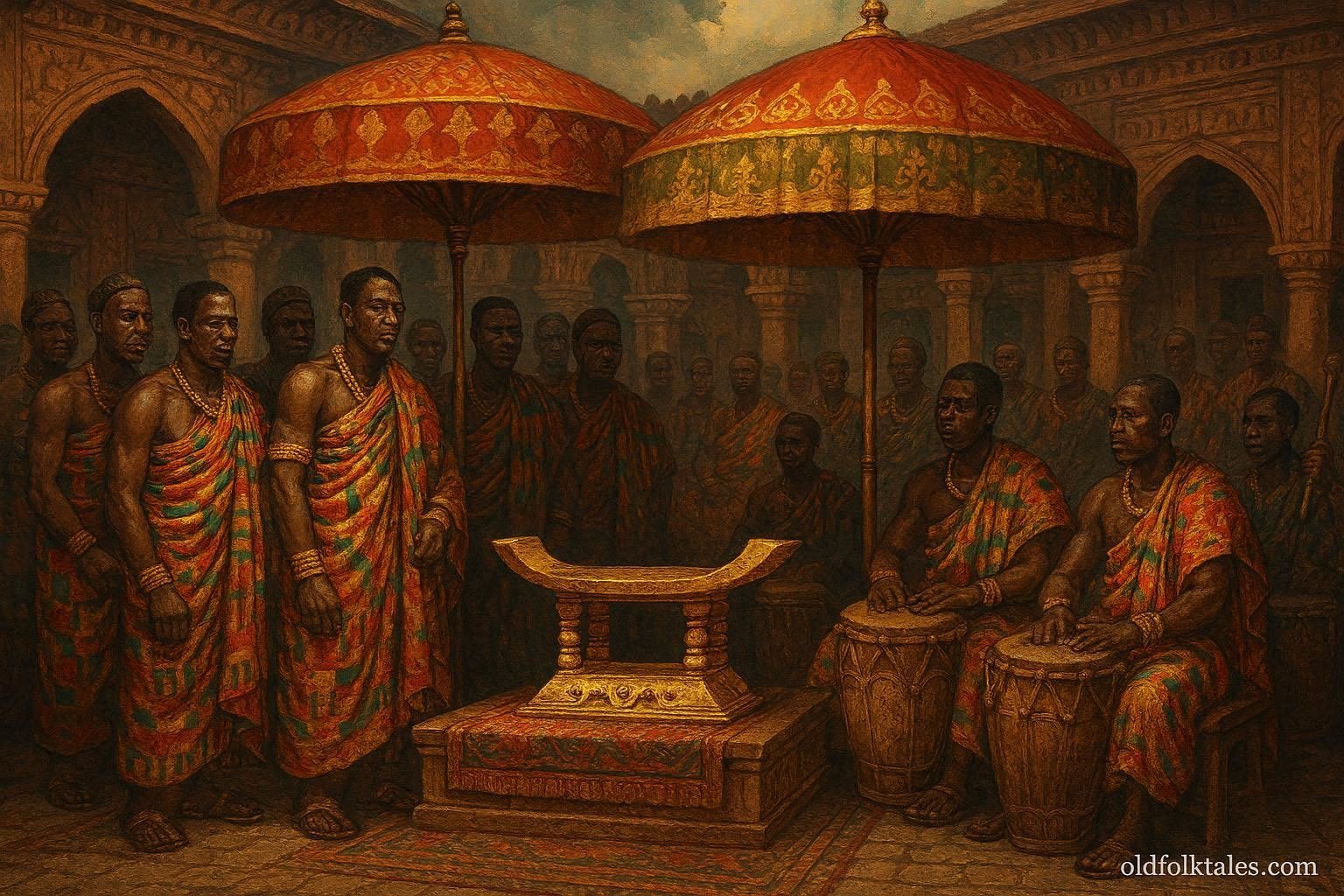
The sacred stool was placed carefully beneath a large ceremonial umbrella at the center of the royal courtyard. Rich cloth covered the stool while attendants surrounded it with gold ornaments and ancestral symbols.
Drumming echoed slowly across the gathering.
Chiefs entered according to rank and tradition while elders watched every movement closely.
Then something unusual happened.
During the formal greetings, Nana Osei Baffour positioned himself closer to the empty stool than tradition normally allowed for someone without official authority. Though subtle, the action did not go unnoticed.
Several elders exchanged troubled looks.
Moments later, supporters of Nana Kwabena Frimpong responded by loudly praising the importance of lawful succession and ancestral custom during ceremonial speeches.
The atmosphere quickly became uncomfortable.
Beneath the beauty of the ceremony, hidden political rivalry now stood dangerously close to open confrontation.
Ordinary people watching from outside the palace sensed the tension immediately. Rumors spread rapidly through Kumasi that factions within the royal family were preparing for conflict over succession.
Inside the courtyard, the drumming continued, but unease filled the gathering.
At the height of the ceremony, an elderly court linguist named Kwaku Anokye rose slowly from his seat.
The linguist carried great authority because his duty involved speaking wisdom on behalf of tradition and interpreting royal symbolism during important gatherings.
Silence spread across the courtyard as he approached the empty stool.
For several moments, he studied the sacred seat quietly before addressing the assembly.
“This stool is empty,” he began, “but the kingdom is not.”
The chiefs listened carefully.
“The ancestors are watching how we behave during uncertainty,” Kwaku continued. “An empty stool is meant to remind us of unity, not ambition.”
His voice echoed clearly across the courtyard.
“If people compete for power before the proper time, they weaken the very authority they hope to inherit.”
The words struck deeply.
Even the rival factions understood the warning hidden within the elder’s speech.
The ceremony was not supposed to become a contest.
It existed to preserve stability until rightful succession could occur according to custom and wisdom.
Gradually, the tension eased.
Both rival royals stepped back publicly from provocative actions, understanding that open division during such a sacred ritual could damage their reputations permanently among the elders and people.
The Empty Stool Ceremony concluded peacefully.
Months later, after the passing of Nana Kwadwo Agyeman, the royal council followed traditional procedures carefully to select the next ruler. Though disagreements remained, the kingdom avoided the violence many had feared during the uncertain period.
Years afterward, the story of that ceremony became part of Ashanti oral tradition.
Elders repeated it whenever political ambition threatened unity within royal families or communities. The tale reminded future generations that symbols of leadership demand humility and responsibility, especially during times of uncertainty.
And throughout the Akan kingdoms, the Empty Stool Ceremony continued as a sacred reminder that power must always remain guided by tradition, patience, and respect for collective stability.
If you enjoyed this story, explore our full West African folktales collection
Moral Lesson
Ambition without patience and respect for tradition can threaten the unity of an entire community.
Knowledge Check
- What did the empty stool symbolize in Akan tradition?
It symbolized continuing royal authority during a ruler’s absence. - Why was the ceremony important?
It preserved unity and stability during uncertain political periods. - Who were the rival royal figures?
Nana Osei Baffour and Nana Kwabena Frimpong competed for influence. - Why did tension grow during the ceremony?
Supporters of rival factions used the event to display political ambition. - Who helped calm the situation?
The elderly court linguist Kwaku Anokye reminded everyone about unity and tradition. - What lesson did the kingdom learn?
Leadership requires patience, humility, and respect for established customs.
Source
Ghanaian royal folklore. Adapted from Akan ceremonial traditions documented in Akan chieftaincy archives and studies by R. S. Rattray.