Long before colonial borders divided the lands of northern Ghana, the Kingdom of Dagbon stood as one of the most respected and organized states across the savannah regions. The kingdom was known for its skilled horsemen, strong political structure, royal courts, and deeply preserved traditions passed carefully from one generation to the next.
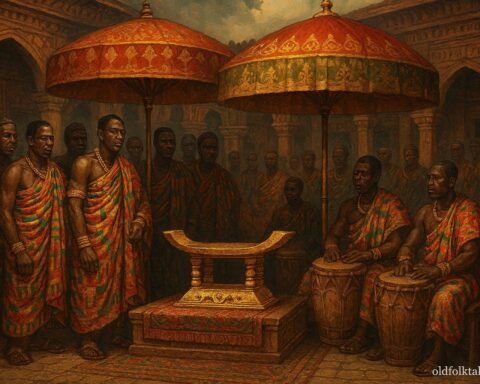
At the center of Dagbon’s authority stood the Ya-Na, the king whose leadership united chiefs, warriors, elders, and communities spread across the region.
But leadership in Dagbon was never treated lightly.
Succession to the royal throne followed strict traditions shaped by ancestry, custom, and the decisions of respected elders. Every major transition carried enormous importance because the stability of the kingdom depended on unity within the royal family.
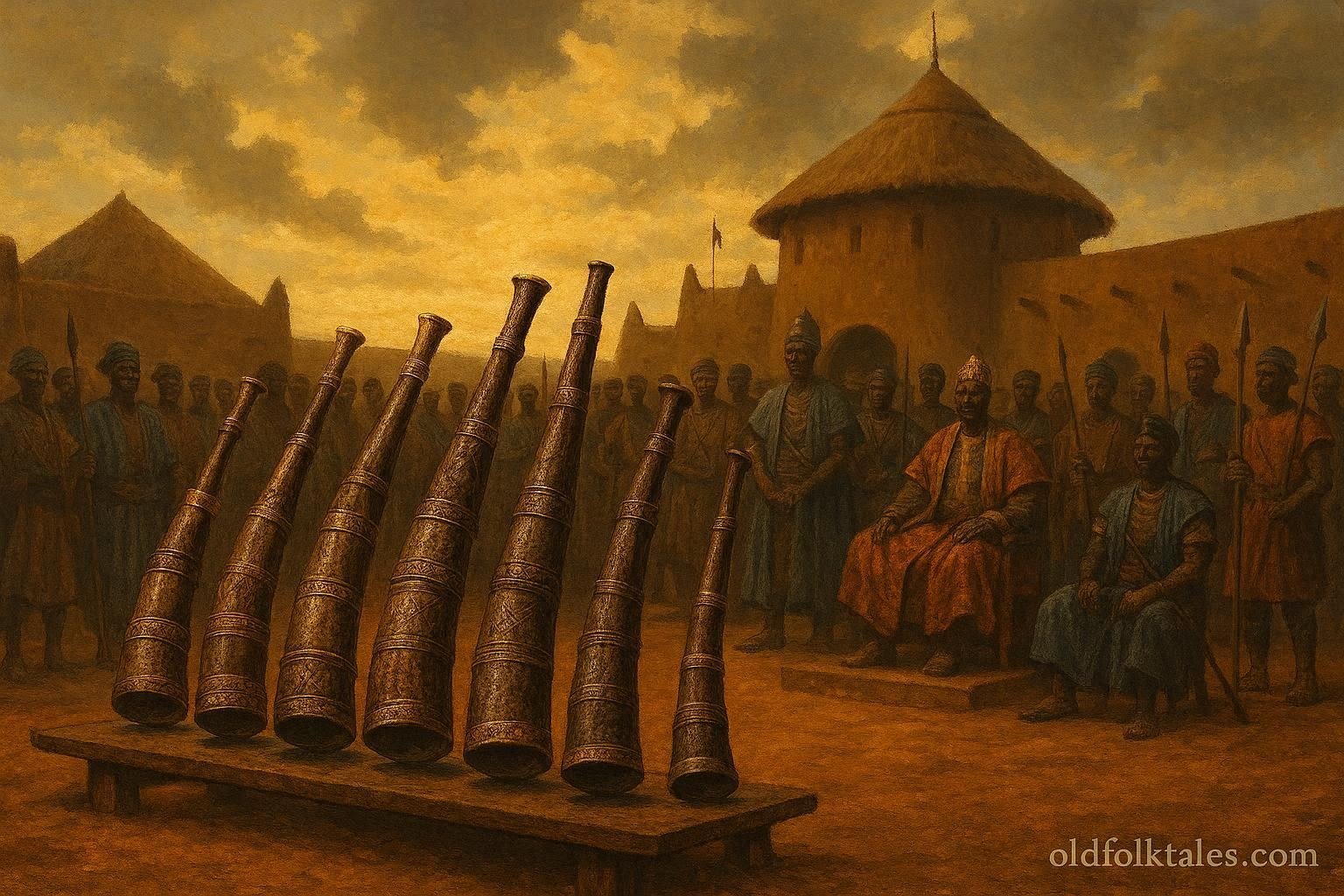
Among the sacred regalia of Dagbon, few objects carried greater symbolic power than the Seven Horns.
The horns were carved from the horns of powerful animals and decorated with leather, brass, beads, and ancient royal markings. During ceremonies, they were sounded to announce royal gatherings, victories, funerals, and the installation of important leaders.
Click here to explore more Central African folktales
According to tradition, the Seven Horns represented the voice of Dagbon itself.
Whenever the horns sounded together, the people understood that the authority of the kingdom remained united and strong.
The horns were guarded carefully inside the royal palace and handled only by trusted ceremonial custodians. Elders believed that division surrounding the horns could bring conflict to the kingdom.
For many years, peace remained stable under the leadership of Ya-Na Andani, a wise ruler respected throughout Dagbon. He governed with patience and maintained balance between rival royal families within the kingdom.
But age eventually weakened him.
As the king’s health declined, concern quietly spread among chiefs and palace elders about who would inherit the throne after his death. Though succession traditions existed, rival branches of the royal family each believed they carried stronger claims to leadership.
At first, disagreements remained private.
Then tensions slowly grew.
Supporters of different princes began gathering influence among local chiefs and warriors. Rumors moved across villages and trading routes. Court meetings became increasingly tense as elders struggled to maintain unity inside the palace.
Among the royal princes, two men stood at the center of the growing rivalry.
The first was Prince Sulemana, known for his military strength and popularity among younger warriors. He was confident, bold, and admired for his courage during regional conflicts.
The second was Prince Ziblim, an older and calmer man respected for his wisdom and knowledge of royal traditions. Many elders trusted his judgment and diplomatic skill.
Both men believed they could guide Dagbon successfully.
But their supporters increasingly viewed one another as rivals rather than members of the same royal family.
As the kingdom entered a period of uncertainty, the Seven Horns became central to the conflict.
According to ancient custom, the ceremonial horns would only sound together during the official recognition of a legitimate ruler. Whoever received the blessing of the horns before the people would gain enormous symbolic authority across Dagbon.
The palace custodians understood the danger immediately.
If rival factions attempted to control the horns, violence could follow.
One evening, shortly after Ya-Na Andani’s death, senior elders gathered secretly inside the royal court. The atmosphere felt heavy with fear and uncertainty.
“The kingdom stands at a dangerous crossroads,” one elder warned quietly.
Another elder looked toward the chamber where the Seven Horns were kept.
“If the horns divide,” he said, “Dagbon will divide with them.”
Outside the palace, tensions worsened rapidly.
Supporters of both princes moved through the capital gathering allies. Warriors sharpened weapons while messengers traveled urgently between chiefs across the region. Ordinary people grew anxious as rumors of conflict spread.
Meanwhile, the ceremonial custodians refused to release the Seven Horns to either faction.
Days passed without agreement.
Then, during a crowded gathering near the royal grounds, supporters of Prince Sulemana demanded immediate recognition of their candidate. Hours later, followers of Prince Ziblim organized their own assembly claiming tradition favored their prince instead.
The kingdom moved dangerously close to open conflict.
At the height of the crisis, the oldest living palace custodian, an elderly man named Naa Jeringa, requested permission to address both factions publicly.
Though physically weak with age, Naa Jeringa carried enormous respect because he had served three generations of Dagbon rulers.
The gathering took place beneath a large tree near the palace courtyard.
Warriors, elders, princes, and citizens assembled silently as the old custodian stepped forward carrying one of the sacred horns wrapped carefully in cloth.
For several moments, he said nothing.
Then he lifted the horn slowly for everyone to see.
“This horn has sounded for kings greater than all of us,” he began quietly. “It has announced victories, peace treaties, royal births, and funerals. But never has it sounded to celebrate division.”
The crowd remained silent.
“The Seven Horns do not belong to one prince,” Naa Jeringa continued. “They belong to Dagbon itself.”
His voice grew stronger despite his age.
“If ambition destroys unity, the horns will become meaningless objects. A kingdom survives because its people protect tradition together.”
The words struck deeply across the gathering.
Even the rival supporters understood the truth hidden inside the elder’s warning. If conflict consumed the royal family, the entire kingdom could weaken.
After many difficult discussions, the elders eventually reached a peaceful settlement guided by royal custom and compromise. Though tensions did not disappear immediately, open violence was avoided.
When the time finally came to recognize the new ruler officially, the Seven Horns were sounded together across the palace grounds.
Their deep echoes traveled through the capital and surrounding villages.
People listened carefully as the ancient sound moved across Dagbon once again — not as a symbol of victory for one faction, but as a reminder that leadership carries responsibility greater than personal ambition.
Years later, the story of the succession crisis and the Seven Horns became part of Dagomba oral tradition. Elders repeated it whenever disputes threatened the unity of families, chiefs, or communities.
And throughout Dagbon, the sounding of ceremonial horns continued to remind people that authority without unity can never protect a kingdom for long.
Want more? Read more West African folktales now
Moral Lesson
Leadership should protect unity and tradition rather than personal ambition and rivalry.
Knowledge Check
- What were the Seven Horns of Dagbon?
They were sacred ceremonial horns symbolizing royal authority and unity. - Why did conflict arise in Dagbon?
Rival princes struggled over succession after the king’s death. - Who were the main rival princes?
Prince Sulemana and Prince Ziblim competed for leadership. - Why were the ceremonial horns important?
The horns represented legitimate leadership and the unity of the kingdom. - Who helped calm the conflict?
The elderly palace custodian Naa Jeringa advised both factions wisely. - What lesson did the people learn?
Leadership should prioritize unity and responsibility over rivalry.
Source
Ghanaian royal folklore. Adapted from Dagomba oral histories and traditions preserved in Northern Ghana historical archives.