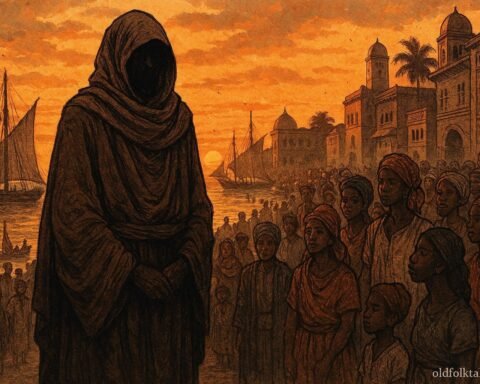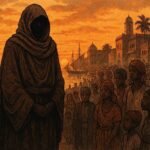
Long before powerful kingdoms rose across the highlands of Madagascar, stories spoke of an ancient people known as the Vazimba. According to Malagasy oral tradition, the Vazimba were among the island’s earliest inhabitants, living close to rivers, forests, marshes, and sacred natural places hidden far from crowded settlements.
Many believed the Vazimba possessed unusual spiritual knowledge.
They were described as guardians of ancestral wisdom, protectors of sacred waters, and keepers of secrets connected to the land itself. Though later generations rarely claimed to see them directly, stories about their presence survived across Madagascar for centuries.
Elders warned travelers to respect certain forests, lakes, and marshlands believed to belong to the spirits of the Vazimba.
Among the most feared legends was the story of the Vazimba Queen of the Hidden Marshes.
Deep within a remote wetland surrounded by thick reeds, twisted trees, and silent waters, people believed an ancient queen still watched over sacred territory untouched by ordinary humans. The marshes were difficult to reach and covered almost constantly by mist rising from the water.
Fascinated by this tale? Discover more North African folktales
Hunters avoided the region.
Fishermen refused to cross it after sunset.
Even experienced travelers moved carefully whenever passing nearby.
According to tradition, the queen had once ruled a powerful Vazimba settlement centuries earlier before disappearing mysteriously along with her people. Some believed the Vazimba had not truly vanished at all, but instead crossed into the spiritual world while continuing to guard sacred places hidden from outsiders.
The queen remained their eternal protector.
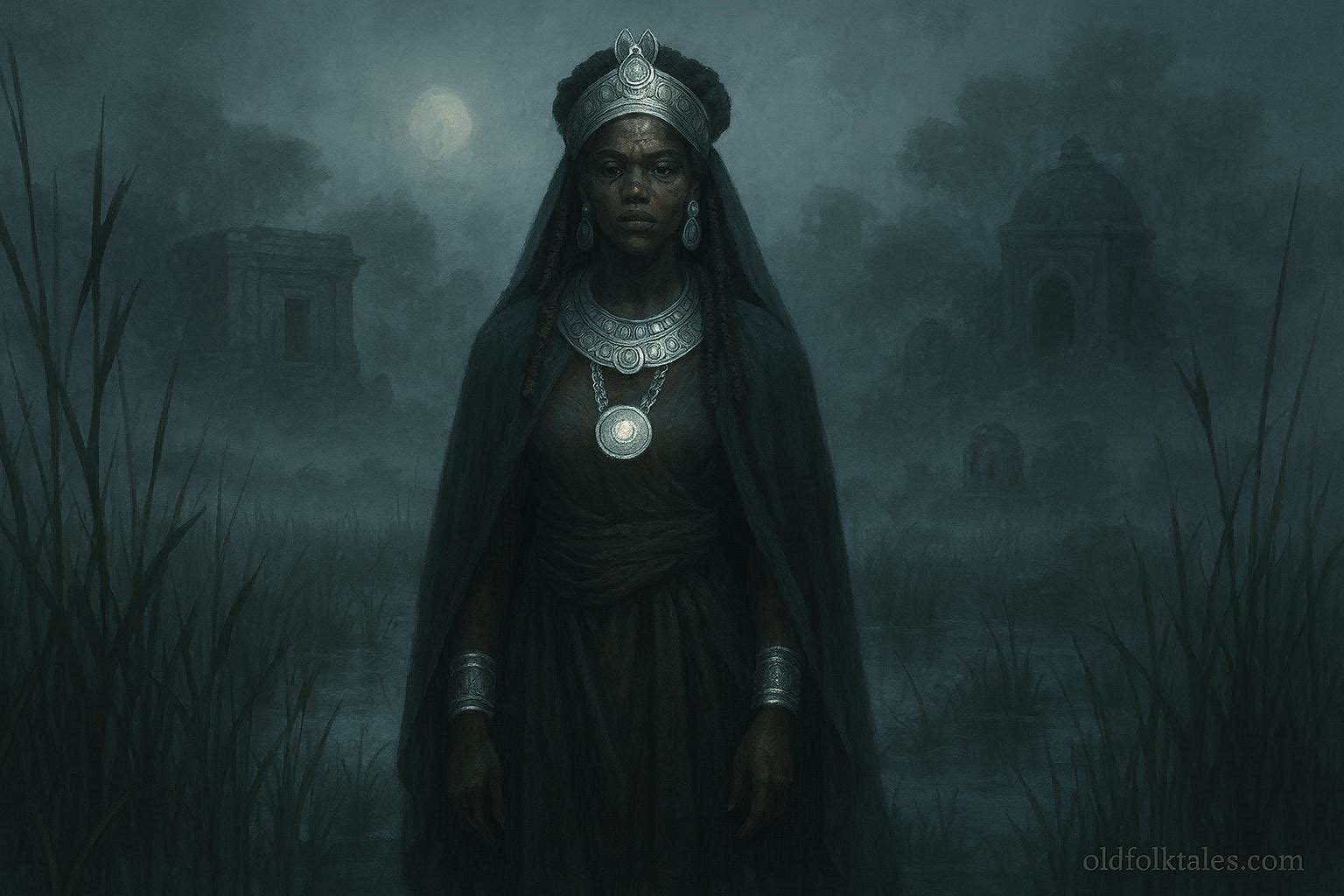
Stories claimed she could appear as a woman dressed in white reeds and silver ornaments or vanish completely into the fog without leaving footprints behind.
Those who respected the marshlands passed safely.
Those who entered with greed or disrespect rarely returned unchanged.
For generations, nearby villages honored the old warnings carefully.
Then came a man named Randria.
Randria was a wealthy trader from the highlands who traveled widely across Madagascar searching for rare objects, ancient relics, and hidden knowledge connected to forgotten kingdoms. Intelligent and ambitious, he often dismissed traditional warnings as superstition meant to frighten ordinary people.
When he first heard stories about the hidden marshes and the mysterious Vazimba queen, curiosity immediately consumed him.
Villagers warned him repeatedly.
“The marshes are protected,” one elder insisted. “The ancestors placed boundaries there long ago.”
But Randria refused to listen.
Instead, he became convinced valuable treasures or sacred artifacts might be hidden within the wetlands. The more people warned him to stay away, the more determined he became to enter the forbidden territory.
Finally, during the dry season, Randria hired several guides and prepared an expedition into the marshlands.
At first, the journey seemed ordinary.
The group traveled through forests filled with birds and crossed narrow waterways surrounded by towering reeds. But the deeper they moved into the marshes, the stranger the environment became.
The air grew colder.
Fog drifted constantly above the water even during daylight.
And unusual silence covered the wetlands.
One guide eventually refused to continue.
“This place does not belong to us,” he whispered nervously before turning back.
Others soon followed.
Only Randria and one young assistant named Soa remained determined to continue deeper into the marshlands.
As evening approached, they discovered something astonishing.
Hidden beyond the reeds stood the remains of an ancient settlement partially swallowed by water and vegetation. Stone foundations, broken carvings, and ceremonial structures emerged from the mist like forgotten memories buried beneath the marshes.
Randria stared in amazement.
“The stories were true,” he whispered.
Excited by the discovery, he immediately began searching the ruins for valuables and sacred objects. Despite Soa’s growing fear, Randria ignored every sign urging caution.
Then they found the shrine.
At the center of the ruins stood a raised stone platform surrounded by still water and covered with ancient symbols worn smooth by time. Upon the platform rested several carved objects wrapped carefully in faded cloth and decorated with shells, beads, and sacred markings.
Soa stepped back immediately.
“We should leave,” she warned. “These things belong to the ancestors.”
But Randria moved toward the shrine eagerly.
The moment he touched one of the objects, the atmosphere changed.
Strong wind suddenly swept across the marshes although the air had been still moments earlier. Fog thickened rapidly around the ruins while the water surrounding the platform began rippling unnaturally.
Then a voice emerged through the mist.
“You were warned.”
Randria froze instantly.
Slowly, a figure appeared across the water.
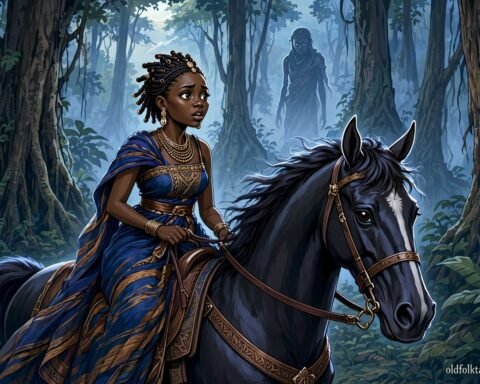
A tall woman dressed in pale woven garments stood silently within the fog. Silver ornaments reflected faintly beneath the moonlight while reeds moved gently around her feet though no wind touched them.
Her eyes remained calm but deeply unsettling.
Soa immediately lowered herself respectfully.
“The Vazimba Queen,” she whispered fearfully.
Randria tried to speak but found himself unable to move.
The queen looked toward the sacred objects disturbed upon the shrine.
“The ancestors protect what memory must not lose,” she said quietly.
The marshlands around them seemed suddenly alive.
Shadows moved beneath the water while distant whispers echoed through the reeds. Randria felt overwhelming fear unlike anything he had ever known before.
“You entered seeking possession,” the queen continued. “But sacred places are not conquered by greed.”
The trader collapsed to his knees.
For the first time, he understood the warnings were never simply stories meant to frighten outsiders. The marshlands carried spiritual meaning connected to ancestry, memory, and respect far older than wealth or ambition.
The queen raised one hand slowly.
Immediately, the winds calmed.
“You may leave,” she declared. “But the marshes will remember your intentions.”
Without another word, the figure dissolved gradually back into the mist until only silence remained across the water.
Randria and Soa fled the ruins before dawn.
When they finally returned to the nearby villages, Randria spoke very differently about the hidden marshes. He abandoned his search for sacred relics and warned others never to disturb places protected by ancestral tradition.
Some villagers believed the queen had spared him because he recognized his mistake before it was too late.
Others believed the marshes themselves had judged his heart.
Years later, the story of the Vazimba Queen continued spreading across Madagascar as a warning about greed, forgotten ancestry, and disrespect toward sacred places.
Even today, many communities still speak carefully about isolated marshlands connected to Vazimba spirits.
And according to local belief, when thick mist rises silently above hidden waters at dusk, the ancient queen may still be watching from somewhere beyond the reeds.
Looking for more? Explore the magic of East African folktales here
Moral Lesson
Sacred traditions and ancestral places deserve respect, especially from those driven by greed or pride.
Knowledge Check
- Who were the Vazimba?
The Vazimba were believed to be ancient inhabitants of Madagascar connected to spiritual traditions. - What protected the hidden marshlands?
The marshlands were guarded by the mysterious Vazimba Queen. - Why did Randria enter the marshes?
He hoped to find valuable treasures and forbidden knowledge. - What happened when Randria disturbed the shrine?
The atmosphere changed, and the Vazimba Queen appeared through the mist. - Why did the queen spare Randria?
He recognized his mistake and understood the importance of respect. - What lesson does the story teach?
Sacred ancestral places should never be approached with greed or disrespect.
Source
Madagascan ancestral folklore. Adapted from Vazimba oral traditions documented in Malagasy ethnographic research and Madagascar folklore archives.