In a village on the island of Madagascar, where the earth once held deep green life and the wind moved gently through wide fields, there came a season unlike any before it.
The rains did not come.
Want more? Read more West African folktales now
At first, the people waited.
They looked to the sky as they always had, trusting the rhythm they had known for generations. But the clouds passed without breaking, the soil hardened, and the rivers grew thin.
Days turned into weeks.
Weeks into months.
The land began to change.
Grass turned brittle beneath bare feet. Crops failed where they once flourished. Even the air seemed to carry a weight, dry, unmoving, uncertain.
“This has happened before,” the elders said, though their voices held less certainty than their words.
“We must endure.”
But endurance alone did not bring back the rain.
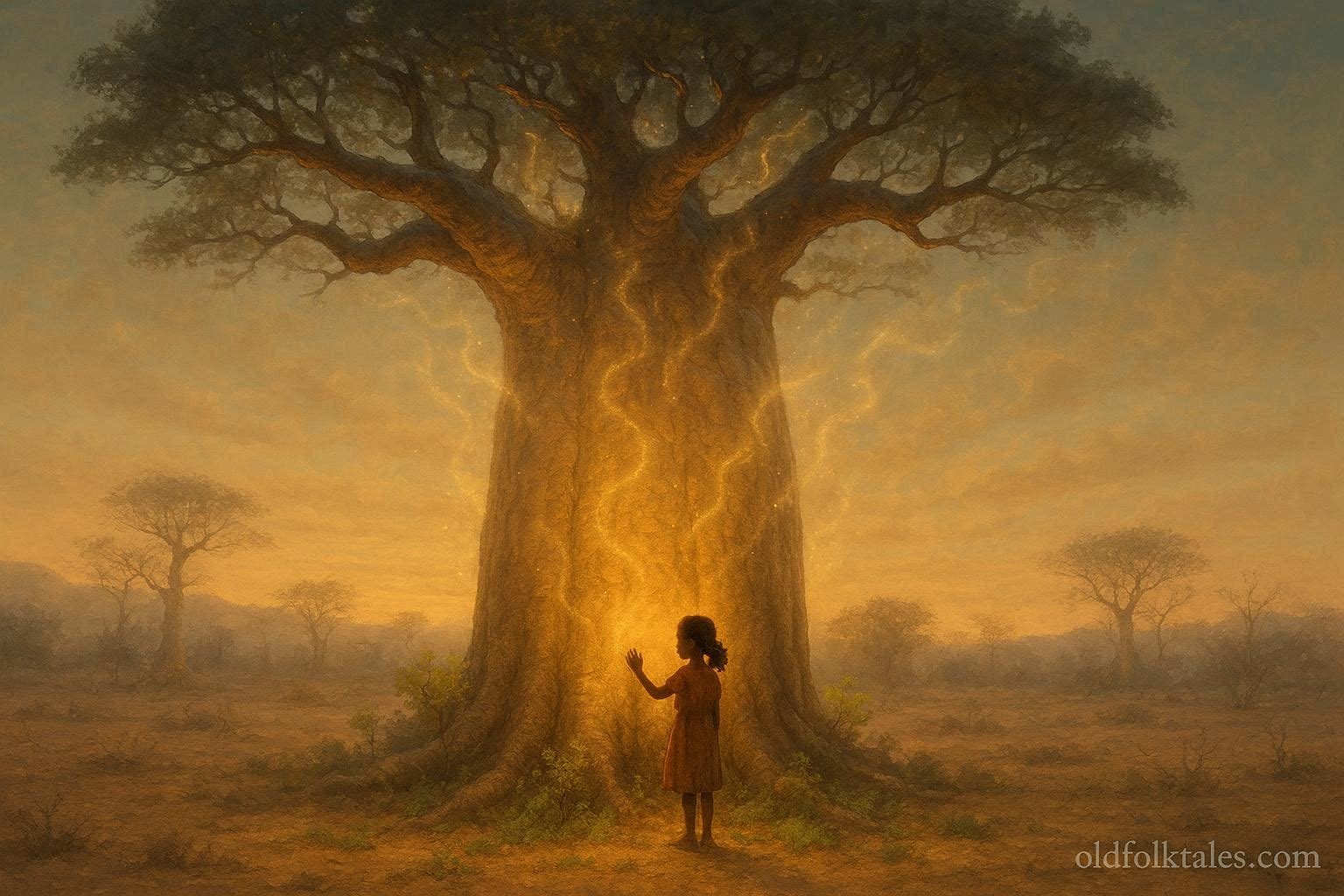
At the edge of the village stood a baobab tree.
It was older than any person living. Its trunk was wide and deeply marked, its branches reaching upward like hands that had long known the sky. The people called it sacred, not because they fully understood it, but because they had always treated it with respect.
It had stood through many seasons.
It had seen what they had forgotten.
But in recent years, fewer people visited it. Fewer offerings were placed at its base. Fewer stories were told beneath its shade.
Life had moved on.
Or so it seemed.
Among the villagers was a young girl who often walked alone.
She had grown up hearing fragments of stories, names spoken in passing, references to those who had come before. But the stories were incomplete, the names rarely repeated.
Still, something about them stayed with her.
During the long dry season, she found herself drawn to the baobab.
It stood unchanged, even as the land around it weakened. Its presence felt steady, as though it held something that the rest of the village had lost.
One evening, as the sun lowered and the sky softened into muted color, the girl approached the tree.
She placed her hand against its trunk.
The surface was rough, warm from the day’s heat.
She closed her eyes.
And then,
She heard it.
A whisper.
Faint, almost like the movement of air through leaves.
At first, she thought it was the wind.
But the wind had been still for many days.
She listened more closely.
The whisper came again.
A sound.
Not random.
A name.
She opened her eyes quickly, her heart beating faster.
“Who is there?” she asked.
The tree did not move.
But the whisper returned.
Another name.
Clearer this time.
The girl stepped back slightly, then forward again.
“You speak?” she asked softly.
The air around her remained quiet.
But from within the tree, the sound continued, low, steady, carrying something older than her own understanding.
A name.
She repeated it aloud.
As the word left her lips, something shifted.
Not suddenly.
Not dramatically.
But enough to be felt.
A faint movement in the air.
A slight softening of the ground beneath her feet.
She looked around.
Nothing had changed.
And yet,
Something had.
The next day, she returned.
She stood before the tree and listened.
Again, it whispered.
Another name.
This time, she did not hesitate.
She spoke it aloud.
The same subtle shift followed.
She began to understand.
“These are not just sounds,” she said quietly. “They are people.”
Ancestors.
Names that had once been spoken often, now nearly lost.
The girl carried the names back to the village.
“I heard them,” she said. “From the baobab.”
The elders listened, their expressions uncertain.
“What names?” one asked.
She spoke them.
The room grew quiet.
Some of the older villagers looked at one another.
“I remember that name,” one said slowly.
“He was known for his fairness,” another added.
“And that one,” a second elder said, “she was generous. She never turned anyone away.”
The girl listened.
Each name held meaning.
Each carried a story, not fully remembered, but still present.
“What happens when you say them?” an elder asked.
The girl thought for a moment.
“The land listens,” she said.
The villagers did not fully understand.
But they could not ignore what was happening around them.
In the days that followed, the girl returned to the baobab again and again. Each time, it whispered a name. Each time, she carried it back.
But now, something had changed.
She did not speak the names alone.
The elders began to join her.
“When we say this name,” one said, “we must remember what he stood for.”
“Then speak it,” the girl replied.
And they did.
They spoke of fairness and acted with fairness.
They spoke of generosity and shared what little they had.
They spoke of patience, of wisdom, of care for one another.
And as they did, the changes in the land became clearer.
The soil softened.
Not fully, but enough to notice.
The air shifted.
Not completely, but with a hint of movement.
The people began to gather more often beneath the baobab, not only to listen, but to remember.
But not all understood.
“There are many names,” one villager said. “If we speak them, the land will return.”
He began to repeat the names quickly, one after another, without pause.
The girl watched.
Nothing changed.
The tree remained still.
The land did not respond.
“That is not how it works,” she said.
“What do you mean?” he asked.
“The names are not enough,” she replied. “We must remember what they mean.”
The villagers fell silent.
The baobab whispered again.
Another name.
The girl spoke it.
The elders followed, not just with sound, but with understanding.
“That one,” an elder said, “stood for truth.”
They paused.
Then, they acted.
They spoke honestly with one another, even when it was difficult.
The air shifted again.
Slight.
But real.
Days passed.
The process continued.
Name by name.
Memory by memory.
Action by action.
The land did not return all at once.
But slowly, steadily, it responded.
Green began to return in small patches.
The ground held moisture a little longer.
And one morning, as the village gathered beneath the baobab, something happened that had not happened in many months.
A cloud formed.
Then another.
The sky darkened.
And rain fell.
Not heavy.
Not overwhelming.
But enough.
The villagers stood in it, their faces turned upward.
Not in surprise.
But in recognition.
The girl stood beneath the tree, her hand resting once more against its trunk.
“It remembers,” she said.
An elder beside her nodded.
“And now,” he replied, “so do we.”
The baobab did not speak again as it had before.
Its whispers grew quiet.
Because what needed to be remembered had been heard.
From that day forward, the people did not wait for the tree to remind them.
They spoke the names.
They lived the values.
And the land, no longer forgotten, held them in return.
Looking for more? Explore the magic of East African folktales here
Moral Lesson
Restoration begins with remembrance. Honoring the values of those who came before us strengthens both community and the world we live in.
Knowledge Check
- What role does the baobab tree play in the Malagasy folktale?
The baobab serves as a sacred symbol that remembers and reveals the names of ancestors. - Why was the village experiencing drought?
The story suggests the drought is linked to the villagers forgetting their ancestors and their values. - How did the young girl help restore the land?
She listened to the tree, spoke the ancestors’ names, and encouraged others to live by their values. - Why didn’t simply repeating the names work?
Because true restoration required understanding and practicing the values behind the names. - What changed when the villagers remembered their ancestors?
The land gradually recovered, and rain eventually returned. - What is the main theme of “The Baobab That Remembered Names”?
The story emphasizes the importance of ancestry, memory, and living out cultural values.
Source: Inspired by oral traditions documented in “Malagasy Folktales and Legends” by Renelison (2015).
Cultural Origin: Malagasy (Madagascar), with emphasis on reverence for ancestors (razana)