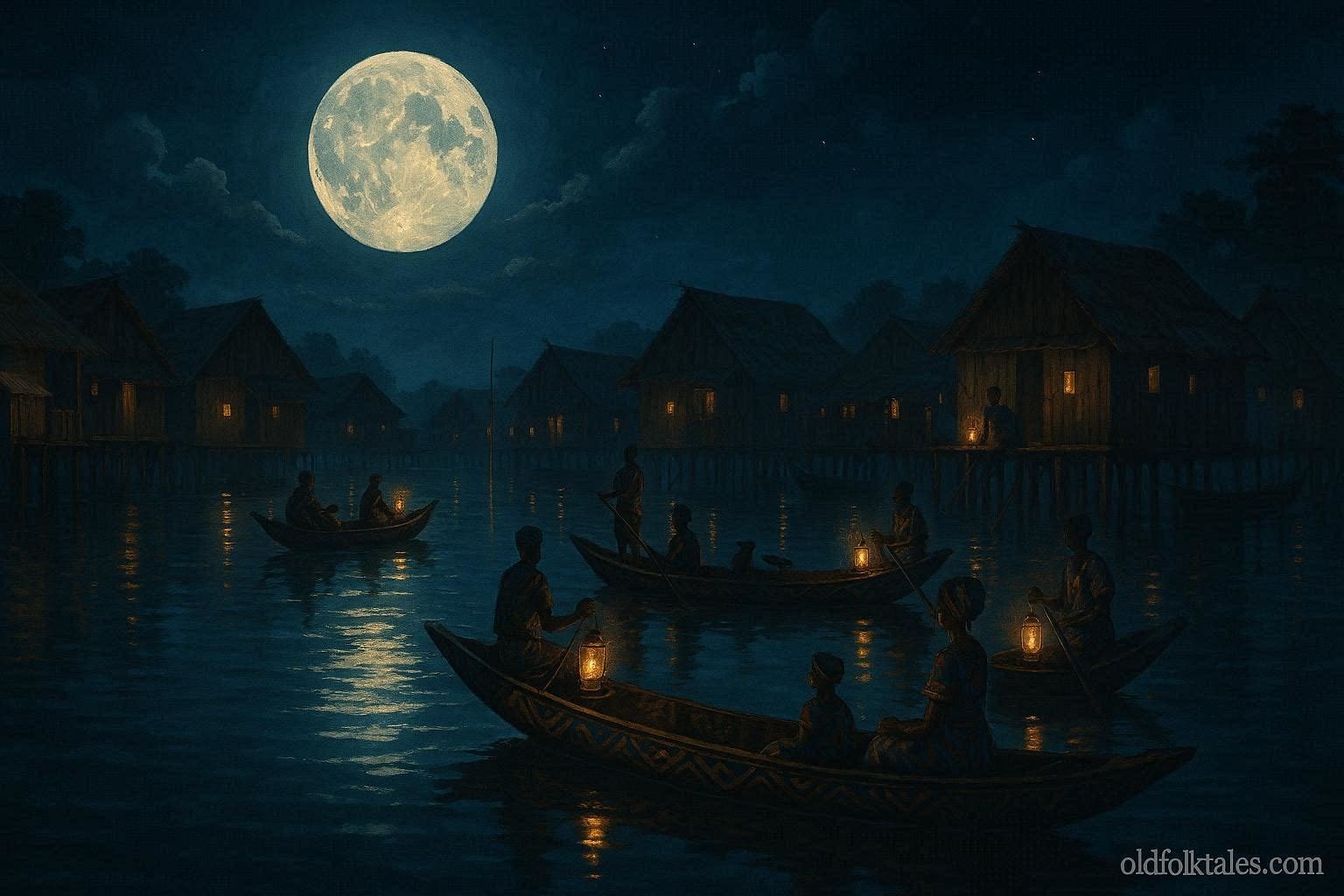
Deep within the wetlands of western Ghana stood the remarkable village of Nzulezu, a community built entirely above water on tall wooden stilts. Narrow wooden walkways connected homes, cooking areas, gathering spaces, and shrines suspended over the calm surface of Lake Tadane. Canoes moved gently between the structures while children learned from an early age how to balance across the raised paths without fear.
To outsiders, Nzulezu appeared mysterious and almost impossible.
But to the Nzema people who lived there, the village represented survival, unity, and obedience to ancient tradition.
The elders taught that their ancestors had not chosen the lake by accident. Long ago, during a period of war and displacement, migrating families followed the guidance of a sacred spirit believed to appear in the form of a snail. The spirit led them through forests and wetlands until they discovered the hidden waters where Nzulezu would eventually rise.
From that time onward, the people believed the lake itself protected the village.
But protection, according to tradition, required respect.
Among the most important customs of Nzulezu was the Moon Festival, a sacred annual ceremony held during the brightest full moon of the rainy season. The festival brought together every family within the village for rituals, storytelling, music, prayer, and communal offerings.
Fascinated by this tale? Discover more North African folktales
The elders believed the ceremony strengthened harmony between the people, the ancestors, and the spiritual forces connected to the lake.
If the festival was neglected, disaster would follow.
Older generations spoke carefully about past years when conflict, selfishness, or carelessness disrupted preparations for the Moon Festival. According to oral tradition, storms, sickness, accidents, and food shortages often followed periods when the community lost its unity.
For this reason, the festival was treated with deep seriousness.
At the center of preparations stood an elderly woman named Nana Esi, the village custodian of ritual traditions. She had spent decades organizing the sacred ceremonies and preserving the stories connected to the lake and ancestors.
Though age had slowed her movements, her voice still carried authority throughout Nzulezu.
“The moon sees what people try to hide,” she often warned younger villagers. “A divided village cannot stand safely above water.”
One particular year, preparations for the festival became unusually difficult.
Heavy rains struck the region earlier than expected, causing water levels around the village to rise dangerously. Strong winds damaged several wooden walkways, and fishermen struggled to catch enough food for the coming celebrations.
At the same time, disagreements began spreading among some of the younger men responsible for repairing parts of the village.
Several argued over leadership and resources. Others complained that the Moon Festival consumed too much effort during a difficult season. A few even questioned whether the old traditions still mattered.
“The storms come from nature, not from forgotten ceremonies,” one young fisherman insisted openly.
His words disturbed many elders.
Nana Esi listened quietly but said little at first.
Instead, she continued guiding preparations carefully despite the growing tension surrounding the festival. Women cleaned ceremonial spaces along the central platforms while drummers practiced ancient rhythms late into the evening. Children gathered firewood and decorated canoes with woven palm leaves for the moon procession.
Yet beneath the activity, unease continued spreading.
Then strange signs began appearing across the lake.
One morning, fishermen discovered large groups of dead fish floating near the outer wetlands. A few days later, part of an old walkway collapsed unexpectedly despite recent repairs. At night, villagers reported hearing unusual sounds moving across the water long after midnight.
Fear slowly entered the community.
Some believed the spirits protecting Nzulezu had become displeased.
Others blamed the worsening weather.
As the full moon approached, tensions between the younger men grew worse. Arguments broke out publicly near the canoe docks, and several families stopped speaking to one another entirely.
Nana Esi finally called for an emergency gathering at the center platform of the village.
Villagers assembled beneath darkening skies while lanterns reflected across the water below. The old woman stood silently for several moments before addressing the crowd.
“When our ancestors arrived here,” she began, “they survived because they remained united. The lake protected them because they protected one another.”
The crowd listened carefully.
“The Moon Festival is not merely about rituals,” Nana Esi continued. “It reminds us that division creates weakness. Water separates anything that cannot hold together.”
Her words settled heavily across the gathering.
That same night, a violent storm swept through the wetlands.
Powerful winds struck the village while waves crashed against the stilts beneath the homes. Several smaller platforms broke apart, and frightened families gathered together as rain poured endlessly across the lake.
Throughout the chaos, the villagers worked side by side to protect Nzulezu.
Men repaired damaged walkways in darkness while women guided children and elders toward safer sections of the village. Canoes carried supplies between homes as drummers beat warning rhythms through the storm.
For the first time in weeks, the divisions between families disappeared completely.
By morning, the storm had passed.
Though parts of the village suffered damage, Nzulezu remained standing.
Exhausted villagers gathered quietly beneath the clearing sky as sunlight reflected across the water once again.
Then the full moon appeared that evening.
Despite the difficult circumstances, Nana Esi insisted the Moon Festival must continue.
That night became one of the most important ceremonies in the village’s history.
Drumming echoed across the lake while canoes decorated with lanterns moved slowly beneath the bright moonlight. Families shared food together despite recent hardships. Elders told stories of survival, migration, and the responsibilities carried by each generation.
At the center of the celebration, Nana Esi raised her hands toward the moon.
“The lake protects those who remain united,” she declared.
The villagers repeated her words together.
From that moment onward, the story of the great storm before the Moon Festival became part of Nzema oral tradition. Parents repeated the story to children whenever disagreements threatened the harmony of the community.
The Moon Festival continued every year afterward, not simply as a spiritual ritual, but as a reminder that survival depends upon unity, respect, and collective responsibility.
And even today, according to local belief, the moonlight over Nzulezu still watches carefully over those who honor the traditions of the lake.
Click here to discover more legendary tales from West Africa
Moral Lesson
Communities remain strong when people protect unity, tradition, and one another during difficult times.
Knowledge Check
- What is Nzulezu known for?
Nzulezu is a village built on stilts above water in western Ghana. - What was the purpose of the Moon Festival?
The festival was believed to protect the village and strengthen unity. - Who was Nana Esi?
She was the elderly custodian of the village’s sacred traditions. - Why did tension grow before the festival?
Some younger villagers questioned the importance of old traditions. - What happened before the Moon Festival began?
A violent storm struck the village and damaged parts of Nzulezu. - What lesson did the villagers learn?
Unity and cooperation are necessary for survival and protection.
Source
Ghanaian folklore. Adapted from Nzema oral traditions documented in Ghanaian cultural archives and folklore studies.