Long before modern borders divided Central Africa, the ancestors of the Yaka people lived in scattered communities surrounded by forests, grasslands, and powerful rivers that shaped the rhythm of everyday life. Their survival depended on farming, hunting, and trade, but above all, it depended on their ability to remain united during times of hardship. The elders believed that every community carried a spiritual connection to the land, and when that balance weakened, signs would appear warning the people that change was coming.
According to oral tradition preserved among the Yaka people of the present-day Democratic Republic of Congo, there came a period when the old settlements began to suffer from repeated difficulties. Hunting paths became unreliable, rivers shifted unpredictably, and seasons no longer followed familiar patterns. Crops failed more often than before, and disagreements between neighboring communities increased. Elders feared that the ancestral harmony protecting the land had weakened.
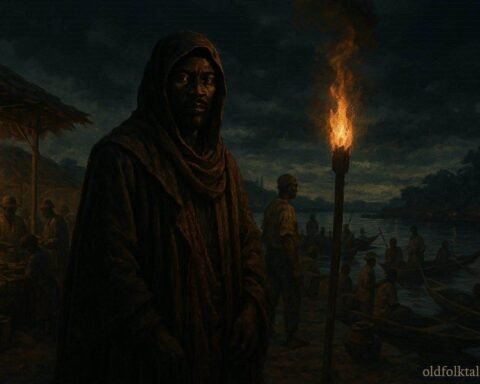
At the center of one settlement lived an elderly spiritual guide named Kambolo, a man respected for his wisdom and ability to interpret ancestral signs. He was known for studying dreams, observing animal movements, and listening carefully to the natural world. Many believed the ancestors spoke through him during moments of danger or uncertainty.
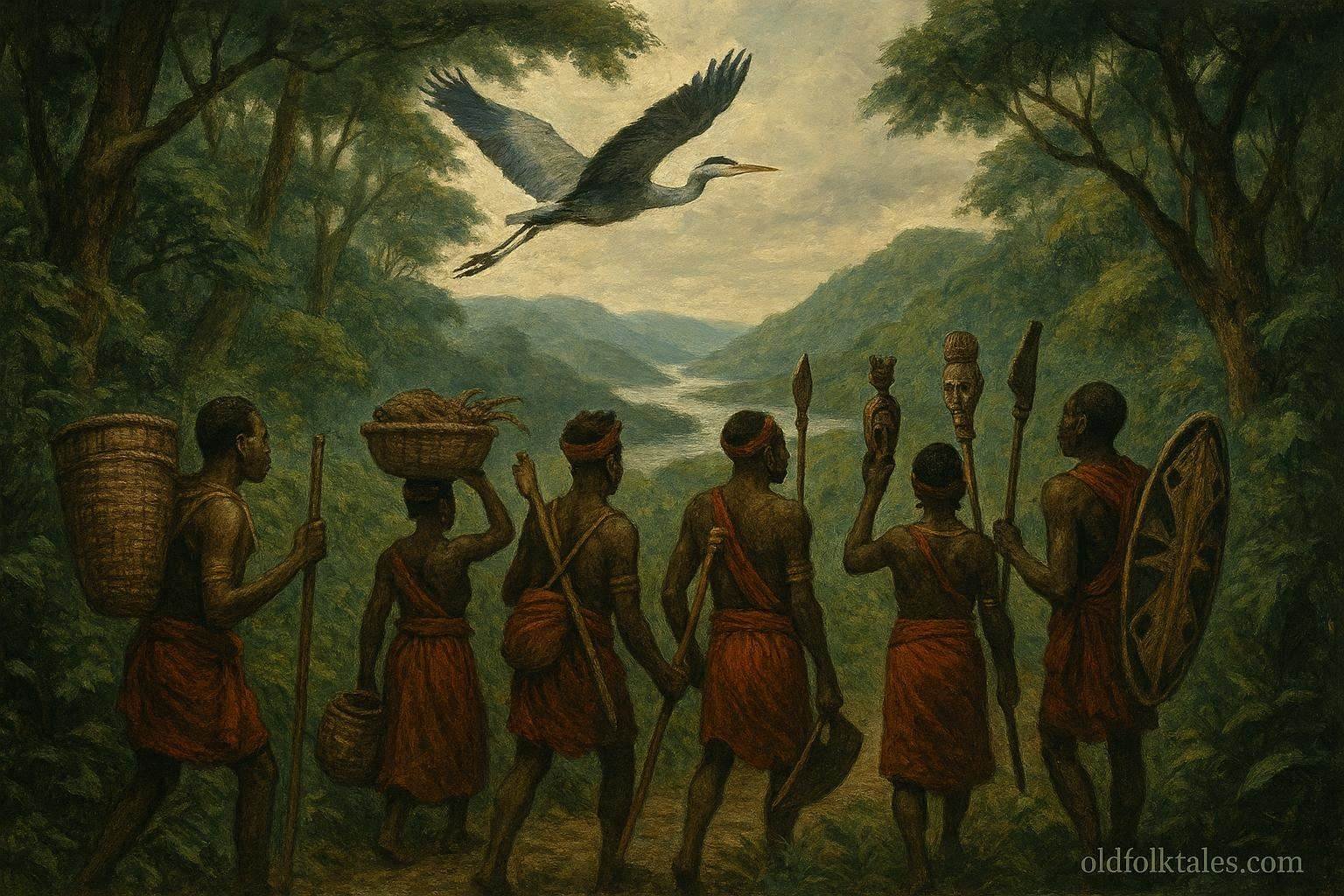
One night, after several weeks of severe drought, Kambolo experienced a powerful vision. He dreamed of a long pathway stretching across forests and rivers toward distant hills covered in sunlight. Along this path walked countless people carrying children, tools, seeds, and ceremonial objects. Above them circled a large grey bird that never landed but continued guiding the travelers forward.
Don’t stop yet! See our complete East African folktales collection
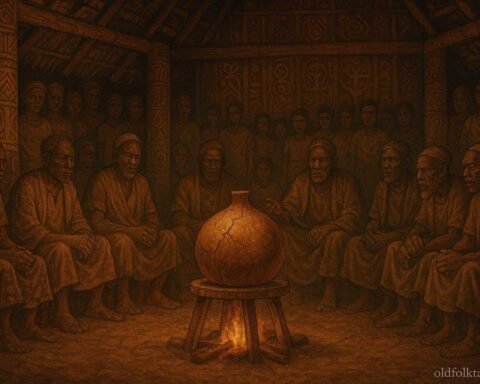
When Kambolo awoke, he gathered the elders before sunrise and shared the vision. At first, many listened in silence, uncertain of what it meant. Some believed the dream was symbolic rather than literal. Others feared it was a warning that the community would soon face disaster if they remained where they were.
In the days that followed, unusual signs began appearing throughout the settlement. Hunters reported seeing the same grey bird from Kambolo’s dream flying repeatedly above the forest trails. Fishermen noticed strange movements in the river currents. Even children spoke of hearing distant drum sounds at night despite no nearby celebrations.
The elders eventually concluded that the ancestors were calling the people to leave their homeland and begin a migration toward a new place of settlement. The decision was not easy. The land they occupied held the graves of ancestors, familiar hunting grounds, and memories built across generations. Leaving meant abandoning part of their identity and stepping into uncertainty.
For many days, debates continued among the people. Some argued that remaining behind was safer than entering unknown territory. Others believed refusing the ancestral signs would bring even greater suffering. Families worried about children, food supplies, and the dangers hidden within distant forests.
Kambolo reminded them that survival often required movement and adaptation. He explained that the ancestors were not abandoning them but guiding them toward a future where the community could continue to grow. Slowly, the people accepted the decision.
Preparations for the journey began immediately. Farmers gathered seeds to carry into the unknown lands. Hunters prepared tools and weapons for protection. Women collected cooking pots, woven baskets, and ceremonial objects considered spiritually important. Elders preserved oral histories and sacred songs so the memory of the old homeland would not disappear during migration.
Before departure, a final ceremony was held at the center of the settlement. Offerings were placed near ancestral shrines, and prayers were spoken asking for protection along the journey. Many wept quietly, knowing they might never return to the land of their birth.
At sunrise the following morning, the migration began.
The line of travelers stretched across forest paths as families carried their belongings and followed Kambolo into unfamiliar territory. The grey bird from the dream was said to appear again above the trees during the first days of travel, strengthening belief that the ancestors were guiding them.
The journey was difficult from the beginning.
Dense forests slowed movement, and heavy rains turned pathways into deep mud. Food supplies had to be carefully rationed. At night, unfamiliar animal sounds echoed through the darkness, making many travelers uneasy. Children grew tired, and elders struggled with the long distances.
Despite these hardships, the people continued moving forward. Each time doubt began to spread, Kambolo reminded them of the vision and encouraged unity. He believed that fear would weaken the journey more than hunger or exhaustion.
Weeks passed as the migration continued through forests, rivers, and open grasslands. Along the way, the travelers encountered other communities. Some welcomed them peacefully and shared resources, while others viewed the newcomers with suspicion. Through careful negotiation and respect for local customs, the Yaka people avoided many potential conflicts.
One evening, after crossing a difficult river, the travelers reached a high ridge overlooking a wide fertile valley. The land below contained flowing streams, healthy forests, and open farming areas untouched by drought. As the people rested, the setting sun illuminated the valley in a golden light similar to the vision Kambolo had described.
The elders gathered immediately to discuss what they had seen. Hunters explored the surrounding area over the next several days and returned with reports of fertile soil, abundant wildlife, and stable water sources. There were no signs of immediate danger or hostile settlements nearby.
Kambolo believed the ancestors had finally led them to the place shown in the dream.
A great ceremony was held to honor the journey and give thanks for survival. Seeds carried from the old homeland were planted into the new soil, symbolizing continuity between past and future. Families began building homes, clearing farmland, and establishing what would become a permanent settlement.
Over time, the new settlement grew into a thriving community. Children born there heard stories about the long migration and the signs that guided their ancestors across forests and rivers. The people never forgot the hardships of the journey, but they also understood that survival had been possible because they remained united and trusted the guidance passed down through ancestral wisdom.
Generations later, the story of the Migration Path of the Yaka People continued to be told as both a historical memory and a spiritual lesson. It reminded listeners that migration was not simply movement from one place to another but a journey of endurance, faith, and collective survival.
Even today, among Yaka communities, elders still speak of the grey bird that guided the travelers and the courage required to leave behind the familiar in search of a future that had not yet been seen.
If you liked this story, see our Central African folktales collection
Moral Lesson
Survival and growth often require courage, unity, and trust in guidance during uncertain times.
Knowledge Check
- Where is the story set?
It is set among the Yaka people in the Democratic Republic of Congo. - Who guided the migration?
An elder spiritual guide named Kambolo led the people. - What sign appeared in Kambolo’s dream?
A grey bird guided people along a migration path. - Why did the Yaka people leave their homeland?
Their settlements faced hardship, drought, and signs of imbalance. - What did the travelers discover at the end of the journey?
They found a fertile valley suitable for a new settlement. - What is the lesson of the story?
Courage and unity help communities survive difficult transitions.
Source
Central African folklore. Adapted from Yaka migration and settlement traditions documented in Kwango oral historical studies of the Democratic Republic of Congo.