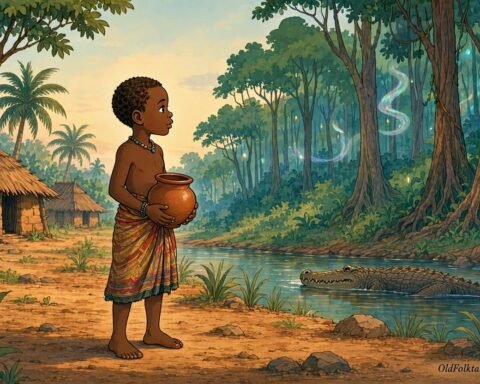
Deep within the western regions of the Democratic Republic of Congo lies the vast and shadowy Lake Mai-Ndombe, a body of water surrounded by thick forests, winding rivers, and villages whose lives have long depended on fishing and trade. Among the Teke people and neighboring communities, the lake was respected not only as a source of food and survival but also as a sacred place connected to ancestral and spiritual forces.
Elders taught children never to treat the waters carelessly.
The lake, they said, listened.
It watched.
And sometimes it answered those who approached it with either respect or greed.
For generations, fishermen shared stories about mysterious lights moving across the water at night, strange songs carried through the mist before dawn, and beautiful spirit beings believed to live beneath the surface of the lake. Most villagers avoided speaking openly about such things after sunset, fearing they might attract unwanted attention from the unseen world.
Among the many stories preserved through oral tradition, none became more famous than the tale of the Spirit Bride of Lake Mai-Ndombe.
Long ago, in a quiet fishing settlement near the lake’s northern shore, there lived a young fisherman named Etoko. Unlike many other fishermen who inherited wealth or large canoes from their families, Etoko owned very little. His parents had died when he was still young, leaving him to survive alone with only a small wooden canoe and worn fishing nets patched together many times over.
Looking for more? Explore the magic of East African folktales here
Though poor, Etoko was respected for his kindness and discipline.
He never stole from other fishermen.
He shared food with widows and elders whenever his catch was successful.
And unlike some young men in the village, he never mocked the spiritual traditions connected to the lake.
Each morning before sunrise, Etoko offered a brief prayer of gratitude before placing his canoe into the water. Older fishermen quietly admired his humility, believing the spirits favored those who respected the balance between humanity and nature.
Still, life remained difficult for him.
Some days he returned with almost nothing.
During storm seasons, his fragile canoe nearly broke apart against violent waves. While others married and built families, Etoko lived alone in a small hut near the edge of the village.
Then one season, strange events began unfolding across Lake Mai-Ndombe.
Fishing catches became unusually scarce.
Several canoes disappeared during calm weather without explanation.
At night, villagers reported hearing singing carried across the water even when no boats were nearby.
Fear slowly spread among the settlement.
The elders warned everyone to avoid fishing after sunset until spiritual balance returned to the lake.
But hunger continued growing.
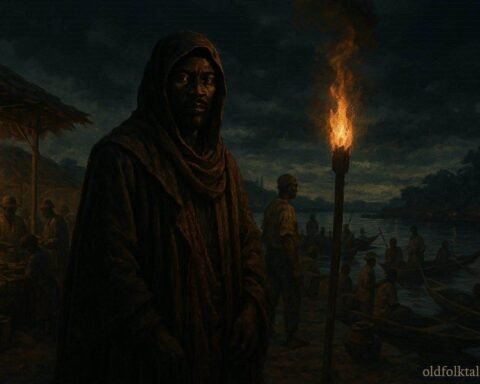
One evening, desperate to provide enough food for himself and several elderly villagers depending on him, Etoko paddled farther into the lake than usual. Dark clouds covered the sky while heavy mist drifted low across the water.
The lake was completely silent.
No birds called from the trees.
No insects moved near the reeds.
Even the sound of water against the canoe seemed strangely distant.
As Etoko prepared to cast his nets, he suddenly heard soft singing somewhere within the mist.
At first, he thought it was another fisherman.
But the voice sounded unlike anything he had ever heard before.
It was calm.
Beautiful.
Almost sorrowful.
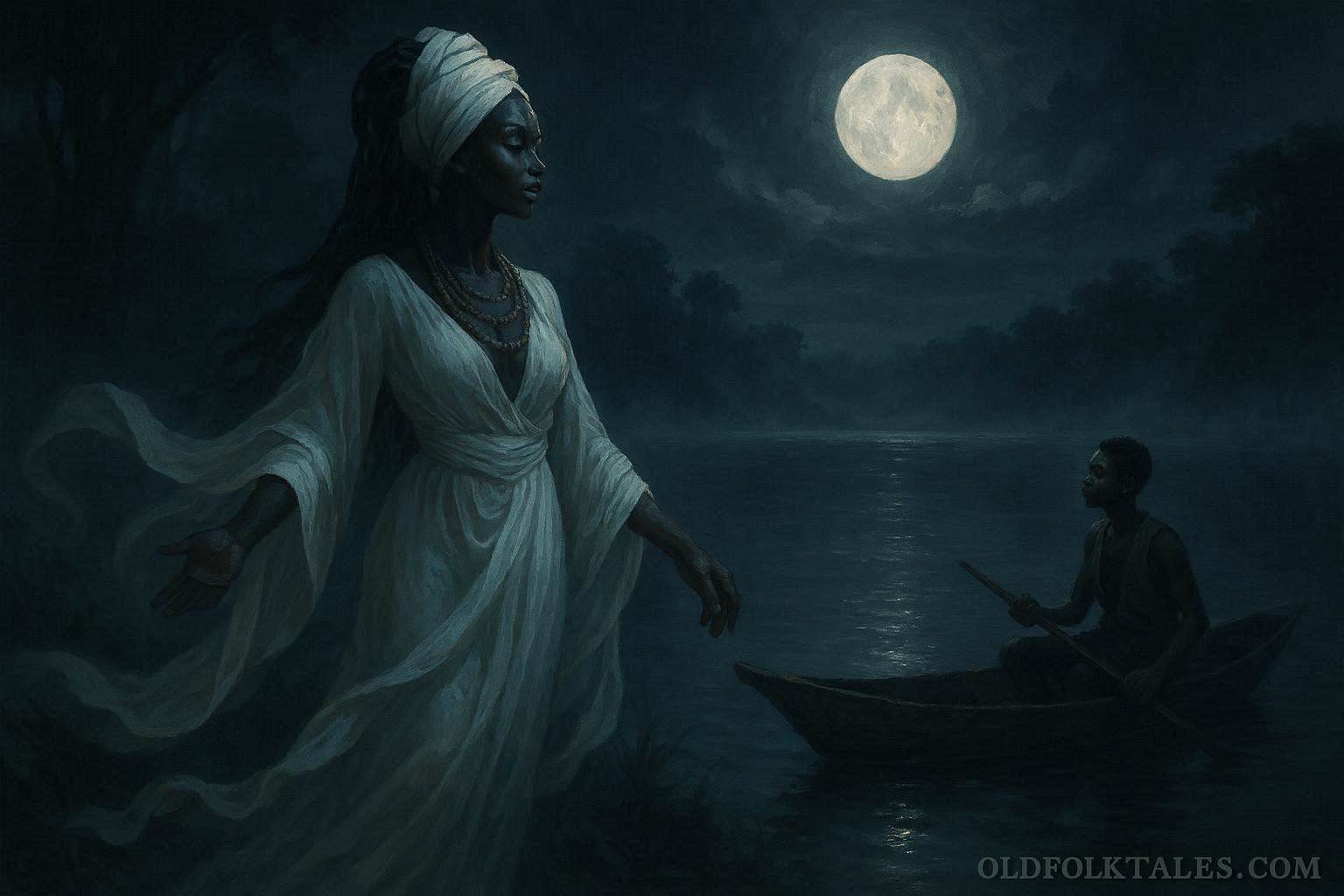
Following the sound carefully, Etoko paddled deeper into the fog until he noticed a figure standing upon a narrow strip of land hidden between reeds and dark water.
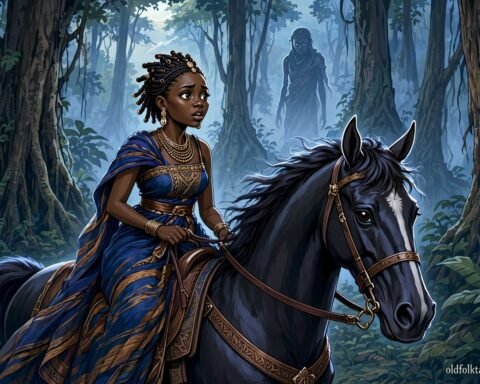
It was a young woman dressed in flowing white cloth decorated with shining beads that reflected the moonlight despite the heavy mist surrounding the lake.
Etoko froze in fear.
The woman did not appear frightened by his presence.
Instead, she looked toward him calmly and spoke his name before he had introduced himself.
This frightened him even more.
The woman explained that she was called Nyasa and that she belonged to the spirit world connected to the waters of Lake Mai-Ndombe. She told Etoko that the lake had watched his honesty and kindness for many years.
Because of his respect toward both people and nature, he had been allowed to see her.
Etoko considered fleeing immediately.
Every story he had heard about water spirits warned of danger.
But Nyasa’s voice remained gentle, and her presence felt strangely peaceful rather than threatening.
Before disappearing back into the mist, she offered him a warning.
The balance of the lake had been disturbed by greed among several fishermen who ignored sacred traditions, polluted fishing grounds, and disrespected ancestral offerings.
If the disrespect continued, greater disaster would follow.
Then she vanished completely.
The next morning, Etoko returned home shaken by the encounter but told no one except the oldest village elder, Mama Ilunga.
After listening carefully, the elder warned him to remain cautious.
Spirit beings, she explained, often tested human intentions before revealing their true nature.
Still, she believed the encounter carried spiritual significance.
Over the following weeks, Etoko continued encountering Nyasa near hidden areas of the lake. She taught him where fish still gathered safely and warned him about dangerous storms before they arrived. Each time he followed her guidance, his catches became larger than ever before.
Soon, Etoko’s life began changing.
His fishing nets overflowed regularly.
He repaired his home and helped feed struggling families throughout the village.
People became curious about his sudden success, but Etoko refused to boast or reveal everything he knew.
As time passed, affection slowly grew between him and Nyasa.
Though she belonged to the spirit world, she spoke warmly about loneliness, responsibility, and the burden of living between two worlds. Etoko no longer feared her presence.
Eventually, Nyasa offered him a choice.
She wished to become his wife and live beside him among the people.
But there was one sacred condition.
He must never publicly reveal her spiritual origin or allow anger, jealousy, or suspicion to make him accuse her before others.
If he broke this vow, she warned, the bond between them would be destroyed forever.
Etoko agreed without hesitation.
Soon afterward, Nyasa appeared openly in the village as a quiet and beautiful woman from a distant settlement. Though some villagers questioned her sudden arrival, her kindness quickly earned respect throughout the community.
Under their union, prosperity returned to the village.
Fishing catches increased again.
Storms became less destructive.
Families once divided by conflict slowly cooperated peacefully.
Even the lake itself seemed calmer.
People began believing Etoko’s household carried ancestral blessings.
Years passed peacefully.
Etoko and Nyasa built a family together and became admired throughout the region. But success eventually attracted jealousy.
Some villagers whispered that Etoko’s wealth came from hidden magic rather than hard work. Rival fishermen resented his influence and began spreading rumors about Nyasa’s mysterious origins.
Among them was a jealous fisherman named Bokula who constantly tried to provoke Etoko into revealing secrets about his wife.
One season, after several weeks of poor fishing caused by natural weather changes, angry villagers demanded explanations. Bokula publicly accused Nyasa of bringing dangerous spirits into the village.
At first, Etoko defended her calmly.
But as accusations continued, fear and pressure overwhelmed him.
During a heated gathering before the elders, Bokula mocked Etoko repeatedly, claiming no ordinary woman could possess such unnatural influence over the lake.
Finally, consumed by anger and humiliation, Etoko shouted the truth before the entire village.
He declared that Nyasa was not human but a spirit woman from Lake Mai-Ndombe.
The moment the words left his mouth, silence covered the gathering.
Nyasa lowered her head sadly.
The wind surrounding the village suddenly intensified.
Dark clouds gathered above the lake.
Without speaking another word, Nyasa walked slowly toward the shoreline as villagers watched in fear.
Etoko realized immediately what he had done.
He begged her forgiveness and tried to stop her.
But the sacred vow had already been broken.
At the water’s edge, Nyasa turned toward him one final time.
She told him she had truly loved him and had hoped humanity and the spirit world could live in balance through trust and respect.
Then she stepped into the waters of Lake Mai-Ndombe and disappeared beneath the surface forever.
After her departure, the village’s prosperity slowly faded.
Fishing became difficult once again.
Storms returned more violently than before.
Etoko lived the rest of his life grieving the loss caused by his broken promise.
Yet he continued honoring the lake with humility and respect, teaching younger fishermen never to allow fear, pride, or public pressure to destroy trust.
Generations later, elders around Lake Mai-Ndombe still share the story of the Spirit Bride.
Some say that during quiet nights, a woman’s singing can still be heard drifting across the water through the mist.
And among the Teke people, many believe the lake remembers both the blessings brought through trust and the sorrow caused when sacred promises are broken.
Keep reading: Discover more Central African folktales
Moral Lesson
Trust, respect, and keeping one’s promises are essential for lasting peace and love.
Knowledge Check
- Where is the story set?
It is set around Lake Mai-Ndombe in the Democratic Republic of Congo. - Who was Etoko?
He was a humble fisherman who respected the traditions of the lake. - Who was Nyasa?
She was a spirit woman connected to Lake Mai-Ndombe. - What condition did Nyasa give before marrying Etoko?
He was forbidden from revealing her spiritual identity publicly. - Why did Nyasa leave the village?
Etoko broke his sacred vow during a public argument. - What lesson does the story teach?
Trust and sacred promises should never be broken.
Source
Central African folklore. Adapted from Teke lake spirit traditions preserved in Mai-Ndombe oral narratives and regional folklore studies of the Democratic Republic of Congo.