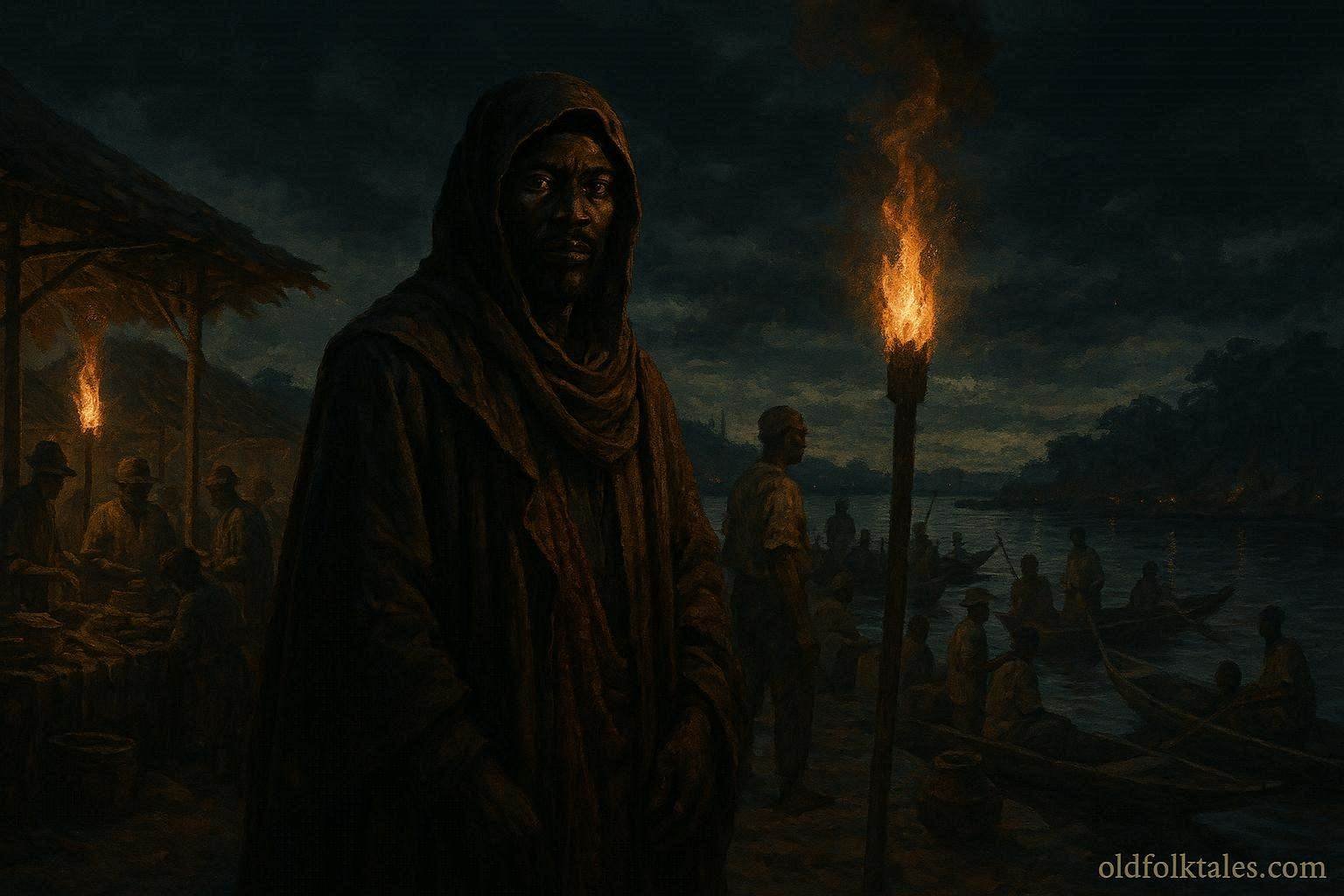
In the northeastern regions of the Democratic Republic of Congo, where great rivers connected distant kingdoms and trade caravans moved through dense forests toward bustling settlements, the city of Kisangani became one of the most important crossroads in Central Africa. Traders from many communities passed through its river ports carrying ivory, salt, copper, woven cloth, spices, and stories gathered from faraway lands.
Among the Swahili Congo communities that lived along these trade routes, oral traditions preserved many tales warning travelers about greed, betrayal, and unseen dangers hidden behind human ambition. One of the most feared stories was the legend of the Shadow Trader of Kisangani, a mysterious merchant believed to appear shortly before acts of treachery or disaster changed the fate of entire communities.
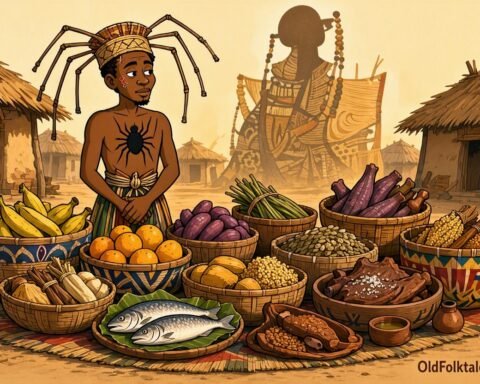
Long ago, before colonial influence transformed the region, Kisangani thrived as a powerful trading center along the Congo River. Canoes lined the riverbanks each morning while merchants negotiated loudly in crowded marketplaces filled with the sounds of drums, animals, and distant conversations in many languages.
The city attracted all kinds of travelers.
Hunters arrived from forest settlements carrying skins and ivory.
River traders transported fish and salt from distant villages.
Metalworkers exchanged tools and ornaments crafted from copper and iron.
Want more? Read more West African folktales now
Alongside these merchants came storytellers, spiritual healers, and wandering strangers seeking fortune within the growing trade networks of the region.
At the center of this busy world lived a respected trader named Salim. He was known throughout Kisangani for his honesty and calm judgment during negotiations. Unlike many merchants who sought quick wealth through deception, Salim believed trust was the foundation of successful trade. He treated travelers fairly and often allowed struggling families to buy supplies on credit during difficult seasons.
Because of this reputation, traders from distant regions preferred working with him.
But prosperity also attracted envy.
Several powerful merchants within Kisangani grew resentful of Salim’s influence. They believed his popularity weakened their own control over trade agreements and market prices. Among these rivals was a wealthy merchant named Jabari, a man admired for his intelligence but feared for his ambition.
Jabari cared little for fairness.
To him, trade was a contest where only the strongest deserved success.
Over time, he began secretly manipulating prices, bribing officials overseeing river transport, and spreading false rumors about competing merchants. His goal was simple: control as much of Kisangani’s trade network as possible.
Still, despite his influence, Salim remained respected by the people.
Then, during one unusually quiet trading season, rumors began spreading about a mysterious merchant traveling along the river routes surrounding Kisangani.
Witnesses described the stranger differently each time.
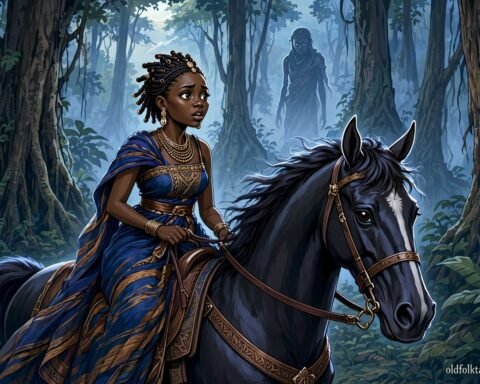
Some claimed he wore dark robes stained by river mud.
Others said his face remained hidden beneath a woven hat no matter how brightly the sun shone.
A few traders insisted his shadow appeared longer than normal even at midday.
Yet nearly everyone agreed on one detail.
The stranger always appeared shortly before disaster struck.
At first, most people dismissed the stories as ordinary travel superstition.
Trade routes were filled with legends meant to entertain weary travelers during long journeys through forests and rivers. Salim himself laughed gently when younger merchants discussed the mysterious figure around evening fires.
But then strange events began unfolding across Kisangani.
A canoe transporting valuable goods overturned unexpectedly during calm weather.
A warehouse fire destroyed supplies belonging to several respected traders.
Disputes between merchant families became increasingly hostile, leading to violent confrontations in the marketplace.
Each time, witnesses claimed the mysterious merchant had been seen nearby shortly before the incident occurred.
Fear slowly spread among the traders.
Some refused to travel certain river paths after sunset.
Others carried protective charms provided by spiritual healers.
Still, no one understood whether the Shadow Trader caused disaster or merely warned of its arrival.
One evening, after returning from negotiations upriver, Salim encountered the mysterious merchant for the first time.
The stranger stood alone near the riverbank market as heavy rain clouds gathered above the city. He appeared older than Salim expected, with calm eyes that seemed unusually observant.
Around him, the noisy market strangely quieted.
The merchant greeted Salim politely and asked simple questions about trade conditions within Kisangani.
At first, the conversation seemed ordinary.
But before leaving, the stranger spoke words Salim never forgot.
He warned that betrayal was already growing within the city and that men driven by greed would soon destroy the peace protecting the trade routes.
Salim attempted to ask the stranger’s name.
But before he could continue, a crowd passed between them carrying baskets toward the docks.
When the path cleared moments later, the merchant had disappeared completely.
Disturbed by the encounter, Salim shared the story privately with several trusted elders. Some advised him to remain cautious, believing the stranger might represent an ancestral warning rather than an ordinary traveler.
Meanwhile, tensions within Kisangani continued worsening.
Jabari and his allies secretly organized a scheme to gain control over major trade routes by accusing rival merchants of theft and smuggling. False accusations spread rapidly, dividing trading families that had cooperated peacefully for generations.
Corrupt officials accepted bribes in exchange for supporting fabricated claims.
As suspicion grew, traders stopped trusting one another.
River shipments were delayed.
Arguments erupted openly in the marketplaces.
Even longtime friendships became strained by fear and uncertainty.
One night, Salim discovered evidence proving that Jabari’s network had been orchestrating the false accusations to eliminate competition. Several innocent merchants faced imprisonment while Jabari’s allies quietly seized control of their goods and trading positions.
Realizing the danger facing the city, Salim called for a public gathering involving merchants, elders, and river authorities.
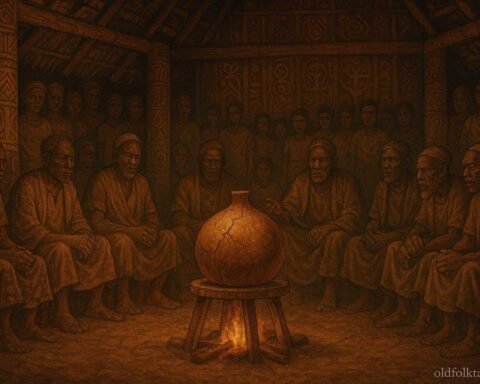
The meeting took place near the central marketplace beneath large torch fires as crowds gathered anxiously to hear the accusations.
Jabari denied everything.
He claimed Salim was attempting to protect criminal activity among rival traders.
For several moments, confusion spread through the crowd as both sides argued fiercely.
Then suddenly, murmurs passed through the gathering.
At the edge of the marketplace stood the mysterious merchant once again.
The Shadow Trader remained silent, watching the confrontation unfold beneath the torchlight.
Some people stepped backward nervously upon seeing him.
Others whispered prayers beneath their breath.
Salim later recalled that the stranger’s presence seemed heavier than before, as though the air itself had become tense.
One elder finally demanded that all trade records and accusations be examined publicly before the entire community.
As the investigation unfolded through the night, hidden bribes, false documents, and secret agreements connected to Jabari’s network were slowly revealed.
The truth shocked Kisangani.
Merchants who had trusted Jabari realized how deeply corruption had spread through the trade system. Families wrongly accused of theft were publicly cleared, while officials involved in the deception lost their authority.
Before dawn, Jabari fled the city fearing punishment from both the authorities and the angry traders whose livelihoods he had endangered.
When the meeting finally ended, many searched for the mysterious merchant who had appeared during the confrontation.
But once again, he had vanished without explanation.
After those events, the story of the Shadow Trader spread throughout the Congo trade routes. Some believed he was an ancestral spirit protecting the balance of commerce and warning communities before greed destroyed them. Others claimed he represented the conscience of the people themselves, appearing whenever corruption became too dangerous to ignore.
No one ever discovered his true identity.
Yet traders across Kisangani continued sharing stories about encounters with the mysterious figure for generations afterward.
Old river merchants often warned young travelers to pay attention whenever a silent stranger appeared unexpectedly near marketplaces or river docks during periods of political tension.
Because according to the legend, the Shadow Trader never arrived without reason.
And wherever greed, betrayal, or hidden ambition threatened the peace of the people, his shadow was never far behind.
Keep reading: Discover more Central African folktales
Moral Lesson
Greed and betrayal eventually destroy trust, while truth and accountability protect communities from collapse.
Knowledge Check
- Where is the story set?
It is set in Kisangani in the Democratic Republic of Congo. - Who was Salim?
He was a respected and honest trader within the city. - What was the Shadow Trader believed to predict?
His appearance was believed to warn of betrayal or disaster. - Who secretly manipulated the trade system?
A wealthy merchant named Jabari organized corruption and false accusations. - What happened during the public investigation?
The corruption and hidden schemes within the trade network were exposed. - What lesson does the story teach?
Greed and dishonesty eventually lead to conflict and downfall.
Source
Central African folklore. Adapted from Congo trade route oral traditions preserved in Swahili Congo regional folklore and historical studies.