In the southeastern regions of Morocco, where endless dunes rise beneath burning skies and ancient caravan paths stretch across the Sahara Desert, the settlement of Merzouga stood for centuries as an important resting point for travelers crossing dangerous trade routes. Merchants, nomads, scholars, and camel caravans passed through the region carrying salt, gold, spices, fabrics, and stories gathered from distant lands beyond the desert horizon.
Life in the Sahara demanded patience, discipline, and respect for nature.
The desert could provide safe passage one moment and destruction the next.
Winds shifted without warning.
Temperatures changed rapidly between day and night.
And sandstorms powerful enough to bury entire caravans sometimes appeared from nowhere across the dunes.
Among Saharan Moroccan communities, survival depended not only on skill but also on listening carefully to old knowledge passed through generations. Elders taught travelers how to read the stars, observe shifting winds, and recognize unusual signs hidden within the silence of the desert.
Yet beyond practical knowledge, the Sahara also carried countless legends.
Stories spoke of lost cities buried beneath the sand.
Hidden spirits wandering ancient trade routes.
And mysterious riders believed to appear before disaster struck the desert.
Looking for more? Explore the magic of East African folktales here
One of the most feared stories among caravan travelers became known as the legend of the Desert Riders of Merzouga.
Long ago, during a period when trans-Saharan trade routes flourished across North Africa, a respected caravan leader named Hamid prepared for a difficult journey through the Moroccan Sahara. Hamid had crossed the desert many times and was admired for his experience navigating dangerous routes between trading settlements.
Unlike reckless merchants who underestimated the desert, Hamid respected its dangers deeply.
Before every journey, he consulted elders, studied weather conditions carefully, and made offerings of gratitude for safe passage.
His caravan that season included merchants transporting valuable fabrics, spices, silver ornaments, and salt across the desert toward distant markets. Several younger travelers also joined the expedition hoping to gain wealth and experience through caravan trade.
Among them was a confident young merchant named Youssef.
Unlike Hamid, Youssef viewed the old desert legends as superstitions invented to frighten inexperienced travelers. He often laughed whenever older men discussed spirits or mysterious warnings hidden within the dunes.
“The desert is only sand and wind,” he once declared confidently beside a campfire.
“It cannot think. It cannot warn anyone.”
The older travelers exchanged uneasy glances but said little.
They knew arrogance rarely survived long within the Sahara.
The caravan departed from Merzouga at sunrise beneath clear skies. Camels moved steadily across golden dunes while guides navigated carefully using landmarks and celestial patterns memorized over generations.
For several days, the journey progressed peacefully.
At night, travelers gathered beside fires listening to stories while cold desert winds swept across the dunes beneath brilliant stars.
Then strange signs began appearing.
On the fifth evening, one of the camel guides noticed unusual tracks crossing the sand ahead of the caravan. The prints belonged to several riders traveling on horseback, yet no nearby caravan or settlement had been reported within the region.
Even more unsettling was the pattern of the tracks.
The horses appeared to move silently in perfect formation before vanishing suddenly among untouched dunes where no trail continued.
Hamid became visibly uneasy after seeing them.
That night, he ordered the caravan to remain alert and avoid unnecessary travel after sunset.
Youssef mocked the concern openly.
“Perhaps your ghost riders are afraid of the dark,” he joked loudly.
But the older guides remained silent.
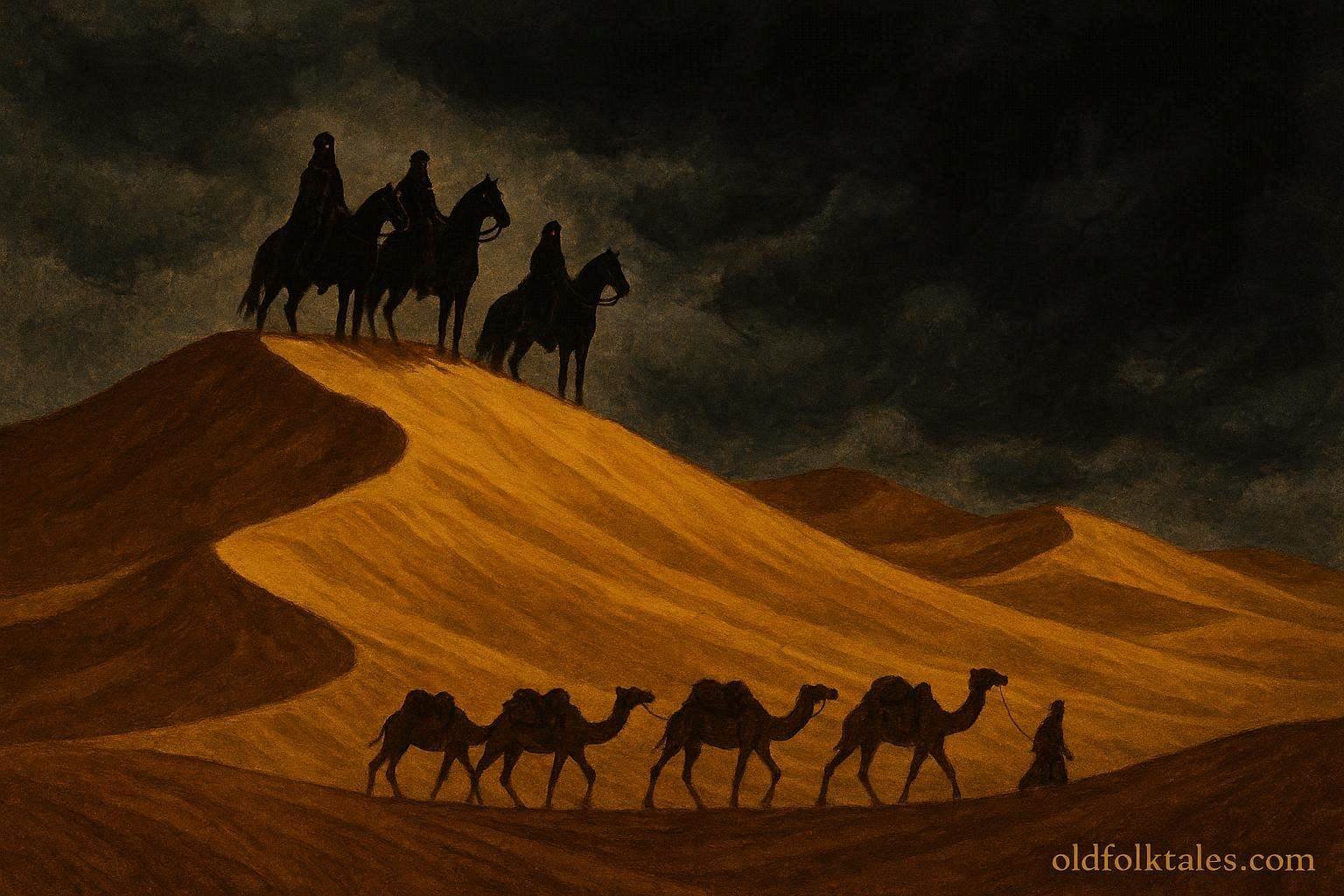
Later that night, as strong winds moved across the camp, several travelers reported seeing distant figures on horseback standing motionless atop nearby dunes beneath the moonlight.
The riders never approached.
They simply watched.
Wrapped in long desert robes with faces hidden beneath dark veils, they appeared strangely still against the shifting sands.
Whenever anyone attempted to move closer, the figures disappeared into the darkness.
Fear slowly spread among the caravan.
Some travelers whispered prayers before sleeping.
Others insisted the riders were spirits guarding ancient desert routes.
Hamid ordered the camp packed before dawn, hoping to reach safer terrain quickly.
As the caravan continued deeper into the Sahara, the atmosphere grew increasingly tense.
The desert itself seemed unnaturally quiet.
Birds vanished from the sky.
Even the camels became restless, snorting nervously and resisting certain paths across the dunes.
Hamid recognized the signs immediately.
A dangerous sandstorm was approaching.
Yet the skies remained strangely clear.
Several younger merchants questioned whether the caravan leader was overreacting. Youssef especially argued against changing direction or delaying travel.
But shortly before sunset, the mysterious riders appeared again.
This time the entire caravan saw them clearly.
Five horsemen stood silently atop a distant ridge overlooking the travelers.
No sound came from them.
No movement.
Only stillness.
One of the older guides fell to his knees in fear.
“The Desert Riders,” he whispered.
According to ancient Saharan tradition, the riders appeared before deadly storms that claimed the lives of careless travelers. Some believed they were spirits of lost caravan guardians who wandered the desert warning the living about approaching danger.
Others claimed they represented the desert itself taking form before unleashing destruction.
Hamid wasted no time.
Ignoring protests from several merchants, he ordered the caravan to abandon the open dunes immediately and seek shelter near a rocky outcrop several hours away.
The journey became increasingly difficult as powerful winds suddenly began rising across the desert.
Sand whipped through the air.
The sky darkened unnaturally fast.
By the time the caravan reached the rocky cliffs, the storm had fully awakened.
A massive wall of sand moved across the Sahara like a living force swallowing the horizon.
The storm struck with terrifying violence.
Winds screamed through the desert while sand buried tents, supplies, and pathways within moments. Travelers wrapped themselves tightly beneath heavy cloth while camels were secured against the cliffs for protection.
For hours, the storm raged without mercy.
Some younger travelers panicked, believing they would never survive.
Even Hamid struggled to maintain order as darkness consumed the desert completely.
Yet the rocky shelter saved them.
Had the caravan remained within the open dunes, they almost certainly would have been buried alive beneath the storm.
When dawn finally arrived, the desert looked completely transformed.
Entire dunes had shifted overnight.
Previous caravan tracks vanished entirely beneath fresh sand.
Several abandoned camps discovered later along nearby routes showed evidence that other travelers had not escaped the storm in time.
As the exhausted caravan prepared to continue its journey, one of the guides noticed something strange atop a nearby dune.
Horse tracks.
Fresh.
Five sets.
Leading toward the horizon.
But no riders could be seen anywhere.
After returning safely to Merzouga weeks later, the travelers shared their story throughout the region. Even Youssef no longer mocked the old desert legends.
From that time onward, Hamid always taught younger caravan leaders never to ignore warnings hidden within nature or dismiss traditions preserved by generations of desert survivors.
Among Saharan Moroccan communities, stories of the Desert Riders continued spreading across caravan routes for centuries.
Some travelers claimed to glimpse silent horsemen during dangerous weather.
Others reported hearing distant hoofbeats moments before storms appeared across the dunes.
To this day, elders near Merzouga still warn travelers to respect both the visible and invisible forces of the Sahara.
Because according to desert tradition, the riders do not appear without reason.
And when they emerge from the dunes, the desert itself is preparing to speak.
Want to dive deeper? Read more North African folktales today
Moral Lesson
Wisdom, humility, and respect for ancestral knowledge can protect people from danger.
Knowledge Check
- Where is the story set?
It is set near Merzouga in the Moroccan Sahara Desert. - Who was Hamid?
He was an experienced caravan leader respected for his wisdom. - What were the Desert Riders believed to predict?
They were believed to warn travelers about deadly sandstorms. - Why did Youssef ignore the warnings at first?
He believed the desert legends were only superstitions. - How did the caravan survive the storm?
Hamid led them to shelter near rocky cliffs before the storm arrived. - What lesson does the story teach?
Respecting wisdom and ancestral knowledge can save lives.
Source
North African folklore. Adapted from Moroccan Sahara caravan traditions preserved in Saharan oral history and regional folklore studies.