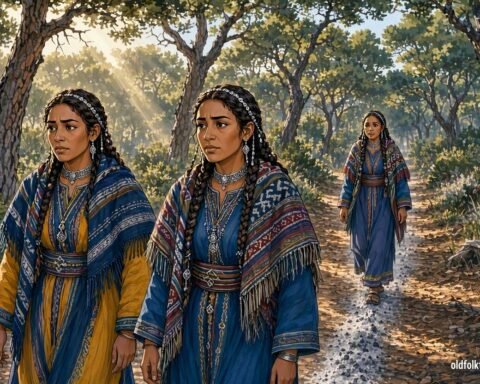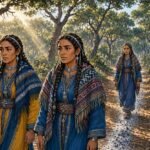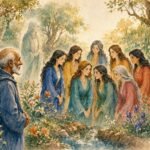
Far beyond the crowded markets and ancient cities of Morocco, the High Atlas Mountains rise across the land like a stone wall separating worlds. Snow covered the highest peaks for much of the year while narrow valleys below sheltered Amazigh villages built from red earth and stone. For generations, the people of the mountains survived through farming, herding, and strong family traditions passed carefully from elders to children.
Among the Amazigh communities of the High Atlas, mountains were never viewed as empty landscapes.
They were alive.
The winds carried memory.
The rivers carried ancestral voices.
And the lonely cliffs hidden above the valleys were believed to belong to powerful spiritual forces older than any village itself.
Travelers were often warned never to wander carelessly through the mountains after sunset. Elders spoke quietly of unseen beings who protected sacred caves, hidden springs, and forgotten paths crossing the peaks. Some spirits were believed to help lost travelers who showed humility and respect.
Others punished arrogance, greed, or broken promises.
One of the oldest oral traditions preserved among the mountain villages was the story of the Bride of the Atlas Mountains, a tale remembered for its mystery, sorrow, and warning about the fragile balance between human desire and the spiritual world.
Don’t stop yet! See our complete East African folktales collection
Long ago, in a small village surrounded by steep valleys and cedar forests, there lived a young woman named Tislit. She was known throughout the region for her beauty, intelligence, and calm nature. Unlike many young people who dreamed only of marriage or wealth, Tislit loved wandering through the mountain paths collecting herbs and listening to the stories of elders.
Her father was a respected shepherd who owned large flocks of goats and sheep, while her mother came from a family known for preserving ancient Amazigh songs and oral traditions.
From childhood, Tislit was taught to respect the mountains deeply.
Her grandmother often warned her that certain peaks belonged to hidden spirits who watched human behavior carefully. She explained that the mountains rewarded those who lived honestly but sometimes claimed those whose destinies became tied to the unseen world.
As Tislit grew older, many families sought her hand in marriage.
Eventually, her parents arranged her engagement to a wealthy young trader named Karim from a neighboring valley. Karim was hardworking and respected, and the union promised to strengthen ties between both families.
Preparations for the wedding began immediately.
Women gathered to weave ceremonial clothing decorated with Amazigh symbols.
Families prepared large celebrations involving music, dancing, and feasts expected to last several days.
At first, Tislit accepted the arrangement quietly.
Yet beneath her calm appearance, uncertainty slowly grew within her heart.
She respected Karim but did not truly feel connected to him. Whenever she imagined leaving her home forever, an unexplained sadness followed her. Instead of spending time with other brides preparing for marriage, she increasingly wandered alone into the mountains seeking silence.
One evening, only weeks before the wedding ceremony, Tislit climbed farther into the High Atlas than she ever had before.
The air grew colder as the sun disappeared behind the peaks.
Clouds moved slowly across the mountains, casting long shadows over the valleys below.
Eventually she reached a hidden spring surrounded by ancient cedar trees and smooth stone cliffs worn by centuries of wind.
There, for the first time, she heard music.
It was unlike the drums or flutes played during village ceremonies.
The sound seemed to rise directly from the mountain itself.
Soft.
Ancient.
Almost sorrowful.
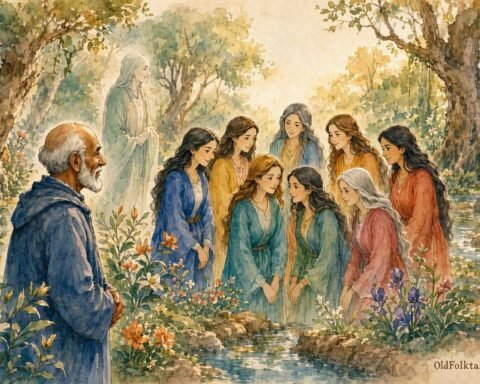
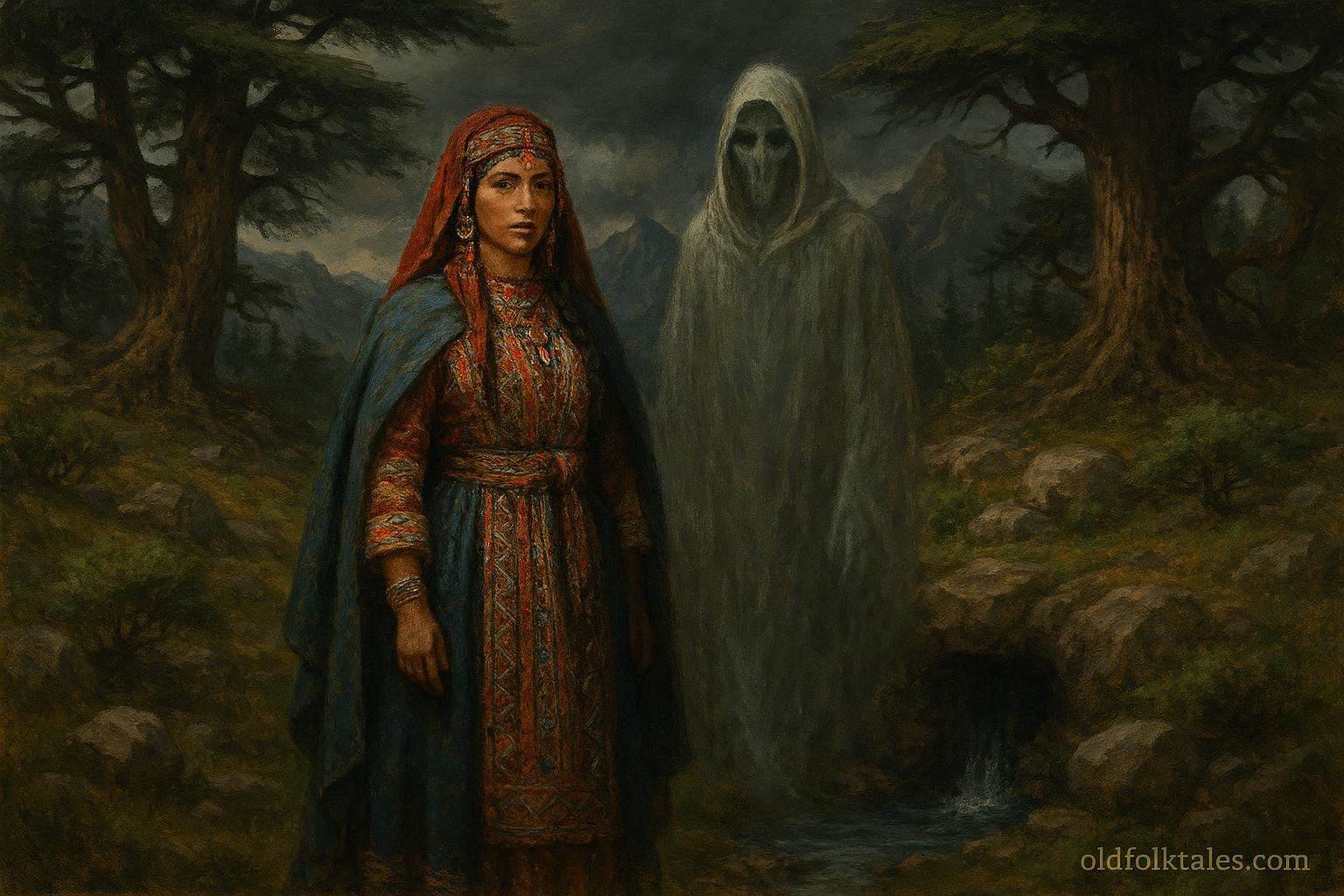
As Tislit followed the sound carefully through the trees, she noticed a man standing beside the spring dressed in dark robes woven with silver patterns that reflected the fading light.
His appearance was strange yet calm.
Though young in face, his eyes carried an age that felt impossible to understand.
Tislit immediately sensed he was not ordinary.
The stranger greeted her in the Amazigh language and spoke her name without introduction.
Fear briefly entered her heart, but the man’s voice remained gentle.
He explained that he was a guardian spirit tied to the mountains surrounding her village, existing between the human and spiritual worlds for longer than any living person could remember.
At first, Tislit believed she should flee immediately.
Every story from her grandmother warned against speaking too long with mountain spirits.
Yet something about the stranger’s presence felt deeply familiar, as though the mountains themselves had been waiting for her arrival.
The spirit told her the mountains had watched her since childhood.
Unlike many others, she listened to the land with respect and understood the silence of the valleys. Because of this, the spiritual world had opened a path before her.
Before disappearing into the evening mist, he warned her that not every destiny followed the expectations of family or tradition.
Then he vanished completely.
Tislit returned home deeply shaken by the encounter.
At first, she told no one.
But over the following days, strange dreams began troubling her sleep. She dreamed of endless mountain paths glowing beneath moonlight and heard the same mysterious music echoing through the valleys.
Sometimes she awoke believing someone was calling her name from beyond the village walls.
Meanwhile, wedding preparations continued.
Karim’s family arrived with gifts.
The village celebrated with dancing and ceremonial songs.
Yet Tislit became increasingly distant.
Her mother noticed the sadness in her eyes and feared her daughter was becoming spiritually unwell.
One night, Tislit visited her grandmother privately and confessed everything about the mountain spirit.
The old woman listened silently for a long time.
Instead of reacting with anger or disbelief, she became visibly afraid.
She explained that stories about mountain spirits were not merely legends meant to frighten children. Some spirits were believed to choose certain humans whose hearts belonged more to the natural and spiritual world than ordinary village life.
Such bonds, she warned, often ended in sorrow because humans and spirits could never fully belong to the same world.
Her grandmother begged Tislit not to return to the hidden spring again.
For several days, Tislit obeyed.
But the dreams continued growing stronger.
She felt restless within the village and increasingly disconnected from the life being prepared for her. Even during wedding celebrations, her thoughts drifted constantly toward the mountains.
Then, on the night before the marriage ceremony, a violent storm swept across the High Atlas.
Powerful winds shook the village while thunder echoed between the cliffs.
As families remained indoors waiting for the storm to pass, Tislit quietly left her home alone.
By dawn, she had disappeared completely.
The village erupted into panic.
Search parties climbed through dangerous mountain paths calling her name across the valleys. Karim himself joined the search despite growing fear among the elders that spiritual forces might be involved.
For days, no sign of Tislit appeared.
Then one shepherd reported seeing a woman dressed in white standing near the hidden spring high in the mountains during sunrise.
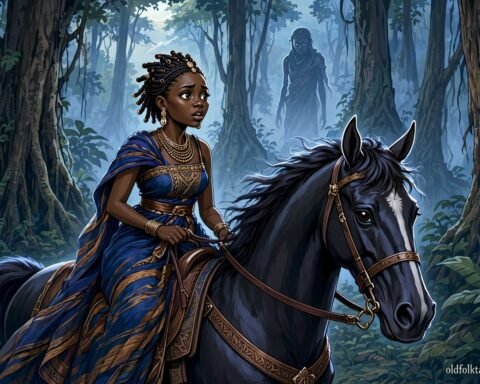
When he approached, she vanished into the mist beside a tall dark figure standing silently among the cedar trees.
After hearing this account, the elders ordered the search to stop.
They believed Tislit had crossed fully into the spiritual world of the mountains.
Her family mourned her as though she had died, though no body was ever found.
Years passed.
The story of Tislit spread across villages throughout the High Atlas Mountains. Travelers claimed that during storms or quiet moonlit nights, the sound of distant music could still be heard near the hidden spring where she first encountered the spirit guardian.
Some shepherds reported seeing a woman walking beside the cliffs dressed in flowing white garments before disappearing into the fog.
Others believed Tislit became a protector spirit herself, guiding lost travelers away from danger in the mountains she once loved.
Among Amazigh communities, the legend of the Bride of the Atlas Mountains survived not only as a story about mystery and love but also as a reminder that some forces within nature cannot be controlled through human plans or expectations.
The mountains, elders say, keep their own secrets.
And sometimes those who listen too closely to their ancient voices are never fully able to return.
Fascinated by this tale? Discover more North African folktales
Moral Lesson
Not every destiny follows human expectations, and respect for spiritual balance is essential.
Knowledge Check
- Where is the story set?
It is set in the High Atlas Mountains of Morocco. - Who was Tislit?
She was a young Amazigh woman promised in marriage. - What did Tislit encounter in the mountains?
She encountered a mysterious spirit guardian connected to the mountains. - Why did Tislit become unhappy before her wedding?
She felt spiritually drawn toward the mountains and uncertain about her future. - What happened on the night before the wedding?
Tislit disappeared into the mountains during a violent storm. - What lesson does the story teach?
Human destiny and spiritual forces cannot always be controlled by tradition or expectation.
Source
North African folklore. Adapted from Amazigh mountain spirit traditions documented in High Atlas oral narratives and Moroccan ethnographic studies.