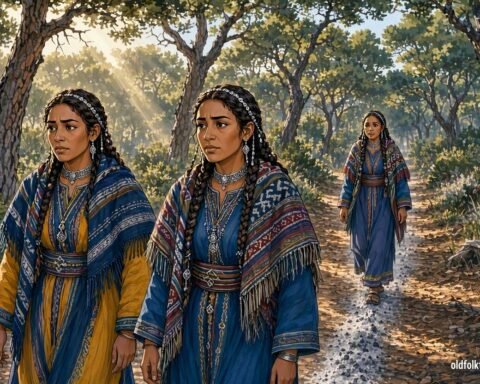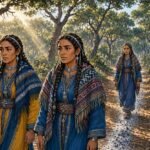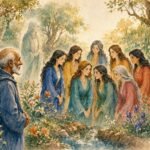
High within the Middle Atlas Mountains of Morocco, where cold rivers flowed through valleys shaded by ancient cedar trees, the forests surrounding Ifrane had long been respected as sacred lands among Amazigh communities. The towering cedars stretched toward the sky like pillars supporting the mountains themselves, their roots buried deep within the earth for centuries beyond memory.
The forests provided life to nearby villages.
Wood for warmth.
Medicinal herbs.
Fresh water flowing from hidden springs.
And shelter for animals that moved silently beneath the trees.
But among the Amazigh elders, the cedar forests were never viewed simply as resources for human use.
They were living places connected to spiritual balance.
Old stories taught that every ancient cedar carried memory within its roots, and the forests themselves listened carefully to the behavior of those who entered them.
Hunters were expected to take only what they needed.
Woodcutters asked permission before cutting certain trees.
Travelers avoided speaking loudly or disrespectfully deep within the woods.
According to oral traditions preserved through generations, a powerful spirit guardian protected the forests from those consumed by greed.
Don’t miss out: Read more Southern African folktales
Many dismissed the legend as only a story told to children.
Others believed it completely.
One of the oldest and most respected tales from the Middle Atlas became known as the story of the Cedar Forest Guardian of Ifrane.
Long ago, during a period when several villages depended heavily on the forests surrounding the mountains, there lived a young hunter named Rafiq. He came from a respected family known for skillful hunting and deep knowledge of the wilderness.
Unlike reckless hunters who killed carelessly, Rafiq understood the traditions of balance taught by the elders.
He hunted only during appropriate seasons.
He never wasted meat or animal skins.
And before entering the cedar forest, he always whispered a quiet prayer of gratitude to the mountains.
Because of this, many villagers trusted him.
Yet as years passed, life around the villages began changing.
Trade with distant towns increased.
Merchants arrived offering silver coins for rare animal furs, cedar wood, and exotic goods gathered from the forests. Soon, some hunters began ignoring traditional limits in pursuit of wealth.
Animals once common near the villages became harder to find.
Young cedar trees were cut carelessly.
Sacred areas of the forest were disturbed by outsiders seeking profit.
Among the most ambitious men was a wealthy trader named Jalal.
Unlike the villagers raised within the traditions of the Middle Atlas, Jalal cared little for the old beliefs surrounding the forest. He viewed the cedar woods only as an opportunity for business and expansion.
“The mountains belong to those strong enough to use them,” he often declared publicly.
He hired groups of hunters and woodcutters to gather as many valuable resources as possible from the forests surrounding Ifrane.
At first, the villages benefited financially.
Families earned money selling wood and animal skins.
New trade routes opened across the region.
But slowly, signs of imbalance began appearing.
Streams that once flowed strongly through the valleys weakened unexpectedly.
Birds disappeared from areas where they had nested for generations.
Several hunters returned from the forest claiming they felt watched deep among the cedar trees.
Then strange events began.
One group of woodcutters reported hearing heavy footsteps moving around their camp at night despite seeing no animal nearby.
Another hunter claimed a shadowy figure appeared between the trees moments before his traps were destroyed mysteriously.
Most unsettling of all, several men hired by Jalal became lost within familiar areas of the forest where no experienced hunter should have lost direction.
Fear slowly spread among the villages.
The elders warned that the cedar forest guardian had awakened because the balance between humanity and nature was being violated.
Jalal laughed at the warnings openly.
He accused the villagers of using superstition to resist progress and ordered his workers deeper into the forest than ever before.
Rafiq became increasingly troubled by what he witnessed.
During hunting trips, he noticed unnatural silence spreading through the woods. Animals avoided entire sections of forest once filled with life.
Even the ancient cedar trees themselves seemed different somehow.
Heavy.
Watchful.
One winter evening, while tracking a wounded deer through falling snow, Rafiq wandered farther into the forest than usual. As darkness approached, he realized he had entered a section of cedar woods forbidden by village tradition.
The trees there were enormous, far older than any others surrounding the valleys.
Their branches blocked most of the fading light.
The air felt strangely still.
Then Rafiq noticed footprints in the snow ahead of him.
At first, he assumed they belonged to another hunter.
But the tracks were unlike anything he had ever seen.
They resembled human footprints yet appeared unnaturally large and deep, as though something impossibly heavy had passed between the trees.
Suddenly, the forest became silent.
No wind moved.
No birds called.
Even the sound of Rafiq’s breathing seemed distant.
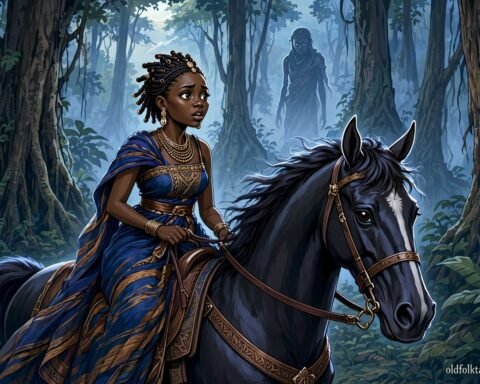
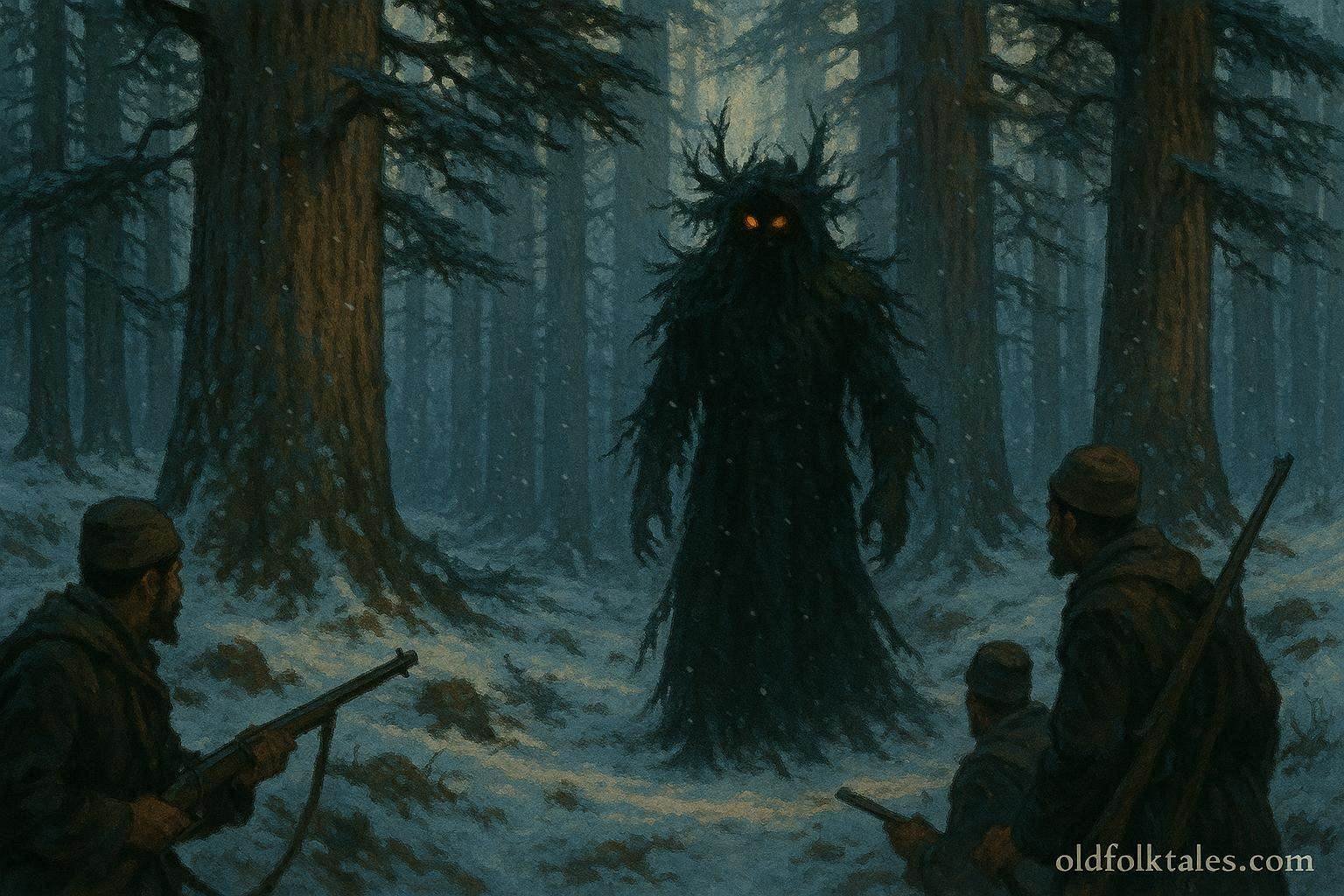
Then he saw the figure.
Standing among the ancient cedars was a tall being wrapped in dark animal skins and moss-covered branches. Its face remained hidden beneath shadows and cedar leaves, yet its eyes glowed faintly like amber fire within the darkness.
Rafiq froze completely.
Though fear rushed through him, he sensed the figure was not purely hostile.
The spirit guardian studied him silently before speaking in a voice that sounded like wind moving through cedar branches.
The forest, it said, had protected the people of the mountains for generations.
But human greed was breaking the balance that allowed both humanity and nature to survive together.
The rivers weakened.
Animals vanished.
Ancient trees were dying before their time.
Unless the destruction stopped, the mountains themselves would begin rejecting those who harmed them.
Rafiq listened carefully without speaking.
Before disappearing among the trees, the guardian gave one warning.
The next full moon would determine whether peace between the villages and the forest could still be restored.
Then the figure vanished completely.
Rafiq returned home shaken by the encounter.
At first, few people believed his story except the oldest elders, who recognized details matching ancient oral traditions passed down through generations.
They urged the villages to stop the uncontrolled hunting and woodcutting immediately.
But Jalal refused.
Driven by greed and anger toward the growing fear among the villagers, he organized a large hunting expedition during the next full moon, determined to prove the guardian was only a myth.
Dozens of men entered the forest carrying axes, traps, and hunting weapons.
Rafiq begged several of them not to go.
Most ignored him.
As night fell beneath the full moon, violent winds suddenly swept through the cedar forest.
Snow and branches crashed across the mountains.
The hunters became separated among the trees as strange sounds echoed through the darkness.
Some later claimed they saw enormous shadowy figures moving silently between the cedars.
Others heard voices whispering from within the forest itself.
By morning, the expedition returned in complete panic.
Several men were injured.
Others had abandoned their tools deep within the woods while fleeing blindly through the snow.
Most frightening of all, Jalal himself never returned.
Search parties looked for him for many days but found only his abandoned horse standing near the ancient cedar grove where Rafiq had encountered the guardian.
After that night, no one again attempted large-scale destruction within the forest.
The villages restored older traditions protecting sacred areas of the cedar woods. Hunting became carefully limited once more, and young trees were replanted throughout damaged sections of the mountains.
Gradually, balance returned.
Streams flowed strongly again.
Animals slowly reappeared.
And peace settled over the forests surrounding Ifrane.
Generations later, Amazigh elders still share the story of the Cedar Forest Guardian as a warning against greed and disrespect toward nature.
Some shepherds and travelers claim that during quiet winter nights, a tall figure can still be seen moving silently between the ancient cedar trees watching over the mountains.
And among the people of the Middle Atlas, many believe the forests survive because the guardian never truly left.
If you liked this story, see our Central African folktales collection
Moral Lesson
Nature must be respected and protected, because greed destroys the balance necessary for survival.
Knowledge Check
- Where is the story set?
It is set in the cedar forests near Ifrane in Morocco’s Middle Atlas Mountains. - Who was Rafiq?
He was a respectful young hunter who honored the traditions of the forest. - Why did the forest guardian become angry?
Greedy hunters and traders were destroying the balance of the cedar forest. - Who was Jalal?
He was a wealthy trader driven by greed for forest resources. - What happened during the full moon expedition?
The hunters became terrified and separated during a violent storm in the forest. - What lesson does the story teach?
Human greed can destroy nature if balance and respect are ignored.
Source
North African folklore. Adapted from Amazigh environmental traditions preserved in Middle Atlas oral narratives and Moroccan folklore studies.