In the northern regions of Guinea-Bissau, where dusty roads connected farming villages and palm forests stretched toward the horizon, the Manjaco people preserved many ceremonial traditions passed carefully from one generation to another.
Among these traditions were sacred masked performances used not only for celebration, but also for maintaining social order within the community.
To outsiders, the masks appeared frightening.
Some resembled spirits.
Others represented animals tied to wisdom, protection, or danger.
But among the Manjaco, masks carried deeper meaning. They allowed ancestral teachings to speak publicly in ways ordinary people could not.
One mask in particular inspired fear throughout the region surrounding Bissorã.
It was known as the Hyena Mask.
Unlike masks used during harvest festivals or dances, the Hyena Mask appeared only during moments of serious conflict when village leaders believed hidden lies threatened the stability of the community.
According to tradition, the spirit represented by the mask could recognize dishonesty no matter how carefully it was hidden.
Keep reading: Discover more Central African folktales
The hyena itself held powerful symbolism among the Manjaco people.
It was seen as clever, patient, and observant.
A creature that moved quietly through darkness while seeing what others ignored.
For this reason, the Hyena Mask became connected to truth and moral judgment.
Elders often warned children and leaders alike with the same saying.
“The hyena hears even the words spoken behind closed doors.”
Long ago, during a season of political tension and mistrust, the village of Bissorã faced one of the most serious crises in its history.
The harvest had been poor.
Trade with neighboring communities weakened.
And arguments spread between influential families over missing supplies stored for the dry season.
At first, the disputes seemed ordinary.
Several farmers accused local officials of secretly taking rice from communal storage houses.
Others claimed important trade goods disappeared before reaching the market.
Rumors spread rapidly across the village.
Soon, people no longer trusted one another.
Even respected elders became divided.
At the center of the crisis stood three powerful community leaders responsible for managing village resources.
The first was Sano, an experienced elder admired for his political influence.
The second was Demba, a wealthy trader who controlled much of the regional commerce.
The third was Nfamara, keeper of the communal granaries.
Each denied any wrongdoing.
But as shortages worsened, anger grew among the villagers.
Families struggled to feed themselves.
Young men demanded punishment for whoever betrayed the community.
Some even threatened violence.
Fearing the situation could destroy the village completely, the council of elders made a difficult decision.
The Hyena Mask would be summoned.
The announcement spread fear immediately.
The mask had not appeared publicly for many years.
According to tradition, its ceremonies were reserved only for cases involving dangerous dishonesty capable of harming the entire community.
Preparation for the ceremony began at once.
The central gathering ground was cleared.
Drummers practiced sacred rhythms used only during judgment rituals.
Women prepared ceremonial offerings.
And messengers traveled to nearby villages inviting respected witnesses to attend the public trial.
Meanwhile, tension spread through Bissorã.
Some villagers feared innocent people might suffer unfair accusations.
Others believed powerful leaders would manipulate the ceremony to protect themselves.
Still, no one openly challenged the decision.
Because among the Manjaco, refusing the authority of the Hyena Mask was considered a rejection of ancestral justice itself.
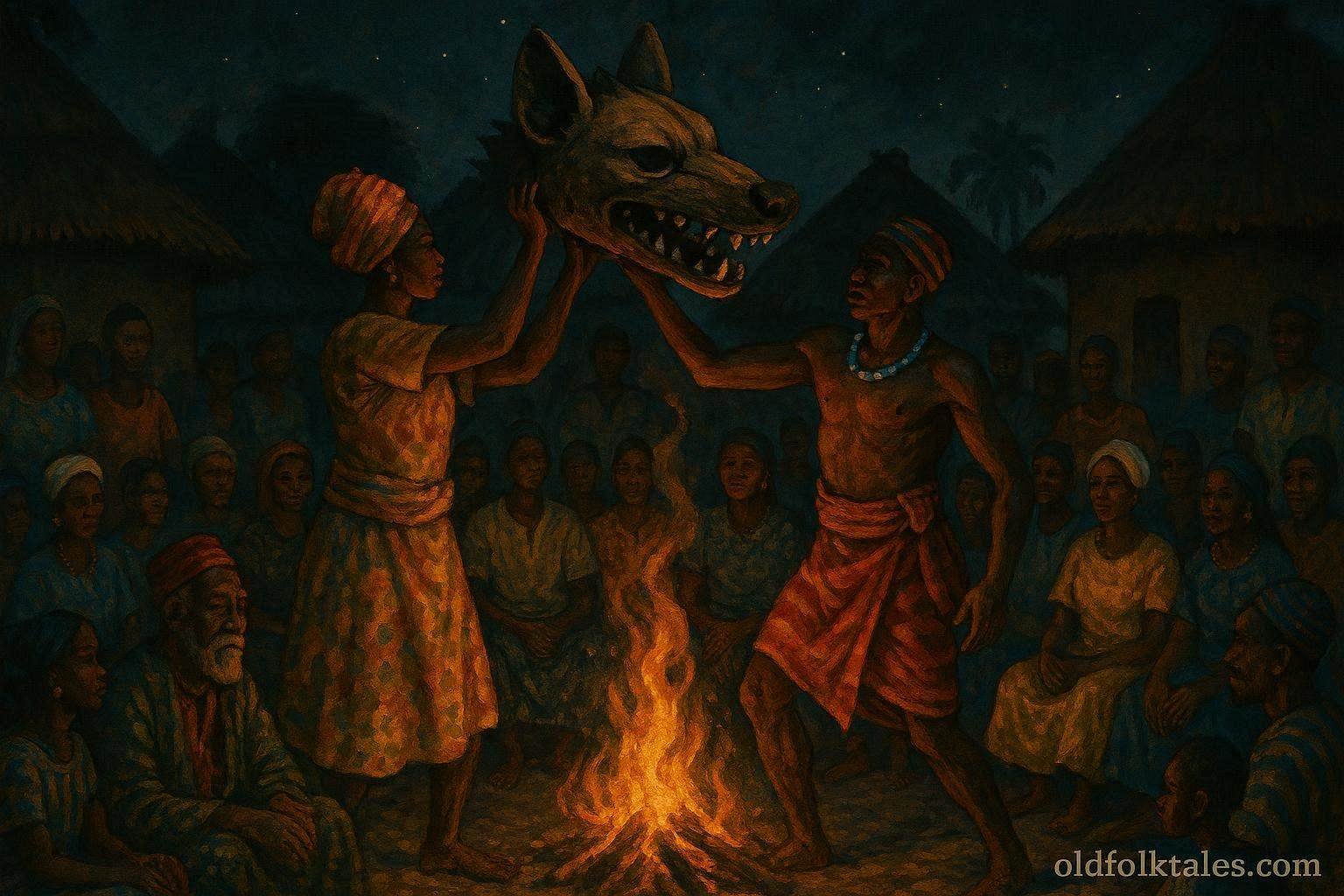
On the night of the ceremony, the village gathered beneath a dark sky lit only by firelight.
No one spoke loudly.
Even children remained unusually silent.
At the center of the gathering stood an empty space surrounded by elders, drummers, and accused leaders waiting nervously.
Then the drums began.
Slow at first.
Heavy and deliberate.
The rhythm echoed across the village like approaching footsteps.
Suddenly, figures emerged from the darkness wearing ceremonial robes woven from raffia and animal skins.
At the center walked the Hyena Mask.
Its appearance terrified many witnessing it for the first time.
The mask itself was carved from dark wood shaped into the face of a hyena with long teeth, narrow eyes, and markings painted in white clay. Feathers and leather strips moved around it as the masked figure advanced slowly toward the gathering.
The drumming intensified.
Several villagers lowered their heads immediately.
Others whispered prayers quietly.
The masked figure circled the crowd in complete silence before stopping before the council of elders.
Then the trial began.
One by one, villagers stepped forward to speak about the missing supplies and growing corruption within the community.
Witnesses described suspicious nighttime movements near the granaries.
Others claimed they saw traders secretly transporting rice away from the village.
Each accusation increased the tension.
But the accused leaders denied everything.
Sano insisted political rivals were spreading false rumors.
Demba argued trade shortages affected the entire region.
And Nfamara claimed thieves from outside villages caused the losses.
The elders listened carefully.
Yet uncertainty remained.
Then the Hyena Mask moved unexpectedly.
The masked figure walked directly toward the communal storage house standing near the edge of the gathering ground.
The drums stopped immediately.
The entire village followed in silence.
Reaching the granary, the masked figure pointed toward the floor without speaking.
Confused villagers began examining the area carefully.
After moving several baskets aside, they discovered hidden wooden panels covering a concealed underground compartment.
Gasps spread through the crowd.
Inside the hidden chamber lay large quantities of stolen rice, trade cloth, and ceremonial goods missing for months.
Shock quickly turned to anger.
Villagers demanded answers immediately.
Under growing pressure, one of Nfamara’s assistants finally confessed.
Several influential leaders had secretly hidden supplies during the shortages to increase their own wealth while ordinary families suffered.
The confession stunned the village.
Even Sano and Demba, who denied direct involvement, could no longer explain how the hidden goods remained concealed beneath the granary they controlled.
The truth had been exposed publicly before the entire community.
But the Hyena Mask ceremony was not designed only for punishment.
It also existed to restore balance.
The elders ordered all stolen supplies returned to the people immediately.
Those responsible lost their positions of authority and were required to perform public acts of restitution for the community.
More importantly, new rules were established ensuring communal resources would be monitored openly by representatives from multiple families rather than controlled by a few powerful individuals.
Slowly, trust returned to Bissorã.
The village survived the crisis not through violence, but through collective accountability and respect for traditional justice.
After the ceremony ended, the Hyena Mask disappeared once again into sacred custody, unseen by most villagers for many years afterward.
But its reputation endured across the region.
Generations later, Manjaco elders still told the story of the Hyena Mask of Bissorã to remind leaders that hidden corruption eventually reveals itself no matter how carefully protected.
Because according to tradition, truth watches patiently from the shadows long before lies collapse in the light.
Click here to discover more legendary tales from West Africa
Moral Lesson
Honesty and accountability are necessary for justice and unity within every community.
Knowledge Check
- Where is the story set?
It is set in Bissorã in Guinea-Bissau. - What was the Hyena Mask used for?
It appeared during important village trials involving dishonesty and corruption. - Why did the villagers summon the mask?
Supplies and food meant for the community had disappeared during a difficult season. - What did the Hyena Mask discover?
It revealed hidden stolen goods beneath the communal granary. - What happened to the corrupt leaders?
They lost authority and were forced to restore what was stolen. - What lesson does the story teach?
Truth and accountability protect communities from corruption and division.
Source
West African folklore. Adapted from Manjaco ceremonial traditions preserved in Guinea-Bissau ritual performance archives and cultural folklore studies.