Off the eastern coast of Tunisia, surrounded by the sparkling waters of the Mediterranean Sea, lie the Kerkennah Islands. For generations, the islanders made their living from the sea. Fishing was not merely an occupation but a way of life passed from parents to children. The rhythms of the tides, the direction of the winds, and the movements of fish were all deeply woven into the culture of the islands.
The people of Kerkennah respected the sea because they understood both its generosity and its power. On calm days, it provided food and prosperity. During storms, however, it could become dangerous and unforgiving.
Among the stories shared by fishermen during long evenings by the shore, one legend stood above all others.
It was the story of the Guardian of the Kerkennah Islands.
According to old traditions, a mysterious protector watched over the islands and the surrounding waters. No one knew exactly who the guardian was. Some described the figure as an ancient fisherman. Others believed it was the spirit of a sailor who had once saved the islands during a terrible storm centuries earlier.
Looking for more? Explore the magic of East African folktales here
Whatever its true nature, the guardian was said to appear whenever great danger approached from the sea.
Most islanders treated the legend with respect.
Some believed every word.
Others regarded it as an important story meant to teach vigilance and respect for nature.
Yet everyone knew the tale.
In one fishing village lived a young fisherman named Youssef.
Like his father and grandfather before him, Youssef spent much of his life on the water. He was hardworking, skilled, and eager to prove himself. Although he respected the wisdom of older fishermen, he often believed modern experience was more reliable than ancient stories.
Whenever elders discussed the Guardian of Kerkennah, he listened politely but remained skeptical.
One evening, while repairing nets beside the harbor, Youssef sat with an elderly fisherman named Hatem.
The old man had spent nearly seventy years at sea and was considered one of the wisest people on the islands.
As the sun disappeared beyond the horizon, Hatem pointed toward the open water.
“My grandfather once saw the guardian,” he said.
Youssef smiled.
“And what did he look like?”
Hatem shrugged.
“Every person who sees him tells a different story.”
“That sounds convenient.”
The elder laughed softly.
“Perhaps. But the warning is always the same.”
“What warning?”
“Never ignore the sea when it tries to speak.”
The conversation stayed in Youssef’s mind, though he dismissed it as another interesting tale.
Several weeks later, the fishing season was at its busiest.
Boats departed before dawn and returned at sunset carrying valuable catches. The weather had been calm for many days, and fishermen were enjoying a period of prosperity.
Then strange reports began spreading across the islands.
A fisherman from a nearby village claimed he had seen a lone figure standing on a rocky outcrop far from shore.
Another sailor reported spotting a small boat drifting silently through the mist before vanishing without a trace.
Others described seeing a lantern moving across the water where no vessel could possibly travel.
At first, many people dismissed the stories.
Yet as the sightings increased, older islanders became concerned.
Several elders quietly remarked that similar accounts had appeared before major storms in the past.
Youssef remained unconvinced.
“People see unusual things on the sea all the time,” he told his friends.
The following week, he joined a fishing expedition heading farther from shore than usual.
The morning was beautiful.
The sea was calm.
The sky was clear.
Everything seemed perfect.
By midday, however, subtle changes began to appear.
The wind shifted unexpectedly.
Birds that normally followed fishing boats disappeared.
The sea became strangely quiet.
Even experienced fishermen noticed the difference.
One of the older crew members frowned as he studied the horizon.
“I don’t like this,” he muttered.
Youssef looked around.
“What do you mean?”
“The sea feels wrong.”
The young fisherman saw nothing alarming.
The water remained calm.
The sky was still blue.
Yet the older men grew increasingly uneasy.
As evening approached, they decided to return home earlier than planned.
While sailing back toward the islands, Youssef noticed something unusual.
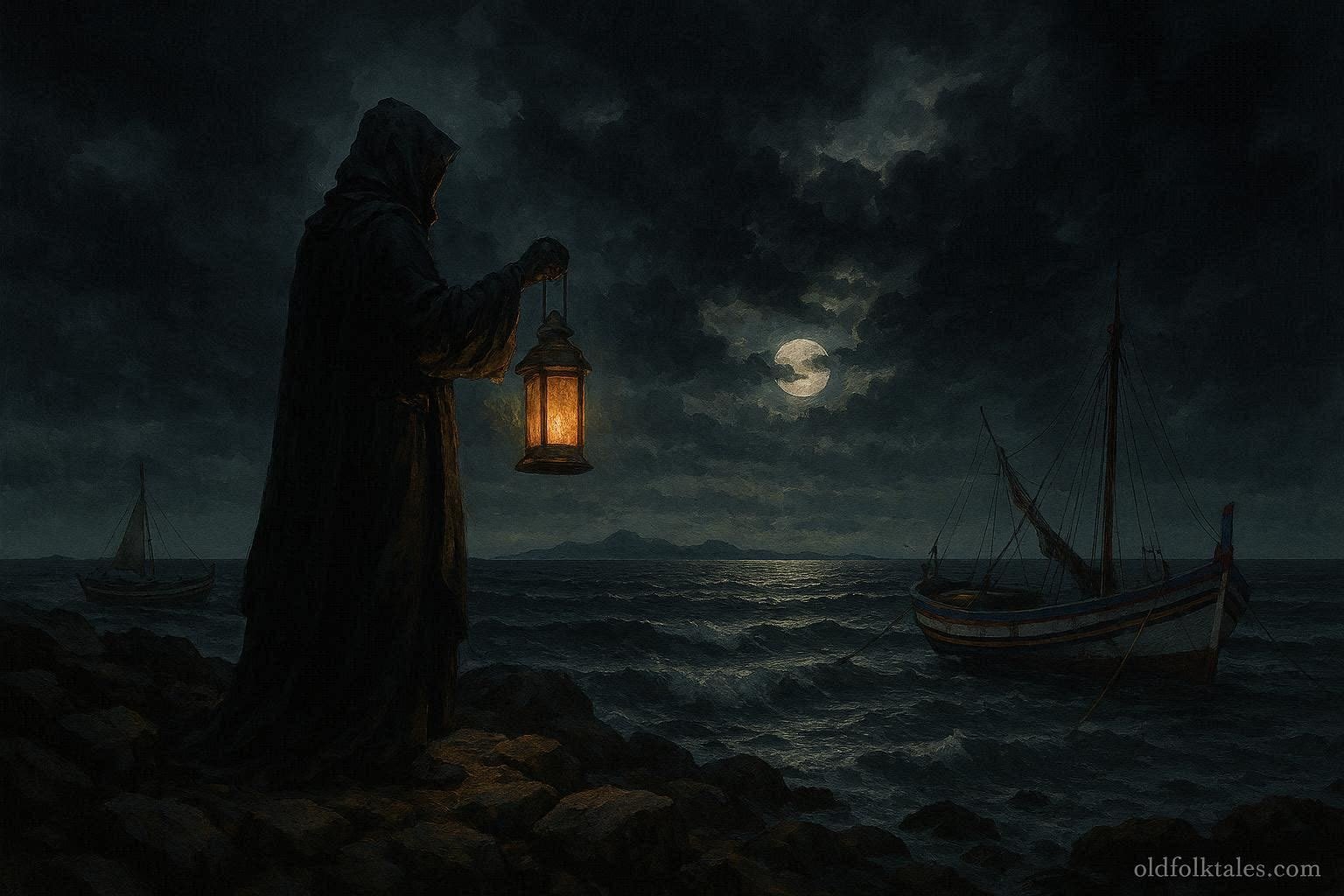
Far ahead, standing on a rocky formation barely visible above the water, was a solitary figure.
The person appeared motionless.
A long cloak fluttered in the wind.
For a brief moment, the figure raised one arm and pointed toward the horizon.
Youssef blinked.
The figure disappeared.
He searched the area again but saw only empty sea.
The sight unsettled him.
That night, powerful winds arrived.
By dawn, dark clouds covered the sky.
A massive storm swept across the Mediterranean.
Waves crashed against the shoreline.
Fishing boats remained anchored in protected harbors.
Families gathered indoors as rain and wind battered the islands.
The storm lasted for two days.
Although property was damaged, the communities suffered far fewer losses than expected because most fishermen had returned early and secured their boats before conditions worsened.
Afterward, conversations throughout the islands focused on the mysterious sightings.
Many believed the guardian had appeared once again.
Youssef said little about what he had seen.
Part of him still searched for a practical explanation.
Yet another part remembered the figure pointing toward the horizon shortly before the storm arrived.
Months passed.
Life returned to normal.
Fishing resumed.
Markets reopened.
The story gradually became another chapter in local folklore.
Then, during the following year, a period of unusual weather affected the region.
Storms became more frequent.
Fishing conditions grew unpredictable.
Concern spread among the island communities.
One evening, while returning from the sea, Youssef noticed a small lantern glowing in the distance.
At first, he assumed another fisherman was nearby.
Yet the light moved strangely.
It seemed to glide across the surface of the water.
Curious, he steered his boat toward it.
The lantern remained ahead of him, neither approaching nor retreating.
As he followed, he suddenly realized that his original course would have taken him directly toward a dangerous sandbank hidden beneath the water.
The lantern continued moving until his boat was safely clear of the hazard.
Then it vanished.
No vessel could be seen anywhere nearby.
When Youssef reached shore, he shared the experience with Hatem.
The old fisherman listened carefully.
Explore the wisdom and wonder of North African folktales
Moral Lesson
True wisdom comes from respecting nature, paying attention to warning signs, and valuing the knowledge passed down by previous generations.
Knowledge Check
1. Where is the story set?
The story is set on the Kerkennah Islands off the eastern coast of Tunisia.
2. Who was Youssef?
Youssef was a young fisherman who initially doubted the legend of the sea guardian.
3. What was the Guardian of the Kerkennah Islands believed to do?
The guardian was believed to appear before powerful storms and other dangers threatened the islands.
4. What strange things did fishermen report seeing?
They reported seeing mysterious figures, moving lanterns, and unexplained boats before severe weather arrived.
5. How did the guardian help Youssef?
A mysterious lantern guided him away from a dangerous sandbank hidden beneath the sea.
6. What lesson does the story teach?
The story teaches the importance of respecting nature, listening to elders, and recognizing warnings before danger arrives.
Source
Adapted from maritime traditions of the Kerkennah Islands preserved in regional Tunisian folklore collections and North African coastal oral history studies.