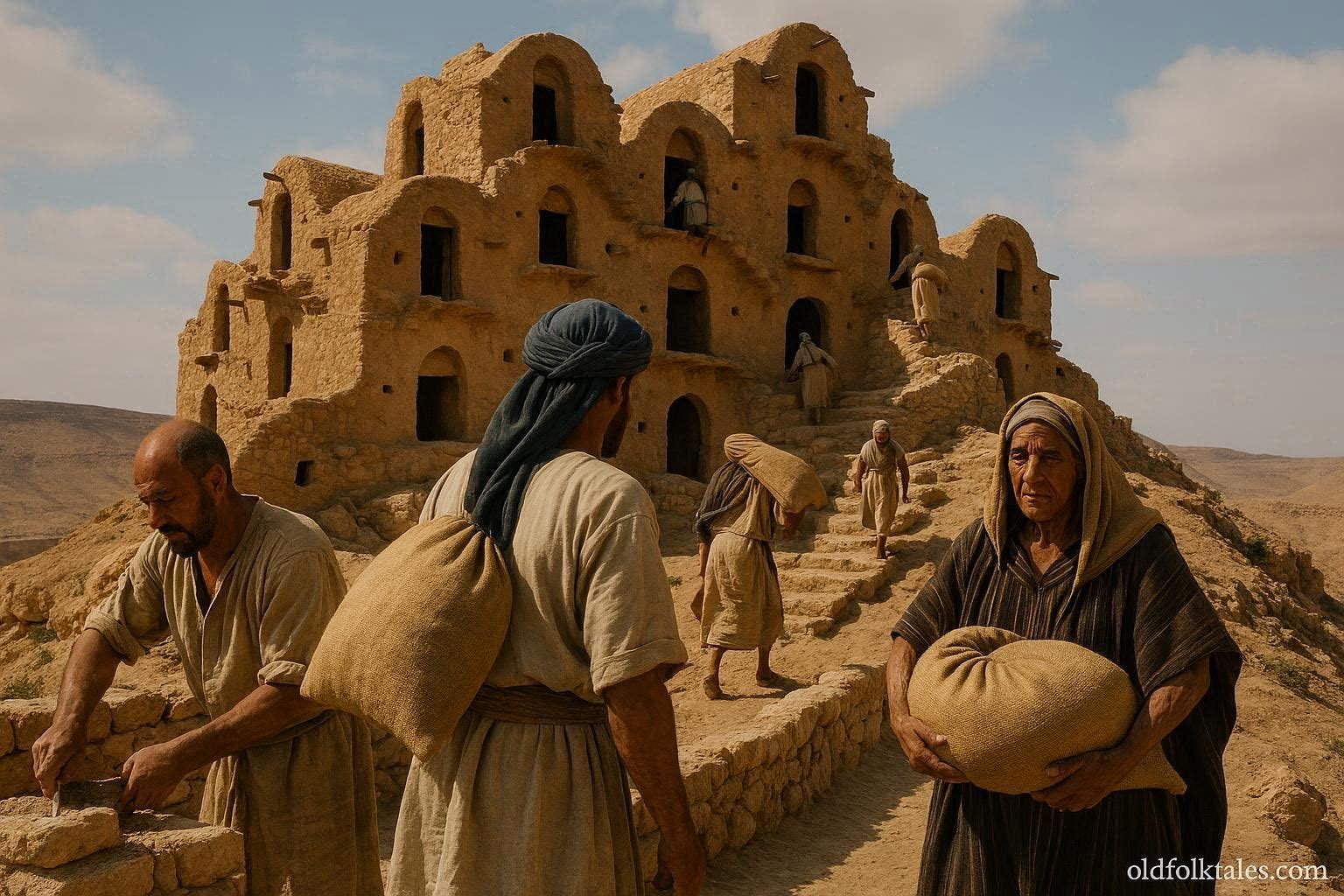
Long before modern warehouses and secure storage buildings appeared across North Africa, the Amazigh communities of southern Tunisia developed an ingenious solution to one of life’s greatest challenges protecting food in a harsh and unpredictable environment. Rain was scarce, harvests could vary from year to year, and families depended upon careful planning to survive long periods of drought. To safeguard their grain, olive oil, dates, and other valuable supplies, they built magnificent fortified granaries known as ksour.
Perched on rocky hills or overlooking caravan routes, these impressive structures became more than places of storage. Their thick stone walls, elevated chambers, and narrow passageways shielded precious harvests from weather, theft, and wild animals. Yet the true strength of a ksar did not lie in its architecture alone. It rested in the cooperation of the people who built, maintained, and shared it.
For generations, elders taught that every stone placed within a ksar represented trust between neighbors. Families worked side by side, knowing that protecting one another’s harvest meant protecting the future of the entire community. These lessons were passed from parents to children, ensuring that the ksour remained symbols of resilience, unity, and foresight long after the builders themselves were gone.
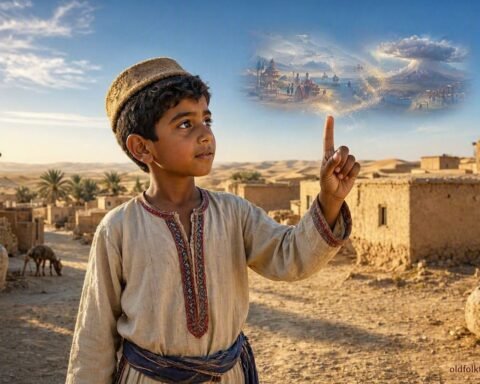
Among one of these desert communities lived a determined young man named Yasin.
Don’t stop yet! See our complete East African folktales collection
Unlike many of his friends, Yasin was fascinated by the towering granaries that stood above the village. Whenever he looked at their rows of small storage chambers stacked neatly upon one another, he wondered how people had managed to construct such remarkable buildings without modern machines.
One evening, as the sun painted the desert cliffs with shades of gold and red, Yasin walked beside his grandfather, Omar, toward the old ksar.
“Grandfather,” he asked, “who built this place?”
Omar rested his hand against the warm stone wall.
“No single person built it,” he replied.
“It was the work of an entire community.”
Yasin looked puzzled.
“But someone must have been the master builder.”
“There were skilled builders,” Omar answered, “but even the greatest architect could not raise these walls alone.”
The following morning, Omar led his grandson through the winding passages of the ancient granary.
The thick stone walls kept the interior pleasantly cool despite the desert heat outside.
Hundreds of small storage chambers lined the upper levels, each belonging to a different family.
Strong wooden doors secured every compartment, while narrow stairways connected one level to another.
“It looks like a village inside another village,” Yasin observed.
Omar smiled.
“In many ways, it is.”
He explained that every family contributed labor during construction.
Some quarried stone from nearby hills.
Others shaped wooden beams from hardy desert trees.
Skilled masons carefully stacked each stone without wasting valuable materials, while women and children helped prepare food and water for the workers.
Every contribution mattered.
As they climbed higher, Omar pointed toward the surrounding landscape.
“From here,” he said, “our ancestors could see travelers approaching from many kilometers away.”
The elevated position allowed the community to monitor caravan routes, welcome peaceful merchants, and protect their stored harvests during uncertain times.
The ksar served not only as a granary but also as a symbol of preparedness.
Weeks later, the date harvest began.
Families carried baskets filled with freshly gathered dates to the ksar.
Others stored sacks of grain, jars of olive oil, dried figs, and precious seeds reserved for the following planting season.
Before each chamber was sealed, elders carefully recorded which family owned its contents.
The system depended upon honesty as much as strong walls.
Yasin noticed that although every family had its own storage room, everyone worked together during the harvest.
No one hurried only to finish their own work.
Instead, neighbors helped one another carry heavy loads, repair damaged doors, and organize supplies.
“The ksar protects all of us,” Omar explained.
“So we protect it together.”
One year, fierce desert winds swept across the region for several days.
When the storm finally ended, part of the outer wall had been damaged.
Rather than waiting for a few builders to repair it, the entire community gathered the following morning.
Stonecutters shaped replacement blocks.
Carpenters reinforced wooden supports.
Young people carried water and tools.
Even elderly villagers offered guidance based on repairs they had witnessed many years before.
Within days, the damaged section stood strong once again.
Yasin realized the true foundation of the ksar was not stone.
It was cooperation.
As he grew older, Yasin apprenticed under one of the village’s master builders.
He learned how builders selected durable stone, designed walls to withstand desert winds, and constructed narrow passageways that helped regulate temperature inside the granary.
His teacher constantly reminded him that good architecture served people before it impressed them.
“A beautiful building means little,” the master builder said,
“if it cannot protect those who depend upon it.”
Years later, visitors from distant towns came to admire the ancient ksour.
Many were amazed that structures built centuries earlier remained standing.
Yasin proudly explained that the secret was not only careful craftsmanship but also continual maintenance by generations who understood their value.
“Buildings survive,” he often told visitors,
“because communities choose to care for them.”
As the years passed, Yasin became one of the respected guardians of the ksar.
He welcomed schoolchildren and travelers, sharing the stories his grandfather had once told him.
He encouraged young people to appreciate not only the impressive architecture but also the spirit of cooperation that had made such achievements possible.
One afternoon, a child asked,
“Could one person build a ksar today?”
Yasin smiled.
“Perhaps one person could design it.”
“But only a united community could truly build it.”
The child looked up at the towering stone chambers with newfound understanding.
For the first time, he realized the ksar was not simply a building.
It was a monument to shared responsibility.
Today, the ksour of southern Tunisia remain among the country’s most remarkable examples of Amazigh architectural heritage. Built as fortified communal granaries, they reflect centuries of ingenuity, cooperation, and adaptation to life in an arid environment. Many of these historic structures continue to be preserved as cultural landmarks, reminding visitors of the resilience and resourcefulness of the communities that built them.
The story of The Builders of the Ksour teaches that the strongest foundations are created not only with stone and timber but also with trust, cooperation, and a shared commitment to protecting the future.
Fascinated by this tale? Discover more North African folktales
Moral Lesson
Communities achieve lasting success when people work together, prepare wisely, and care for what they build.
Knowledge Check
1. What was the main purpose of the ksour?
To safely store grain, dates, olive oil, and other valuable supplies for the community.
2. Why were the ksour built on high ground?
To protect harvests and provide a clear view of the surrounding landscape and caravan routes.
3. What did Yasin learn from his grandfather?
That the ksar was built through the cooperation of the entire community.
4. How did the villagers repair the damaged wall after the storm?
Everyone contributed according to their skills and worked together to rebuild it.
5. What lesson did Yasin’s master builder teach him?
That good architecture should serve and protect people before impressing them.
6. What is the main lesson of the story?
Unity, cooperation, and careful planning create strong communities that endure.
Source
Adapted from Amazigh traditions of southern Tunisia, with reference to Southern Tunisia Ksour heritage archives, UNESCO cultural landscape documentation, and archaeological studies of Tunisia’s fortified granaries.