In Tripoli, a poor man named Dschuha found himself in a difficult situation. He had little money and many needs, yet he remained known for his quick mind and unusual way of looking at problems.
One day, Dschuha became desperate enough to pray for help. He wished for a large sum of money that would free him from his troubles and allow him to live without constantly worrying about his next meal or unpaid obligations.
A Jewish man who lived nearby happened to hear Dschuha’s prayer.
The man was amused by the poor man’s confidence that help would come simply because he had asked for it. But instead of ignoring him, he decided to play a trick of his own.
The following day, the Jewish man secretly prepared a bag containing ninety nine gold pieces.
He threw the bag into Dschuha’s house.
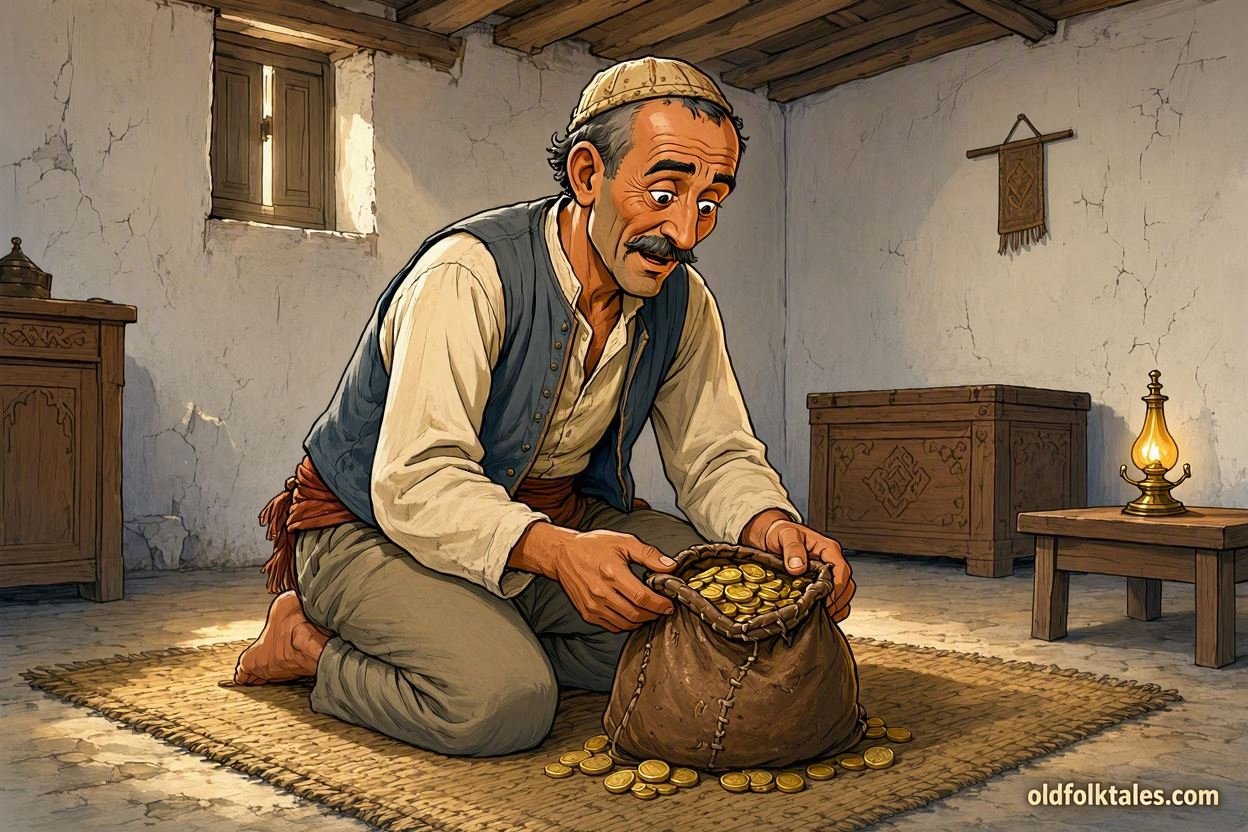
When Dschuha discovered it, he was astonished.
He opened the bag and counted the coins carefully.
There were ninety nine.
For a moment, he wondered whether he should be grateful or suspicious. He had prayed for a large amount of money, and now almost the amount he had imagined was sitting in his hands.
If you enjoyed this story, explore our full West African folktales collection
Then Dschuha smiled.
He had an idea.
Instead of worrying about the missing coin, he said to himself that the person who had given him ninety nine would surely provide the hundredth coin as well.
The Jewish man soon appeared and demanded that Dschuha return the money.
Dschuha refused.
The Jewish man was surprised.
“That money belongs to me,” he insisted.
Dschuha calmly replied that the money had come to him as a gift. He had not asked the man to throw it into his house, and he certainly had not agreed to return it.
The argument quickly became serious.
The Jewish man insisted that Dschuha had taken his money.
Dschuha insisted that he had received a gift.
Neither man was willing to surrender.
Eventually, the matter was taken to the authorities.
The Jewish man expected the dispute to be settled quickly. After all, he knew exactly where the ninety nine gold pieces had come from.
But Dschuha had another problem.
He needed to appear before the judge properly dressed.
His clothes were worn and unsuitable for such an occasion.
So Dschuha turned to the Jewish man and asked him for help.
“Lend me a coat and a mule,” he said. “I cannot appear before the judge looking like this.”
The Jewish man, still determined to recover his money, agreed.
Dschuha put on the borrowed coat, climbed onto the mule and went with the Jewish man to the judge.
The judge listened to both sides.
The Jewish man explained that he had given Dschuha nothing. He said that Dschuha had somehow obtained his ninety nine gold pieces and was now refusing to return them.
Dschuha listened quietly.
Then the judge asked him what he had to say.
Dschuha pointed toward the Jewish man’s coat and mule.
“Your Honour,” he said, “this man says that I am a thief because I have his ninety nine gold pieces. But look at me. I am wearing his coat and riding his mule. If he says everything I have belongs to him, then surely these must also belong to him.”
The Jewish man immediately protested.
“That coat is mine, and the mule is mine. But I only lent them to him!”
Dschuha looked at the judge.
“You heard him,” he said. “He admits that he can lend something to me without giving it to me permanently. That is exactly what happened with the money.”
The judge considered the argument carefully.
The Jewish man realized that Dschuha was twisting his own words against him.
He tried to explain the difference, but Dschuha remained calm.
The dispute had become less about the ninety nine gold pieces and more about who could outwit whom.
The Jewish man had intended to teach Dschuha a lesson by giving him ninety nine coins instead of a hundred.
Instead, Dschuha had turned the situation around.
He had taken advantage of the man’s determination to recover the money and used the man’s own actions to strengthen his argument.
The judge eventually ruled in Dschuha’s favour.
The Jewish man left frustrated, while Dschuha walked away with the money, the coat and the mule that had been lent to him.
What had begun as a simple attempt to trick a poor man had become a contest of cleverness.
Dschuha had not possessed wealth, influence or power.
What he possessed was confidence and a remarkable ability to find an unexpected answer when everyone else thought the matter was settled.
The story does not present Dschuha as an ordinary hero. He is mischievous, opportunistic and sometimes willing to stretch the truth when it benefits him. That is part of the humour surrounding the traditional Dschuha character.
His strength is not physical.
It is his ability to turn an ordinary situation upside down.
The ninety nine gold pieces were supposed to leave Dschuha worried about the missing coin.
Instead, he treated the missing piece as an opportunity.
The borrowed coat and mule were supposed to help the Jewish man recover his money.
Instead, Dschuha used them to expose a weakness in his opponent’s argument.
And the dispute that seemed certain to end with Dschuha losing the money ended with him walking away victorious.
The tale ultimately turns on the unpredictability of human cleverness.
A person may enter a negotiation believing that they have complete control, only to discover that the other person has found a completely different way to understand the situation.
For Dschuha, the difference between ninety nine and one hundred gold pieces was not simply a missing coin.
It was the opening he needed.
Keep reading: Discover more Central African folktales
Moral Lesson
Quick thinking can change the outcome of a difficult situation, but cleverness should always be balanced with honesty and fairness.
Knowledge Check
1. What did Dschuha pray for?
He prayed for money to help him overcome his difficulties.
2. How many gold pieces were placed in Dschuha’s house?
Ninety nine gold pieces were placed in his house.
3. Why did Dschuha refuse to return the money?
He argued that the money had been given to him as a gift.
4. Why did Dschuha ask the Jewish man for a coat and a mule?
He needed suitable clothing and transportation to appear before the judge.
5. How did Dschuha use the borrowed items during the dispute?
He used the coat and mule to challenge the Jewish man’s claim that everything he had received from him must automatically be returned.
6. What is the central lesson of the tale?
The story highlights the power of quick thinking and clever negotiation while also showing the importance of fairness and honesty.
Source
Adapted from Hans Stumme, Märchen und Gedichte aus der Stadt Tripolis in Nordafrika, Leipzig, 1898, p. 176 onward, No. 10, “Dschuha und der Jude.”