After the death of his wife, a father was left to raise his three daughters. The girls had already lost the person who had protected and cared for them, and their lives changed further when their father married another woman.
The new wife soon became a harsh presence in the household. Instead of treating the three girls as her own children, she grew resentful of them and wanted them gone. Her influence over their father gradually became stronger, and the girls found themselves facing rejection inside the very home where they should have been safe.
The two elder sisters were noticeably different from the youngest. They were strong and had large appetites, while the youngest was smaller and more delicate. Yet the youngest possessed a determination that would eventually carry all three of them through dangers they could never have imagined.
Her stepmother continued to mistreat them, and their father increasingly listened to his wife’s complaints. Rather than protecting his daughters, he began looking for ways to abandon them.
The girls were eventually taken away from their home.
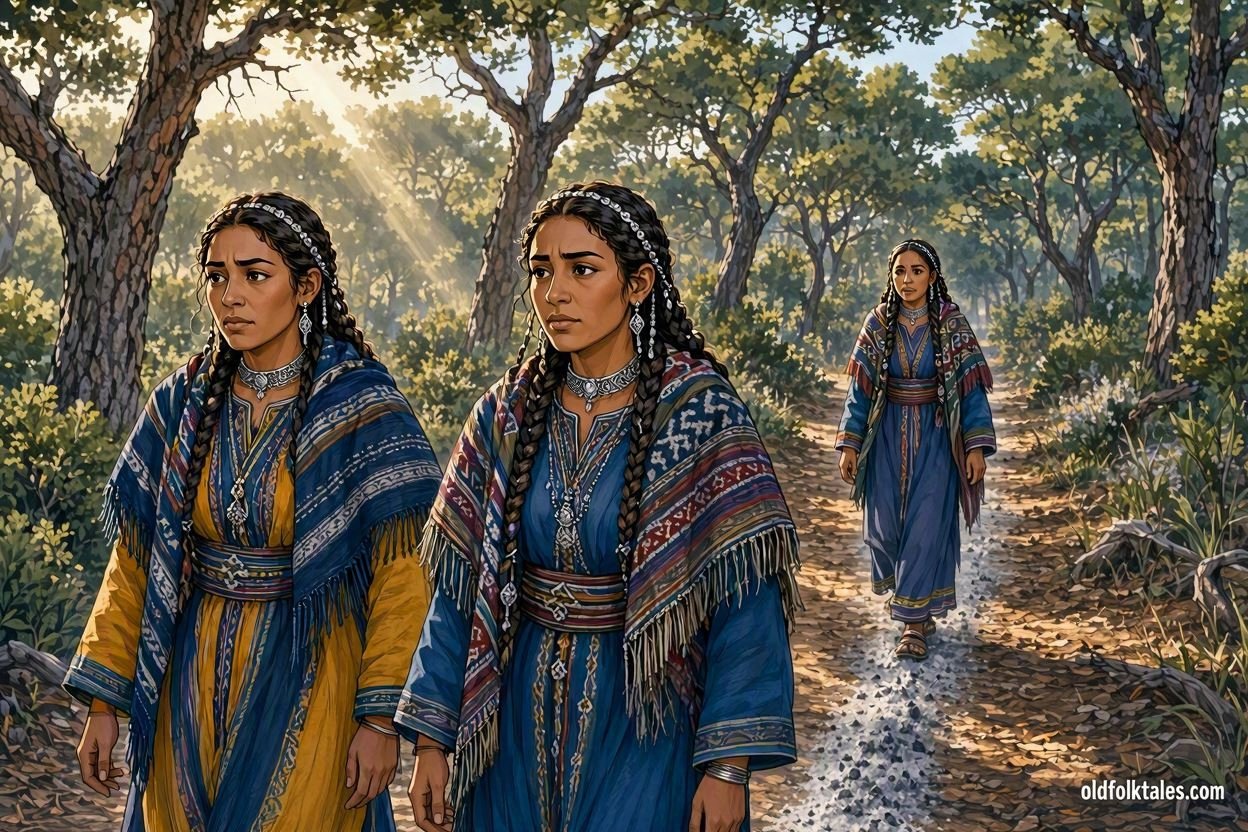
Their father led them into the wilderness, intending to leave them there. The youngest sensed that something was wrong. She could see that her father was no longer acting like the loving parent they had once known.
If you enjoyed this story, explore our full West African folktales collection
She tried to reach his heart.
She reminded him that they were his daughters and that he should not allow another person’s bitterness to destroy his relationship with them. But the pressure from their stepmother had already taken hold.
The father continued with his plan.
The three sisters were left in the wilderness, far from the security of home.
For the girls, the forest was frightening. They had no clear idea where they were or what dangers might be waiting for them. Yet the youngest refused to surrender to fear.
She understood that remaining together was their best chance of survival.
The sisters moved through the wilderness until they encountered a well. Their father’s actions had been connected to this place as well, and the sisters became caught in a strange sequence of events involving the well and their father’s belongings.
Their situation became even more dangerous when they discovered the dwelling of an ogress named Tergu.
Tergu was not an ordinary woman. She belonged to the supernatural world of the tale and lived apart from ordinary human society. The discovery of her dwelling marked a major turning point in the sisters’ lives.
The girls eventually found themselves beneath the water well, inside the ogress’s dwelling.
There, the elder sisters gave their youngest sister a name that would remain with her.
They called her Iɣed n Tinnurt, meaning Ash of the Hearth.
The name would later become deeply connected to her journey.
Although Tergu was frightening, the relationship between the ogress and the youngest girl was more complicated than it first appeared. Tergu discovered that the girl was human and eventually adopted her, even referring to her as her daughter.
For the young girl, however, remaining with Tergu was not the end of her troubles.
The ogress had forbidden her from entering certain chambers in the dwelling. Those rooms were not ordinary storage spaces. They contained beautiful clothing, food and silver jewellery.
The forbidden rooms naturally became a source of curiosity.
The young girl wanted to understand what Tergu was hiding.
She also understood that her sisters remained trapped in a dangerous situation. If she wanted to regain her freedom and help them, she needed to find a way to overcome the ogress.
She therefore began to observe Tergu carefully.
The young girl understood that physical strength would not be enough. She needed to use intelligence.
Eventually, she found an opportunity while Tergu was preparing bread in a large clay oven known in the local Tayefrnit language as a Firnu.
The young girl acted decisively.
She pushed Tergu into the oven, killing the ogress and removing the danger that had held them captive. The act allowed her to enter the forbidden chambers.
Inside, she discovered the treasures Tergu had kept away from her.
There were beautiful clothes, food and silver ornaments.
The silver jewellery was especially significant. Silver has a longstanding importance in Amazigh cultural traditions, and the tale places it at the centre of the young girl’s transformation from an abandoned child into someone prepared for a new stage of life.
The young girl was no longer simply the smallest daughter who had been abandoned in the wilderness.
She had survived.
She had defeated the danger that threatened her.
And she had found a way to help her sisters.
After their escape, the sisters eventually made their way back toward the world they had once known.
But the journey was not over.
The youngest girl’s fate was beginning to change.
She received beautiful clothing and silver jewellery and was given an opportunity to attend a wedding, something her elder sisters had previously prevented her from doing.
For once, she was able to experience the kind of celebration from which she had been excluded.
She went to the wedding, but her happiness was short-lived.
Her elder sisters had not forgotten the differences between them. Their jealousy would later become important to the events that followed.
When the celebration ended, the young girl hurried away.
As she made her way home, she lost one of her beautifully decorated slippers.
She did not realize that the lost slipper would change the direction of her life.
The slipper was discovered by the son of a sultan while he was watering his horse near a water well. He found the decorated slipper and became determined to discover the woman to whom it belonged.
He did not simply keep it as a curiosity.
He declared that he would marry its owner.
The sultan’s son therefore entrusted the search to a servant named Aberraḥ, who was known for his ability to locate people.
Aberraḥ was instructed to travel throughout the land and have the young women try on the slipper.
The task became a search for the mysterious owner of the slipper.
House after house was visited.
The slipper was tried by different girls.
But it did not fit.
Eventually, Aberraḥ heard information about girls living in the dwelling of an ogress.
The information led him toward Tergu’s former dwelling.
When he arrived, the elder sisters tried the slipper first.
It did not fit either of them.
Then Aberraḥ heard a noise from inside.
He called out and demanded that whoever was there come forward.
The youngest sister appeared.
She was asked to try on the slipper.
It fitted perfectly.
The mystery was solved.
The girl who had once been abandoned in the wilderness, mistreated by her stepmother and forced to endure hardship had finally been recognized for who she was.
Her journey had taken her from rejection to discovery, from danger to safety and from abandonment to a new future.
The story’s ending brings together several of its most important symbols.
The ashes associated with the young girl’s name become a reminder of her difficult beginnings, but they also represent the path she used to find her way through the wilderness. Silver becomes a symbol of beauty and transformation. The slipper becomes the object that allows her true identity to be recognized. And the journey itself demonstrates the resilience of a young girl who refused to let cruelty determine her fate.
What began with the loss of a mother and the cruelty of a stepmother became a journey of survival.
The father who had abandoned his daughters could not know what his decision would eventually produce.
The youngest daughter, whom others treated as insignificant, became the one who found a way through danger.
She protected herself.
She helped her sisters.
She overcame an ogress.
She escaped the wilderness.
And ultimately, a single slipper helped reveal her identity and open the door to a new life.
Her story reminds us that hardship does not always have the final word.
Sometimes, the smallest person in the family carries the greatest courage.
And sometimes, the path home begins with nothing more than a handful of ashes left behind in the wilderness.
Fascinated by this tale? Discover more North African folktales
Moral Lesson
Cruelty and rejection may create suffering, but courage, intelligence and resilience can help a person overcome circumstances that seem impossible.
Knowledge Check
1. What happened to the girls’ mother?
She died, leaving their father to raise the three daughters.
2. Why did the girls’ situation become difficult after their father remarried?
Their stepmother mistreated them and influenced their father to abandon them.
3. How did the youngest sister help her sisters survive?
She remained determined, used her intelligence and eventually found a way to overcome the danger posed by Tergu.
4. Who was Tergu?
Tergu was a supernatural ogress whose dwelling became an important turning point in the sisters’ journey.
5. Why was the youngest sister called Iɣed n Tinnurt?
Her elder sisters gave her the name, which means Ash of the Hearth, after their experiences together.
6. How was her identity eventually discovered?
The sultan’s son found her decorated slipper and sent his servant to search for its owner. When the slipper was tried by the young woman, it fitted her perfectly.
Source
Adapted from Mazigh Buzakhar, “A Tale of Two Cultures: Comparative Study of Iɣed n Tinnurt from Infusen and Aschenputtel from Germany,” Tamazgha Studies Journal, Volume 3, Issue 1, 2025.