Long before bustling towns and busy markets covered the island of Mauritius, thick forests stretched across the hills, rivers flowed through quiet valleys, and the songs of rare birds echoed from sunrise until nightfall. In those days, many families survived by farming the land, gathering fruit, or hunting wild game in the forests that blanketed the island.
Among them lived a poor hunter.
He owned neither fertile fields nor herds of cattle. His small wooden hut stood at the edge of a forest where he lived with his devoted wife and their young son. Every morning before dawn, he carried his worn hunting bag and handmade traps into the woods, hoping to return before sunset with enough food to feed his family.
Some days he was fortunate.
Most days he returned empty-handed.
Yet despite their poverty, the little family remained grateful for every meal they shared. They believed that honest work, patience, and kindness were treasures no hardship could take away.
One cool morning, as mist drifted through the trees, the hunter walked farther into the forest than he had ever dared before. The birds sang overhead, monkeys leaped from branch to branch, and shafts of sunlight pierced the thick canopy.
Want to dive deeper? Read more North African folktales today
Hours passed without success.
Just as he began thinking of returning home, something extraordinary caught his eye.
Perched on the branch of a tall tree sat the most beautiful bird he had ever seen.
Its feathers shimmered like polished gold beneath the morning sun. Every movement sent flashes of brilliant light dancing across the leaves, making the bird appear almost magical.
The hunter stood perfectly still.
He had never seen such a creature.
Slowly and carefully, he prepared one of his finest traps beneath the tree. Then he stepped back and waited.
Before long, the golden bird fluttered down from its branch.
It landed gently on the forest floor.
A moment later, the trap closed.
The bird struggled for only an instant before becoming calm, almost as though it already knew its fate.
The hunter approached with great care.
Instead of fear, he felt wonder.
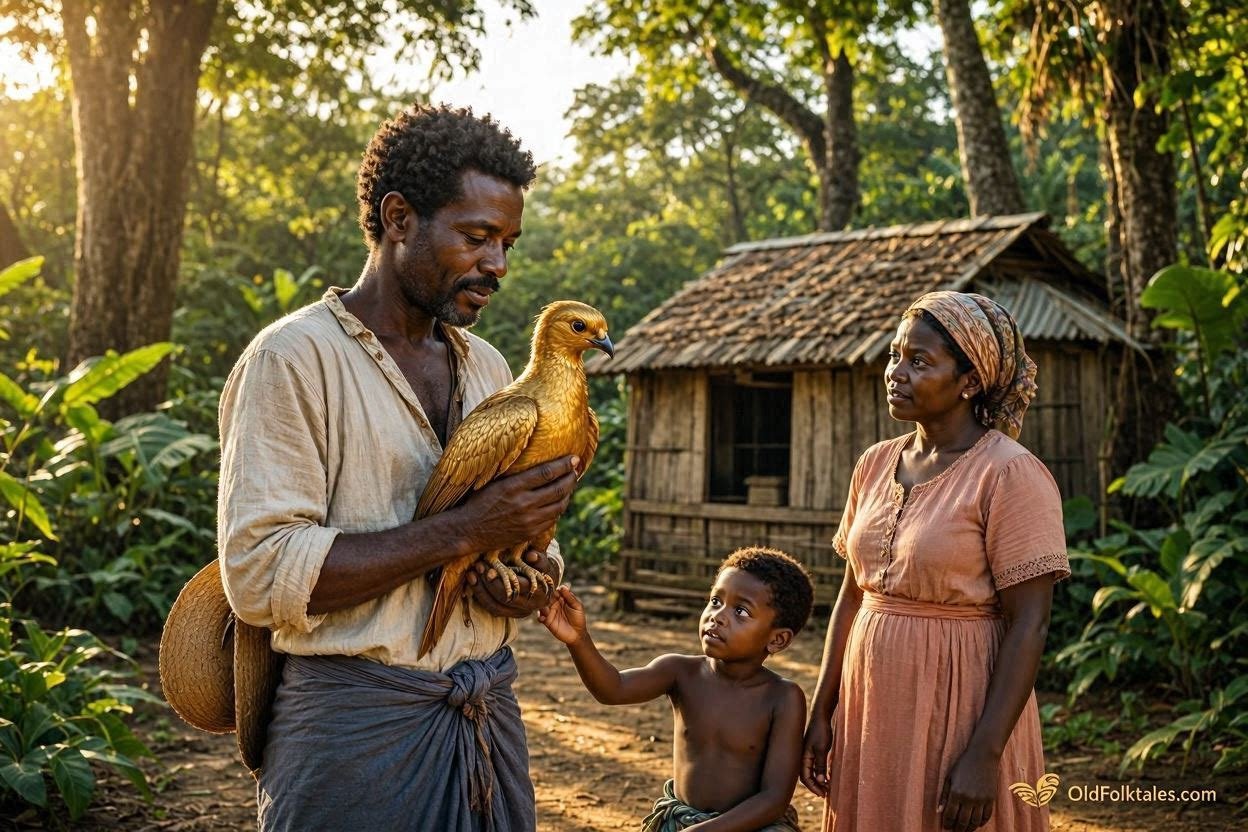
He wrapped the bird gently in a soft cloth and carried it home.
When his wife saw the magnificent creature, she covered her mouth in amazement.
“I have never seen a bird like this,” she whispered.
“Neither have I,” the hunter replied.
“We must care for it well.”
They built a comfortable wooden cage, placed fresh water beside it, and fed the bird with the finest grain they could afford.
The next morning, something astonishing happened.
Resting inside the cage lay a single shining egg.
The hunter reached down to pick it up.
The moment sunlight touched it, the room filled with a warm golden glow.
His wife gasped.
“It is made of gold.”
Unable to believe their eyes, they hurried to the nearest goldsmith.
The craftsman carefully examined the egg.
His eyes widened.
“This is pure gold,” he said.
The hunter and his wife looked at one another in disbelief.
The goldsmith offered them more money than they had ever seen in their lives.
With grateful hearts, they sold the egg and returned home carrying enough food to last many weeks.
The following morning, the miracle happened again.
Another golden egg rested inside the cage.
Then another.
And another.
Every sunrise brought a new golden egg.
Soon the hunter repaired his crumbling roof, replaced his worn clothes, and filled his home with enough food that no one in the family ever went hungry again.
Yet although their lives became more comfortable, they remained humble.
The hunter still greeted his neighbours kindly.
His wife continued sharing food with those who had less.
No one knew the secret behind their sudden prosperity.
Or so they believed.
Across the village lived a merchant whose eyes were always fixed on the wealth of others.
He noticed the remarkable changes in the hunter’s life.
The once-poor family now dressed neatly, repaired their home, and never seemed to worry about money.
Curiosity soon turned into suspicion.
One afternoon the merchant quietly followed the hunter from the marketplace.
Hidden behind a fence, he watched through a narrow opening in the wooden wall.
There, inside the small house, he saw the magnificent golden bird.
The next morning, before the hunter even entered the room, the bird laid another gleaming golden egg.
The merchant’s heart raced.
“So that is the secret,” he whispered.
Instead of admiring the family’s good fortune, envy filled his heart.
He spent the entire night thinking about the bird.
“If that creature belonged to me,” he muttered, “I would become the richest man on the island.”
From that moment, greed began to weave a dangerous plan that would soon draw not only the hunter’s family but also powerful people from the royal court into a story no one would ever forget.
The merchant could think of nothing else.
Each passing day strengthened his desire to possess the miraculous bird. He knew he could never persuade the hunter to sell such a priceless treasure, so he searched for another way.
At last he devised a plan.
The merchant travelled to the royal palace and requested an audience with the king. When he was finally admitted into the great hall, he bowed respectfully before speaking.
“Your Majesty,” he began, “there lives within your kingdom a poor hunter who keeps a bird unlike any other creature on earth. Every morning it lays an egg of pure gold.”
The king frowned.
“Such a thing is impossible.”
“So I believed,” replied the merchant, “until I saw it with my own eyes.”
The king was intrigued. If such a bird truly existed, it was a wonder worthy of the kingdom. He ordered his guards to bring the hunter before him, together with the bird.
Though frightened, the hunter obeyed.
Standing before the throne, he placed the cage gently on the polished floor.
The king examined the bird with great interest.
“It is indeed a remarkable creature,” he said. “Can it truly do what this merchant claims?”
The hunter answered honestly.
“Your Majesty, every morning it lays one golden egg. It has never failed.”
The king considered the matter carefully.
“This bird is too extraordinary to remain hidden. It shall stay in the royal palace, where it can be cared for properly.”
The hunter’s heart sank.
He knew he could not refuse the king.
With sadness, he handed over the cage. Before leaving, he looked once at the bird that had rescued his family from poverty.
The following morning, the royal servants hurried to the bird’s cage.
Just as the hunter had said, a shining golden egg rested inside.
The palace erupted with excitement.
Day after day, another golden egg appeared.
The king was pleased, and the bird received the finest food, fresh water, and careful attention.
But where wealth gathers, jealousy often follows.
The royal cook watched the bird with growing curiosity. He wondered what secret lay within such a miraculous creature.
“If its eggs are made of gold,” he thought, “perhaps its heart is made of gold as well.”
His foolish imagination grew stronger each day.
At last greed overcame wisdom.
One evening, while no one was watching, the cook secretly killed the bird, believing he would discover an even greater treasure inside.
He searched carefully.
There was no golden heart.
No hidden jewels.
No magical stone.
Only the ordinary organs of a bird.
The cook stood frozen.
In a single reckless moment, he had destroyed the kingdom’s greatest wonder.
Fear seized him.
Knowing the king would be furious, he tried to conceal what he had done.
But the truth cannot remain hidden forever.
When the king came to see the bird the next morning, he found it lifeless.
His face filled with sorrow.
“What has happened?” he demanded.
The frightened servants searched for answers until the cook finally confessed everything.
Falling to his knees, he admitted that greed had blinded his judgment.
“I believed the greatest treasure was hidden inside the bird,” he cried. “Instead, I destroyed the very blessing we already possessed.”
The king remained silent for a long time.
Then he spoke.
“The bird’s gift was never the gold within it. Its gift was the faithful blessing it gave each day.”
He turned toward his advisers.
“Greed teaches people to chase tomorrow’s riches while destroying today’s blessings.”
The hunter was summoned once more.
The king apologized for taking the bird from him and rewarded the hunter generously for his honesty and patience.
Although no more golden eggs would ever appear, the hunter used the king’s reward wisely. He bought fertile land, planted fruit trees, and continued to work with the same humility that had guided him through poverty.
His family never forgot the lesson the golden bird had taught them.
They understood that lasting prosperity is not built upon miracles alone but upon gratitude, honest labour, and contentment.
As for the merchant, he returned home ashamed that envy had led him to betray an innocent neighbour. The royal cook spent the rest of his life regretting the single moment of greed that had destroyed a blessing beyond measure.
And throughout Mauritius, parents told their children the story of the golden bird, reminding them that the greatest treasures are often those that arrive little by little, one faithful gift at a time, and that those who grasp for everything at once may lose even what they already possess.
Looking for more? Explore the magic of East African folktales here
Moral Lesson
True prosperity is not measured by how much wealth a person possesses but by how wisely they use the blessings they receive. The hunter’s gratitude and humility brought lasting happiness, while the merchant’s envy and the royal cook’s greed destroyed a miracle that could have benefited many for years. The story reminds us that greed often blinds people to the value of what they already have, but contentment and honest living lead to lasting peace.
Knowledge Check
1. Why did the hunter’s life change after he captured the golden bird?
The bird laid one golden egg each day, providing the hunter and his family with an honest and steady source of prosperity.
2. What mistake did the merchant make?
Instead of celebrating the hunter’s good fortune, he allowed envy to control his actions and revealed the bird’s secret to the king.
3. Why did the royal cook kill the golden bird?
He wrongly believed that an even greater treasure was hidden inside the bird and allowed greed to overcome wisdom.
4. What did the king learn from the loss of the bird?
He realized that faithful daily blessings are more valuable than reckless attempts to gain instant riches.
5. What qualities helped the hunter remain respected even after losing the bird?
His honesty, humility, patience, and willingness to work hard earned him the king’s respect and a generous reward.
6. What is the central message of this Mauritian folktale?
Greed destroys blessings, while gratitude, patience, and contentment lead to lasting prosperity.
Source
Adapted from: Histoire d’un oiseau qui pondait des œufs d’or in Charles Baissac, Le Folk-lore de l’Île-Maurice (1888).
Cultural Origin: Mauritian Creole tradition, Mauritius.