The fertile highlands of central Angola had long been home to the Ovimbundu people, whose prosperous kingdoms flourished through farming, trade, craftsmanship, and strong community traditions. Villages were connected by well traveled paths, markets welcomed merchants from distant regions, and respected elders ensured that customary laws were honored from one generation to the next. Although each kingdom had its own ruler, every community believed that the strength of leadership depended not upon power alone but upon wisdom, fairness, and service.
The ruler of an Ovimbundu kingdom was known as the Olosoma. To the people, the Olosoma was more than a chief or king. He was expected to protect the community, settle disputes with impartiality, preserve ancestral customs, and guide the kingdom through both prosperous and difficult times. For this reason, the coronation of an Olosoma was among the most important ceremonies in Ovimbundu tradition.
When an Olosoma passed away or stepped aside, the elders did not rush to appoint a successor. They believed that leadership required careful consideration because the decisions of one ruler could affect countless lives. Representatives from important families gathered with senior advisers and respected custodians of tradition. Together they discussed the qualities needed in the next Olosoma.
Courage alone was not enough.
Neither was wealth.
A ruler had to demonstrate patience, self control, honesty, and a willingness to place the needs of the kingdom before personal ambition.
Don’t stop yet! See our complete East African folktales collection
After many days of consultation, the elders finally agreed upon a successor named Kafuti.
Although Kafuti belonged to a respected family, he had never expected to become Olosoma. Throughout his life he had earned admiration by listening carefully to others, helping neighboring villages during difficult harvests, and resolving disagreements without anger. Even so, he understood that becoming ruler would require far greater responsibility than anything he had previously known.
As news spread across the kingdom, preparations for the coronation began.
Messengers traveled from village to village carrying invitations.
Craftsmen repaired ceremonial stools that had served previous rulers.
Blacksmiths polished staffs and ornaments reserved for royal occasions.
Women prepared woven cloths while musicians rehearsed songs that had accompanied coronations for generations.
Every family contributed in some way because the ceremony belonged to the entire kingdom.
On the evening before the coronation, Kafuti was invited to meet privately with the council of elders.
Inside the meeting house, no musicians played and no celebrations could be heard.
The atmosphere was quiet.
The eldest adviser addressed him with gentle seriousness.
“Tomorrow the people will see the symbols of leadership,” he said.
“We are here tonight to remind you that the symbols carry responsibilities greater than honor.”
One elder placed a carved staff before Kafuti.
“This staff represents justice. It must never be raised in anger or used to threaten the innocent.”
Another presented a ceremonial stool.
“This seat reminds every ruler that the comfort of the throne depends upon the trust of the people.”
A third elder held up a woven cloth.
“It symbolizes unity. Just as many threads create one fabric, many families together create one kingdom.”
Kafuti listened without interruption.
Each lesson settled deeply in his mind.
Before dawn, the kingdom awakened to the sound of traditional drums echoing across the hills.
People dressed in their finest garments and gathered in the ceremonial grounds.
Visitors arrived from neighboring communities, bringing gifts and messages of goodwill.
Children watched with excitement, eager to witness a tradition they had heard about from their grandparents.
When the sun rose above the hills, the procession began.
The elders entered first, followed by musicians whose songs celebrated the wisdom of earlier rulers.
Behind them walked Kafuti, not with displays of pride but with calm and measured steps.
His quiet manner reminded everyone that true leadership required humility before authority.
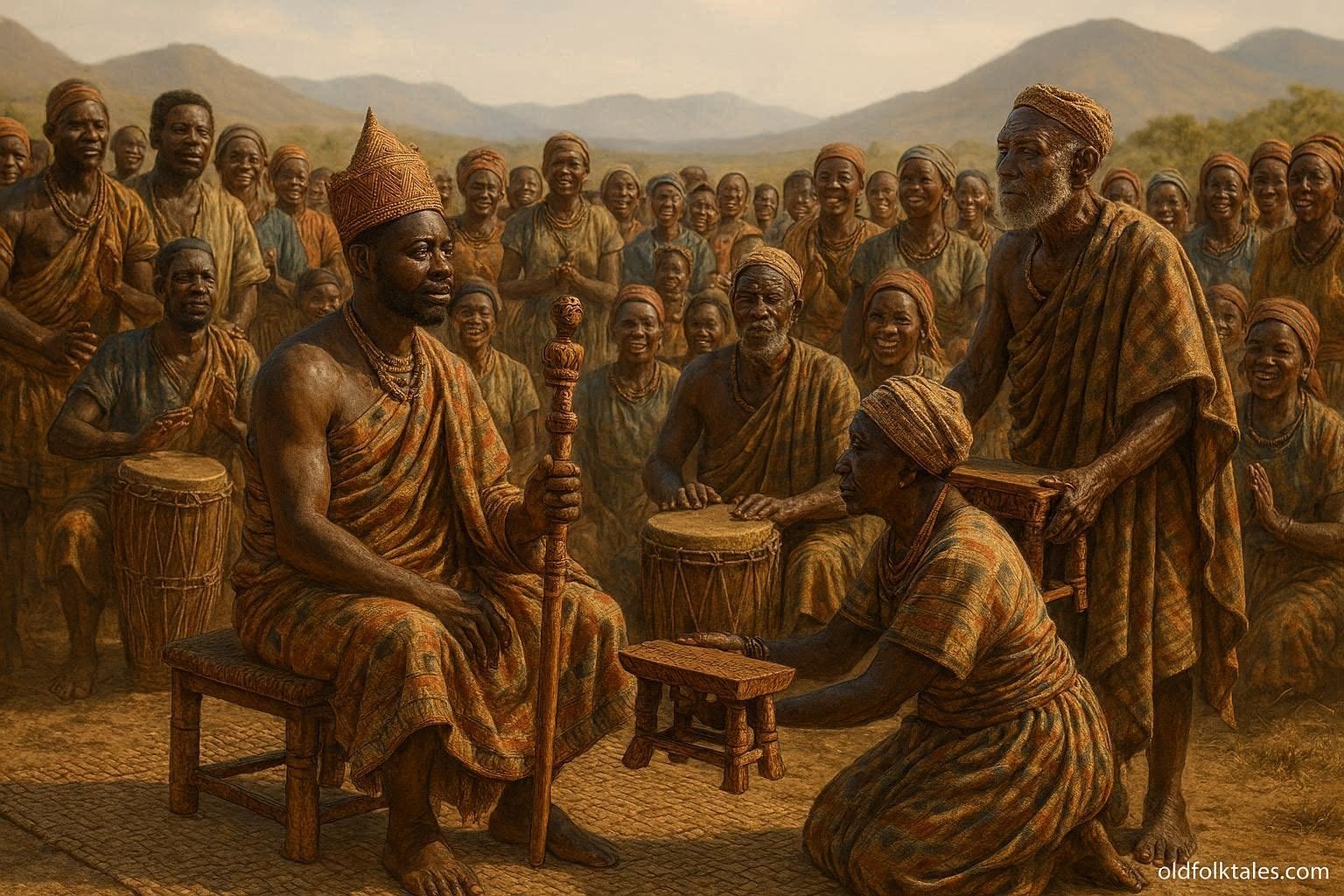
At the center of the gathering stood the ceremonial stool.
Before taking his seat, Kafuti remained standing while the eldest adviser addressed the assembly.
“The kingdom does not exist for the ruler,” he declared.
“The ruler exists for the kingdom.”
The people responded with voices of agreement.
The adviser then turned toward Kafuti.
“Will you listen before judging?”
“I will.”
“Will you protect the weak?”
“I will.”
“Will you preserve our customs with wisdom?”
“I will.”
“Will you seek peace whenever justice allows?”
“I will.”
Each promise was witnessed by the entire community.
Only after making these public commitments did Kafuti sit upon the ceremonial stool.
The elders placed the staff in his hands.
The musicians struck joyful rhythms upon their drums.
Women sang songs celebrating continuity between generations.
The people greeted their new Olosoma with cheers that echoed across the hills.
The festivities continued throughout the day.
Dancers performed traditional movements.
Storytellers recalled the achievements of earlier rulers whose wisdom had strengthened the kingdom.
Families shared food with visitors, renewing friendships that stretched across many communities.
Yet even during the celebrations, Kafuti remembered the quiet lessons given by the elders the previous evening.
Only a few weeks later, his first major challenge arrived.
Two neighboring villages disagreed over grazing land after unusually heavy rains changed the course of a small stream.
Both communities believed the land belonged to them.
Some young men demanded immediate action.
Others prepared for confrontation.
Rather than choosing sides quickly, Kafuti invited representatives from both villages to the royal council.
For two days he listened without interruption.
Farmers described the history of the land.
Hunters explained how seasonal changes affected traditional boundaries.
Elders shared memories of earlier agreements made by previous rulers.
Only after hearing every voice did Kafuti announce his judgment.
The grazing land would remain shared according to customary practice, while the altered stream would be recognized as a natural change rather than a reason to abandon longstanding agreements.
Neither village received complete victory.
Instead, both received fairness.
The decision prevented conflict and strengthened respect for the new Olosoma.
Months later, another test appeared when poor harvests affected several villages.
Instead of allowing each community to struggle alone, Kafuti encouraged cooperation.
Grain reserves were shared.
Families with larger harvests supported those facing shortages.
Craftsmen repaired farming tools without demanding payment from struggling households.
The kingdom endured the difficult season because its people worked together.
The elders quietly observed these events.
One evening, the oldest adviser smiled as he watched the kingdom preparing for another successful harvest.
“The coronation is complete,” he said softly.
A younger elder looked surprised.
“It was completed months ago.”
The old man shook his head.
“No.”
“It is completed only when the promises made before the people become part of everyday life.”
Years passed, and Kafuti became remembered as one of the kingdom’s most respected rulers.
Future generations continued to tell stories about his fairness, patience, and willingness to seek wise counsel before making important decisions.
Whenever another coronation approached, elders repeated the same lessons they had once shared with him.
The traditions endured because every generation understood that leadership could never depend upon titles alone.
It depended upon character.
Today, historians and cultural researchers continue to study the kingship traditions of the Ovimbundu, recognizing that ceremonies such as the coronation of an Olosoma reflected sophisticated systems of governance built upon consultation, customary law, and community responsibility.
The story of the Coronation of an Olosoma reminds us that lasting leadership is earned through justice, humility, and faithful service to others.
Explore more Southern African folktales here
Moral Lesson
True leadership is measured not by authority but by the wisdom and fairness with which it is exercised.
Knowledge Check
1. Who was the Olosoma?
The ruler responsible for governing an Ovimbundu kingdom with justice and wisdom.
2. Why did the elders choose Kafuti?
Because he had shown patience, honesty, humility, and a commitment to serving others.
3. What did the ceremonial staff symbolize?
Justice and the responsibility to govern fairly.
4. How did Kafuti resolve the dispute over grazing land?
He listened to both communities, consulted tradition, and reached a fair decision based on customary practice.
5. How did the kingdom respond to the poor harvest?
Communities cooperated by sharing food, resources, and assistance.
6. What is the main lesson of the story?
Leadership requires humility, justice, and a commitment to serving the community.
Source
Adapted from Ovimbundu oral traditions, ethnographic studies of kingship and royal investiture, and materials preserved in Ovimbundu historical and cultural archives.