In the fertile highlands of western Cameroon, the Bamileke people built thriving kingdoms known for their skilled artisans, respected rulers, and vibrant cultural traditions. Villages stretched across rolling hills where farming, craftsmanship, and community life flourished from one generation to the next. Every important occasion was marked with ceremonies that strengthened the bond between the living, their ancestors, and the kingdom they shared.
Among the most celebrated of these traditions was the Festival of the Elephant Masks.
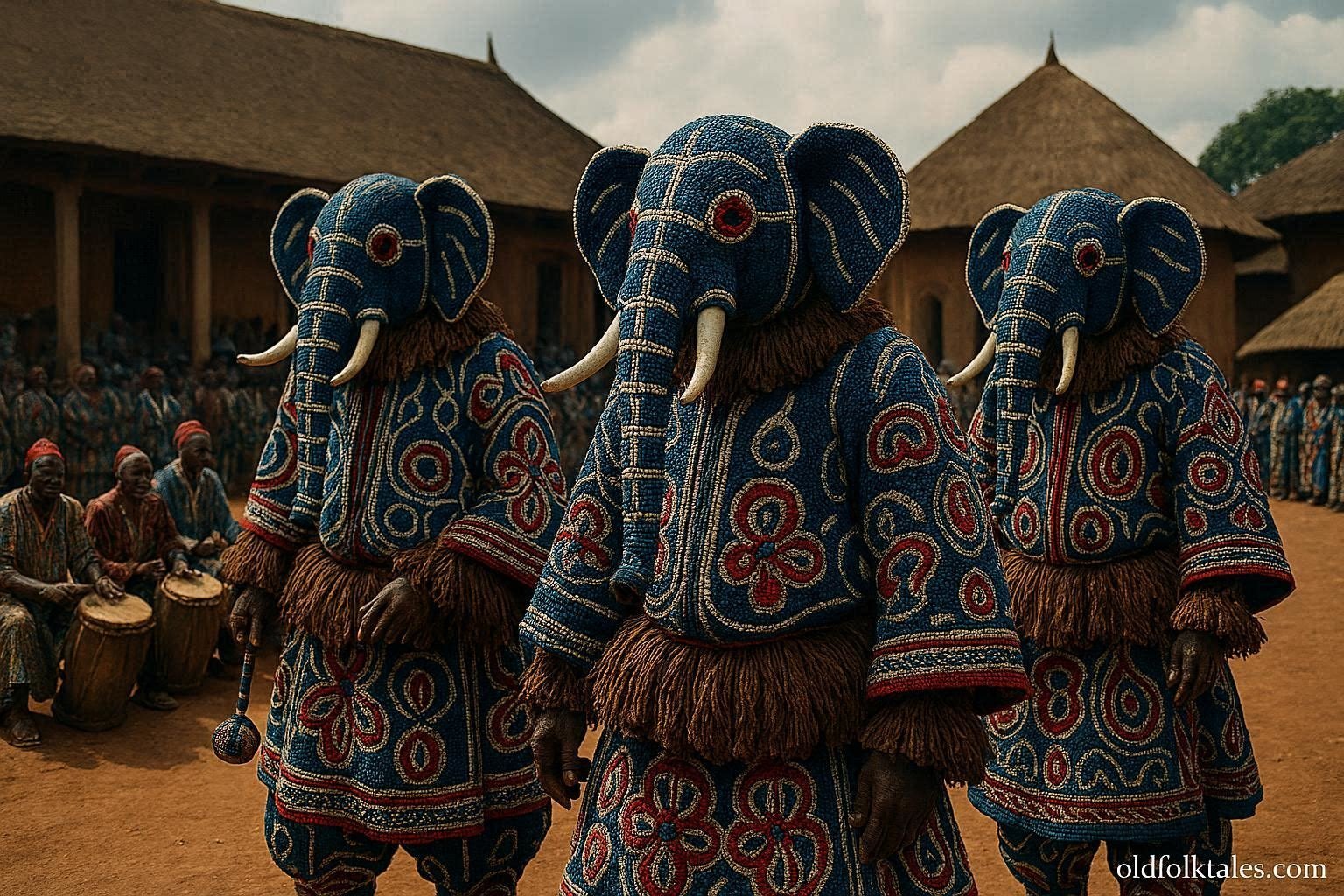
Whenever the kingdom prepared for an important royal ceremony, the appearance of the magnificent elephant masks filled the people with excitement and reverence. The masks were not ordinary costumes worn for entertainment. They represented royal authority, ancestral continuity, and the unity of the community. Through graceful performances accompanied by music and dance, the masquerade reminded everyone that the kingdom’s strength rested upon respect for its history and traditions.
In one Bamileke kingdom lived a young artisan named Ndzi.
Fascinated by this tale? Discover more North African folktales
From childhood, Ndzi had admired the elephant masks whenever they appeared during festivals.
Their colorful beadwork shimmered beneath the sunlight.
Their carefully embroidered fabrics moved gracefully with every step.
The rhythmic sound of drums echoed across the hills as masked performers danced through the palace courtyard.
Like many young people, Ndzi dreamed of one day participating in the great festival.
His grandfather, however, always reminded him that the elephant mask carried responsibilities far greater than admiration.
“The people see beauty,” the old man often said.
“But those who wear the mask carry the memory of the kingdom.”
Ndzi wondered what those words truly meant.
As he grew older, he became an apprentice to one of the kingdom’s respected bead artisans.
Day after day he learned how thousands of tiny glass beads were carefully sewn onto cloth to create intricate patterns.
Every color carried meaning.
Every design reflected traditions preserved through countless generations.
Nothing was added simply for decoration.
The artisans worked patiently because they believed every stitch honored those who had come before them.
One afternoon, while helping his teacher repair an elephant mask before the annual festival, Ndzi asked why the work required such extraordinary care.
The elderly artisan paused before answering.
“This mask is not owned by the person who wears it,” he explained.
“It belongs to the kingdom.”
He gently placed another row of beads into position.
“When people see the elephant mask, they remember their ancestors, their rulers, and the customs that unite us.”
Ndzi carefully considered those words.
As the festival approached, activity spread throughout the kingdom.
Drummers practiced traditional rhythms that had accompanied ceremonies for generations.
Musicians tuned their instruments.
Palace attendants prepared the ceremonial grounds.
Families cleaned their homes and welcomed relatives traveling from neighboring villages.
Artisans worked together to restore royal regalia that would appear during the celebration.
Every member of the community contributed in some way.
Several days before the festival, the palace elders invited a small group of apprentices to observe the final preparations.
Ndzi was among them.
Inside a quiet chamber, away from the growing excitement outside, the elephant masks rested carefully upon woven mats.
Without music or celebration, the elders explained their significance.
“The elephant is respected because of its strength,” one elder said.
“But true strength is guided by wisdom.”
Another elder continued.
“The mask reminds us that authority exists to protect the people.”
A third elder added.
“The performance belongs to everyone because the kingdom belongs to everyone.”
Ndzi realized the festival celebrated values far deeper than appearance.
On the morning of the ceremony, people gathered from villages throughout the kingdom.
The palace courtyard filled with elders, families, visitors, musicians, and community leaders.
The sound of drums gradually grew louder.
Excitement spread as everyone anticipated the arrival of the elephant masquerade.
When the performers finally appeared, silence briefly settled across the gathering.
The magnificent elephant masks sparkled with colorful beadwork.
Long embroidered panels flowed gracefully as the dancers moved with measured dignity.
Each movement reflected generations of carefully preserved tradition.
The dancers did not perform hurriedly.
Every step carried meaning.
The musicians followed ancient rhythms known throughout the kingdom.
Elders watched with quiet satisfaction.
Children observed with wide eyes, knowing they were witnessing a tradition their grandparents had once admired as children themselves.
During one performance, a sudden gust of wind loosened part of the embroidered fabric on one elephant mask.
Ndzi noticed it immediately.
Without drawing attention away from the ceremony, he quietly retrieved the loose section after the performance ended and carefully repaired it alongside the senior artisans.
His quick thinking protected the dignity of the masquerade.
The chief artisan thanked him.
“You understood that preserving our traditions sometimes means serving without seeking recognition.”
Ndzi smiled.
He realized that true service often happened quietly.
Later that afternoon, the kingdom welcomed honored guests from neighboring communities.
The elephant mask performers greeted them with ceremonial dances that symbolized friendship and mutual respect.
The visitors admired not only the beauty of the performances but also the unity displayed throughout the kingdom.
One elder remarked that traditions like these helped preserve peace because they reminded every generation of the values shared by the community.
As evening approached, the celebrations continued with storytelling, music, and shared meals.
Elders gathered young people together to explain the history behind the festival.
They spoke about earlier rulers who had encouraged craftsmanship, cooperation, and respect for cultural identity.
They reminded everyone that each generation inherited the responsibility of preserving these traditions for those who would come after them.
Ndzi listened carefully.
He understood that learning the skills of beadwork alone would never be enough.
He also needed to preserve the meaning behind every design, every performance, and every ceremony.
Years passed.
Ndzi eventually became one of the kingdom’s most respected artisans.
Many younger apprentices came to learn from him.
Whenever they admired the beauty of the elephant masks, he shared the same lesson once taught by his grandfather.
“The mask is beautiful because it carries the memory of our people.”
He encouraged every apprentice to work patiently, respect tradition, and understand the purpose behind their craft.
The Festival of the Elephant Masks continued through the generations.
Although kingdoms changed and new influences reached the region, the masquerade remained a powerful symbol of Bamileke identity.
Its performances continued to celebrate royal authority, honor the ancestors, and strengthen the bonds that united the community.
Today, researchers recognize the elephant masquerade as one of the most celebrated artistic and ceremonial traditions of the Cameroon Grassfields. Its elaborate beadwork, graceful performances, and royal symbolism continue to attract admiration while preserving centuries of Bamileke cultural heritage.
The story of The Festival of the Elephant Masks reminds us that cultural traditions endure because each generation accepts the responsibility of preserving them with respect, skill, and pride.
If you liked this story, see our Central African folktales collection
Moral Lesson
A community preserves its identity by honoring its traditions and faithfully passing them to future generations.
Knowledge Check
1. What does the elephant mask symbolize in Bamileke tradition?
It symbolizes royal authority, ancestral continuity, and the unity of the community.
2. Why did Ndzi become an apprentice bead artisan?
To learn the craftsmanship used to create and preserve the elephant masks.
3. What did the elderly artisan teach Ndzi about the mask?
That it belonged to the kingdom and represented the people’s history and identity.
4. How did Ndzi help during the festival?
He quietly repaired a loose section of an elephant mask, protecting the dignity of the ceremony.
5. Why were the elephant mask performances important?
They celebrated leadership, honored ancestors, and strengthened community unity.
6. What is the main lesson of the story?
Cultural heritage survives when each generation preserves it with respect and dedication.
Source
Adapted from Bamileke oral traditions, Cameroon Grassfields masquerade practices, and ethnographic studies preserved in Grassfields masquerade archives.