Across the wide grasslands of the Bahr el Ghazal region in South Sudan, the rhythm of life has long followed the changing seasons. When the rains arrived, rivers overflowed their banks, wetlands expanded across the plains, and fresh grazing lands appeared in every direction. As the dry season gradually returned, the landscape changed once again. Water became scarce in some places while new pastures opened elsewhere. For generations, the Dinka people adapted to these seasonal changes through careful movement with their families and cattle. These journeys required more than courage. They demanded thoughtful planning, cooperation among neighboring villages, and complete trust in experienced elders who understood the land, the rivers, and the seasons. Among the most respected customs passed from one generation to the next was the tradition of crossing the Bahr el Ghazal River. Every crossing reminded the community that no family traveled safely through life without the support of others. It was a living lesson in unity, responsibility, and resilience that continued to strengthen Dinka cultural heritage across South Sudan.
Within Dinka society, cattle represented far more than wealth. They provided milk, supported livelihoods, strengthened family relationships, and formed an important part of ceremonies and community life. Protecting both people and cattle during seasonal movements therefore became one of the greatest responsibilities entrusted to village leaders. Before every journey, elders met beneath large shade trees to discuss river conditions, weather patterns, grazing opportunities, and the safest routes for travel. Younger members listened carefully because these discussions contained generations of knowledge gathered through observation and experience. Every successful crossing depended upon wisdom shared freely between old and young.
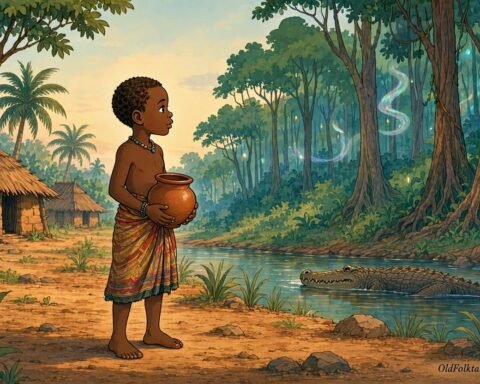
In one Dinka village lived a thoughtful boy named Deng. He admired the experienced herders who guided cattle across rivers each season. They always appeared calm, even when the water flowed swiftly or the journey became difficult.
One evening, after returning from the grazing fields, Deng sat beside his grandfather.
“Grandfather,” he asked,
“How do you always know when it is time to cross the river?”
His grandfather smiled gently before answering.
“The river speaks.”
Deng looked surprised.
“I have never heard it speak.”
His grandfather laughed softly.
“It speaks through the rain.”
“It speaks through the grass.”
“It speaks through the cattle.”
“If we learn to observe carefully, we understand its message.”
Those words stayed with Deng.
Fascinated by this tale? Discover more North African folktales
Several weeks later, the elders announced that the time had come for the seasonal crossing.
Preparations began immediately.
Women packed food for the journey.
Young people repaired ropes and gathered supplies.
Experienced herders examined every animal carefully to ensure none were injured before the journey.
Nothing was left to chance.
On the morning of departure, the village awoke before sunrise.
The air remained cool while stars still shone above the open plains.
Families moved quietly as everyone completed their responsibilities.
Children carried smaller bundles.
Adults prepared the cattle.
Elders walked through the village offering encouragement.
Before leaving, the oldest chief gathered everyone together.
“We do not cross as separate families.”
“We cross as one community.”
Everyone nodded in agreement.
The journey toward the Bahr el Ghazal River lasted several hours.
Along the way, Deng noticed that nobody hurried.
Although everyone wished to reach the crossing before midday, the elders maintained a steady pace.
Whenever younger children became tired, older youths helped carry their belongings.
Whenever an elderly traveler slowed behind the group, others waited patiently.
Deng asked his grandfather,
“Why do we keep stopping?”
His grandfather replied,
“A fast journey that leaves someone behind is never successful.”
The words reminded Deng that cooperation mattered more than speed.
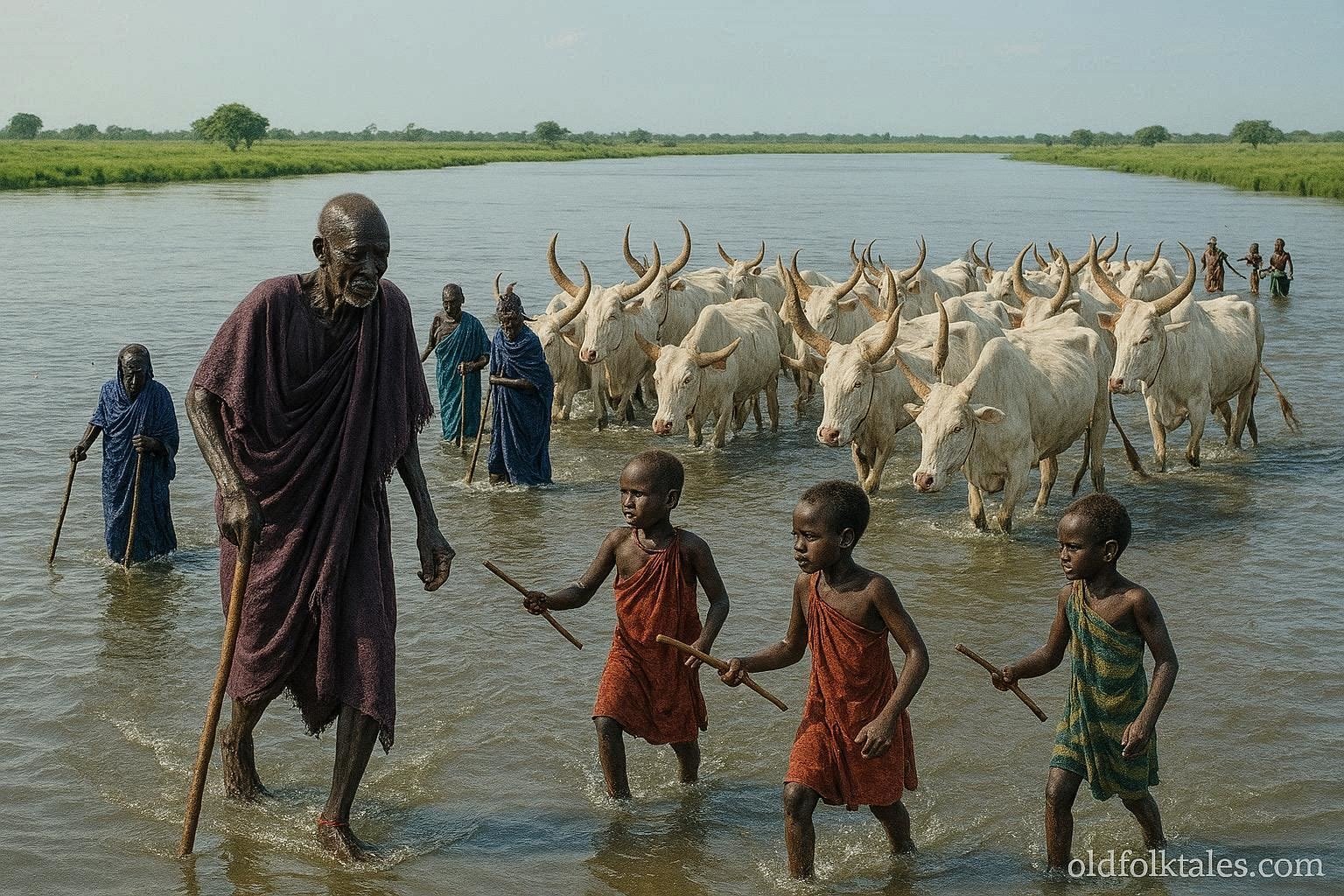
By midday the travelers reached the wide river.
The water reflected the bright South Sudan sun while gentle currents moved steadily downstream.
Several experienced elders walked along the riverbank studying the flow.
They searched for the safest place where both people and cattle could cross.
No one entered the water until the elders agreed upon the best route.
Deng watched with curiosity.
One elder stepped into the river using a long wooden staff to measure the depth.
Another observed the movement of floating branches.
Others watched how the cattle reacted near the water.
Only after careful discussion did the chief finally raise his hand.
“This is where we cross.”
Immediately everyone began working together.
Strong young men formed lines beside the water.
Older boys helped guide smaller calves.
Women carried young children safely across the shallower sections.
Experienced herders encouraged the cattle to move calmly without fear.
Nobody shouted.
Nobody rushed.
Each person understood their role.
Halfway across the river, one frightened calf suddenly turned away from the group.
The young animal struggled against the current.
Without hesitation, two experienced herders moved toward it.
Another group steadied the nearby cattle to prevent panic.
Within moments the frightened calf returned safely beside its mother.
Deng watched everything carefully.
Later he asked,
“Were you afraid?”
One of the herders smiled.
“Fear reminds us to be careful.”
“But cooperation keeps everyone safe.”
Those words became another lesson Deng would never forget.
After reaching the opposite bank, nobody continued walking immediately.
Instead, every family waited until the final person and every animal had completed the crossing.
Only when the chief confirmed that everyone had arrived safely did the community continue its journey.
Deng noticed something important.
The celebration did not begin because his own family had crossed successfully.
It began because every family had crossed together.
That evening the travelers rested beneath large trees overlooking fresh grazing land.
The cattle grazed peacefully while cooking fires appeared across the camp.
After supper, the elders gathered the younger generation together.
One elder pointed toward the river they had crossed earlier that day.
“Our ancestors crossed these waters long before us.”
“They survived because they trusted one another.”
“If we lose that trust, we lose far more than the path across the river.”
Deng looked quietly toward the distant water.
For the first time, he understood that the crossing represented much more than reaching another side.
It represented the strength of an entire community.
During the days that followed, the community settled into the rich grazing lands beyond the river. Fresh grass stretched across the plains, and the cattle quickly regained their strength after the long journey. Children laughed as they helped watch the younger calves, while experienced herders led the larger animals toward the best pastures each morning.
Although the new grazing grounds provided relief after the dry season, life remained carefully organized.
Every family accepted responsibilities that benefited everyone.
Some people gathered clean water.
Others collected firewood.
Young men watched the cattle during the hottest hours of the day.
Women prepared meals for both their own families and elderly neighbors who needed assistance.
Nobody believed that survival depended upon individual effort alone.
The elders often reminded the younger generation,
“A community moves forward only when everyone carries part of the load.”
Deng found himself thinking often about the crossing.
He realized that every activity in the camp reflected the same lesson.
The journey had not ended at the riverbank.
Cooperation continued every single day.
One afternoon dark clouds gathered across the distant horizon.
Strong winds soon swept across the grasslands.
The experienced elders immediately recognized the signs of a powerful storm.
Without waiting for heavy rain to begin, they calmly organized the camp.
Families secured their shelters.
Cooking fires were safely covered.
Children helped gather smaller animals.
Older youths guided the cattle toward higher ground where flooding would be less dangerous.
Deng noticed that nobody questioned the instructions.
The elders had earned the community’s trust through many years of experience.
The storm arrived before sunset.
Rain fell heavily across the plains while thunder echoed above the grazing lands.
Several streams quickly overflowed, creating new channels of moving water.
Throughout the night the community remained together.
When morning finally arrived, everyone carefully inspected the camp.
Some fences needed repairs.
Several shelters required fresh grass for their roofs.
A few cooking pots had been washed away by the flowing water.
Instead of worrying about individual losses, families immediately helped one another rebuild.
By evening the camp looked almost as it had before the storm.
Deng quietly asked his grandfather,
“How did everyone know exactly what to do?”
His grandfather smiled.
“We practiced cooperation long before the storm arrived.”
“When people trust one another during peaceful times, they remain united during difficult times.”
Those words became another lesson that Deng carried in his heart.
As months passed, the cattle grew healthy and strong.
The grazing lands had fulfilled their purpose.
Soon the elders announced that the season was changing once again.
It would soon be time to return home.
Before preparing for the journey, the chief gathered every family beneath a large tree.
He thanked everyone for their cooperation throughout the season.
He reminded them that no successful crossing belonged to a single person.
“The river welcomed us because we respected one another.”
“Our return home must reflect the same spirit.”
The journey back followed the same careful planning as before.
Scouts traveled ahead to examine the river.
Experienced herders prepared the cattle.
Children remained close to their families.
When the community finally reached the Bahr el Ghazal River once again, Deng noticed how much he had learned.
This time he observed the movement of the water.
He watched how the elders studied the current before making their decision.
He understood why nobody hurried.
He even helped guide several young calves toward the safest crossing place.
His grandfather watched quietly before placing a gentle hand upon his shoulder.
“You have learned to hear the river.”
Deng smiled.
“I listened with my eyes.”
His grandfather laughed warmly.
“That is exactly how wisdom begins.”
Years later, Deng himself became one of the respected elders responsible for guiding seasonal crossings. Whenever young children asked why everyone waited for the slowest traveler or why every crossing required careful planning, he patiently shared the same lessons his grandfather had taught him.
“The river belongs to all of us.”
“The journey belongs to all of us.”
“The responsibility belongs to all of us.”
Generation after generation, these words continued guiding Dinka communities throughout the Bahr el Ghazal region.
Today, seasonal movement across rivers remains an important part of the documented cultural heritage of many Dinka communities in South Sudan. Regional history studies and ethnographic research describe how experienced elders guided families and cattle through changing landscapes by combining environmental knowledge, careful planning, and communal cooperation. These traditions demonstrate that successful journeys depended not only upon understanding the land but also upon maintaining trust, unity, and shared responsibility within the community.
The story of The Crossing of Bahr el Ghazal reminds us that every challenge becomes easier when people work together. Like the Dinka communities who crossed the river through cooperation and wisdom, families and societies grow stronger when they trust one another, plan carefully, and ensure that no one is left behind.
Don’t stop yet! See our complete East African folktales collection
Moral Lesson
True strength is found in unity. When people plan together, help one another, and trust wise leadership, they can overcome even the greatest challenges.
Knowledge Check
1. Why did the Dinka communities make seasonal crossings of the Bahr el Ghazal River?
They crossed the river to reach fresh grazing lands and reliable water for their families and cattle as the seasons changed.
2. Why did the elders carefully study the river before crossing?
They examined the water depth, current, weather conditions, and safest route to protect both people and cattle.
3. What did Deng learn from watching the experienced herders?
He learned that patience, observation, and cooperation are essential for making wise decisions.
4. How did the community respond when a frightened calf struggled in the river?
Everyone worked together calmly to guide the calf back safely instead of acting in panic.
5. Why did the chief insist that everyone wait until the last person and animal had crossed?
Because the crossing was considered successful only when every member of the community reached safety together.
6. What is the main lesson of the story?
Unity, careful planning, and mutual trust help communities overcome difficult journeys and preserve their traditions.
Source
Adapted from the seasonal migration traditions of the Dinka people of the Bahr el Ghazal region, with reference to Bahr el Ghazal regional history studies, the Rift Valley Institute, and ethnographic research on Dinka pastoral life and seasonal movements in South Sudan.