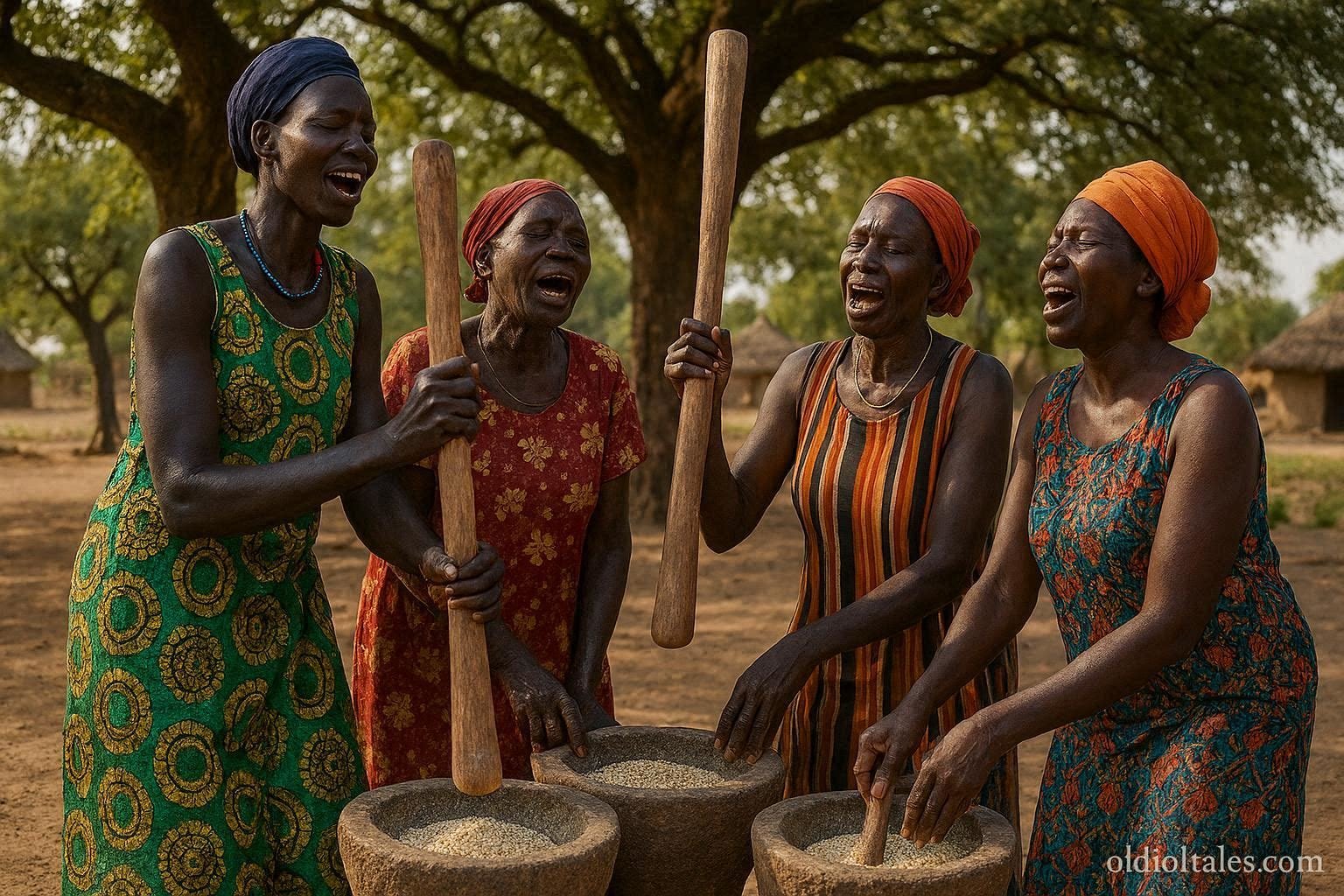
Across the fertile plains and river valleys of South Sudan, the daily preparation of food has long been more than a household responsibility. Among the Dinka and Bari communities, women gathered each day to grind sorghum, millet, and other grains that would nourish their families. The steady rhythm of wooden pestles striking stone or wooden mortars echoed through villages from sunrise until late afternoon. Yet these sounds were rarely heard alone. They blended with voices raised in song, creating melodies that carried stories of family, gratitude, hard work, hope, and community life.
These grinding songs were never performed for entertainment alone. They preserved history, encouraged cooperation, and made demanding work lighter. Mothers taught daughters the songs they had learned from their own mothers, while grandmothers explained the meaning behind each verse. Some songs praised a successful harvest after months of careful farming. Others celebrated friendship, welcomed visitors, encouraged young people to remain diligent, or reminded families to face hardship with courage. Every rhythm matched the movement of the grinding stones, allowing many women to work together in perfect harmony.
In one Bari village near the banks of the White Nile lived a young girl named Aluel. Every morning she awoke to the familiar sound of singing drifting through the cool morning air. Before the sun had fully risen, women from neighboring homes had already gathered beneath a cluster of large shade trees where several grinding stones stood waiting.
The voices always reached her before she could see them.
Sometimes the songs were cheerful and lively.
Other mornings they were calm and reflective.
If you enjoyed this story, explore our full West African folktales collection
No matter the melody, every voice blended naturally with the steady rhythm of the work.
Aluel often watched from a distance.
She knew every song by heart but had never joined the women.
One morning, her grandmother, Nyabor, noticed her listening quietly.
“Today you will come with me,” she said warmly.
Aluel smiled nervously.
“I do not know if I can sing well enough.”
Her grandmother laughed gently.
“The songs do not ask for perfect voices.”
“They ask for willing hearts.”
Together they carried baskets of freshly harvested sorghum to the gathering place.
Several women greeted them with bright smiles.
Without ceremony, they made room for Aluel beside one of the grinding stones.
Before anyone began working, the oldest woman present offered a short prayer of gratitude for the harvest and for the strength to care for their families.
Only then did the work begin.
The first pestle rose into the air.
Another followed.
Soon the steady rhythm spread through the circle like a heartbeat.
Then the singing began.
At first Aluel listened carefully.
The song praised the farmers who had patiently cared for the fields through changing seasons.
Each verse reminded the women that every loaf of bread and every bowl of porridge began with many months of shared effort.
As the chorus returned, the women encouraged Aluel to join them.
Softly at first, she added her voice.
Nobody corrected her.
Nobody laughed.
Instead, the others smiled as though they had been waiting for her all along.
As the morning continued, different songs followed one another naturally.
One celebrated friendship between neighboring families.
Another honored mothers who cared for children with patience and kindness.
A playful song made everyone laugh as it told the story of a lazy farmer who expected a rich harvest without working his fields.
Even the youngest girls smiled as they repeated its familiar chorus.
Between songs, the women shared stories about weddings, births, visitors, and preparations for the coming planting season.
Aluel noticed that the work no longer felt tiring.
The music seemed to carry everyone’s strength together.
Later that week, heavy rain kept many families indoors.
When the skies finally cleared, several grinding stones had become damaged by flooding.
Without waiting to be asked, women from every household gathered to repair them.
Some carried fresh stones.
Others cleaned the work area.
The songs returned almost immediately.
This time they celebrated cooperation.
As they worked, Aluel asked her grandmother why the women always sang instead of working silently.
Nyabor smiled.
“A song can carry a burden that one person cannot.”
“When we sing together, nobody works alone.”
Months passed, and Aluel became one of the strongest voices in the morning gathering.
She memorized songs that spoke of courage during drought, gratitude after abundant harvests, and respect for elders whose wisdom guided the community.
She also learned that new songs were sometimes created to remember important events.
When a neighboring family welcomed healthy twins, the women composed joyful verses celebrating new life.
When respected elders passed away, gentle songs preserved their memory for future generations.
Every event became part of the community’s living history through music.
One afternoon, visitors from another village stopped to rest beneath the trees.
As they listened to the women singing while they worked, one traveler remarked,
“Your village sounds happy.”
An elderly woman replied with a smile,
“Our work becomes lighter when our voices work together.”
Those simple words remained with Aluel for many years.
As she grew older, younger girls began joining the morning gatherings just as she once had.
Some arrived shy and uncertain.
Others worried that they did not know enough songs.
Aluel welcomed each of them warmly.
She never began by teaching difficult melodies.
Instead, she encouraged them to listen first.
“Every song begins by hearing someone else’s voice,” she would say.
Little by little, each new generation found its place within the circle.
Years later, although modern grain mills became available in many towns across South Sudan, the traditional grinding songs continued to hold great cultural importance. During festivals, cultural celebrations, and heritage gatherings, women still performed many of the songs their grandmothers had once sung. Ethnomusicologists and cultural historians have documented these performances as valuable expressions of South Sudan’s living heritage, preserving not only beautiful melodies but also the history, values, and shared experiences of the communities that created them.
Today, the grinding songs of the Dinka and Bari peoples continue to remind younger generations that ordinary work can become extraordinary when carried out with friendship, cooperation, and gratitude. Their voices preserve a tradition that celebrates both the dignity of labor and the enduring strength of community.
The story of The Women’s Grinding Songs teaches that shared work becomes joyful when people encourage one another, preserve their traditions, and lift their voices together.
Don’t stop yet! See our complete East African folktales collection
Moral Lesson
Working together with kindness and unity strengthens both friendships and communities.
Knowledge Check
1. Why did women sing while grinding grain?
They sang to make work lighter, preserve traditions, and strengthen community bonds.
2. What grains were commonly ground?
Sorghum, millet, and other staple grains.
3. What did Aluel learn from her grandmother?
That the songs required willing hearts more than perfect voices.
4. What kinds of events inspired new songs?
Harvests, births, weddings, community celebrations, and the remembrance of respected elders.
5. Why did the women repair the grinding stones together?
Because cooperation ensured that everyone could continue preparing food for their families.
6. What is the main lesson of the story?
Shared work, music, and cooperation preserve culture while strengthening community relationships.
Source
Adapted from the work song traditions of the Dinka and Bari communities of South Sudan, with reference to Smithsonian Folkways, South Sudan ethnomusicology studies, and oral cultural heritage research.